St John Lateran,
Hengrave
('Church
of the Reconciliation')

www.suffolkchurches.co.uk - a journey through the churches of Suffolk
|
St John Lateran,
Hengrave |
|
|
||
www.suffolkchurches.co.uk - a journey through the churches of Suffolk |
||





Follow these journeys as they happen at Last Of England Twitter.
| Many years ago, late on a winter
afternoon near the end of the old century, I was
travelling this way with the writer Aiden Semmens. On an
impulse we decided to revisit the church, which sits in
the Park of the Hall. We'd both explored it relatively
recently, so I'm not sure what motivated us to stop, but
stop we did. Already a mist was rising from the sprawling
lawns around the Hall, reaching out to enwreathe the
church. As we stood in the south porch, and even as I
placed my hand on the handle of the door, we heard from
within the church ethereal chanting, women's voices
singing unaccompanied. We stood listening. It was an
ancient chant, going back centuries. Time passed, I don't
know how much time. The voices rang on, and I think we
both knew that it would be impossible for us to break the
spell by entering. We turned, and wandered back to the
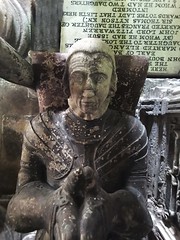
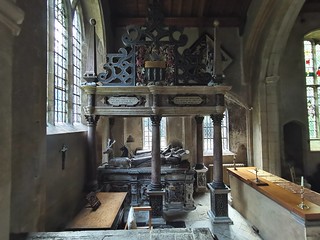
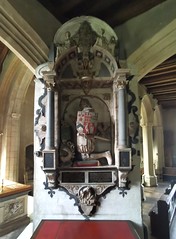
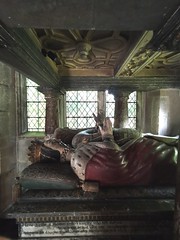
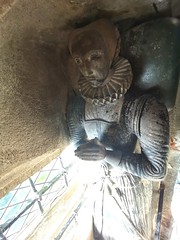
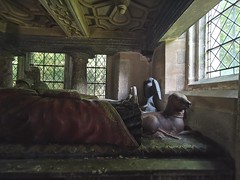
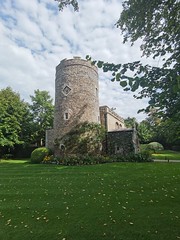
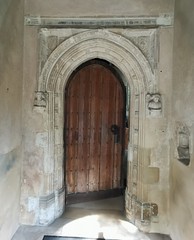
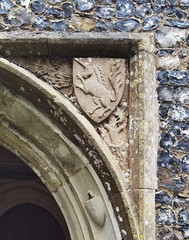
car in silence. If any church was likely to serve up such an experience it would be this one, for Hengrave church is an unusual one in several ways. There is a cluster of round-towered churches in the Bury St Edmunds area, and Hengrave's is one of them. This is a small village scattered along the Bury to Mildenhall road, but it contains one of East Anglia's more significant buildings, for Hengrave Hall is, as James Bettley revising the Buildings of England volumes for Suffolk noted, one of the most important and externally one of the most impressive houses of the later years of Henry VIII. It was built for Thomas Kytson, a London cloth merchant who had bought the estate from the doomed Duke of Buckingham. Work began in the 1520s, and the house appears to have been more or less complete by 1538, a date which forms part of an inscription on the grand south facade. Kytson had two more years to live. The Hall was built on the site of an earlier manor house, and so Hengrave's was clearly a manorial church. It sits immediately to the east of the Hall, tiny by comparison and almost a garden ornament as James Bettley memorably puts it. The 12th Century round tower appears squat thanks to the nave being heightened in the early 15th Century, replacing that of a late 13th Century church of which the chancel survives. A discreet north aisle was added at the same time as the nave was rebuilt, and then a chapel at the end of the north aisle was built on by Sir Thomas Kytson shortly before his death. The church is pretty rather than beautiful. The tall Perpendicular windows of the nave seem out of proportion, and there is a smoothness to the surfaces thanks to the 1890s ministrations of Herbert Green, with hindsight not an architect that you would choose to set loose on a church like this, but thankfully the damage he did is slight. So far, so fairly typical of an East Anglian country church, but in fact the post-Reformation history of Hengrave church is a singular one. Its medieval dedication was to St John Lateran, named for the great church in Rome dedicated to both St John the Evangelist and St John the Baptist. As the Elizabethan Settlement bedded down it became Hengrave's parish church for the newly created Church of England, but in 1589 the parish of Hengrave was subsumed into that of neighbouring Flempton. There were probably political reasons for this, for as we have seen the church sits in the grounds of the Hall and the Kytsons remained stubbornly Catholic in this new protestant landscape. There was a private Catholic chapel within the Hall itself, but the old parish church now fell into disuse, the parishioners having to make their way up the road to Flempton. As the Kytsons now owned the church they made it their mausoleum, and so it remained for nearly three hundred years. In the 17th Century the Hengrave estate was handed down to the Gage family, who like the the Kytsons were recusant Catholics. The Gages married into yet another local Catholic family, the Rokewodes of Stanningfield, but in 1887 the last of the Rokewode Gage's died heirless, and the estate, including the Hall and the church, were put up for sale. It was bought by Sir John Wood, the wealthy Conservative MP for Stalybridge in Cheshire, who was created Baronet Hengrave in 1918. It was Wood who commissioned Herbert Green to restore the church, this time as a private chapel for his family (Wood was not a Catholic) but the Kytson tombs were to remain in situ. When Wood died in 1951 the Hall and church were sold again, this time to a Catholic order of nuns, the Community of the Sisters of the Assumption who turned it into a school. At last, they reopened the church for public worship again, and rededicated it as the Church of the Reconciliation. The sisters closed the school in 1974, and the church served as a chapel of ease within the Catholic parish of St Edmund, Bury St Edmunds until 2005. The community, finding the maintenance of the Hall too great a burden, were then forced to sell the estate. Since then, both the Hall and the church have been in private ownership. The church sits surrounded by lawns and flowerbeds. The Hall has become a venue for wedding ceremonies, and the church is used for wedding blessings by all denominations. It remains a consecrated building, and the Catholic parish is still able to use it for occasional baptisms and weddings. The elegant little south porch was sharpened up by Green, but it still retains a unicorn in one of its spandrels and encloses a delightful doorway contemporary with the early 15th Century rebuilding of the nave. You step into a space which is at first unfamiliar, for the nave is disproportionately high, the north aisle turns out to be nearly as wide as the nave, and the arcade appears to turn to become the chancel arch. The space beyond to the east is crammed with the Kytson memorials, the round tower is filled with a gallery, and the overall effect is slightly disorientating. Thomas Kytson probably died before the chapel at the east end of the aisle was completed, but he was buried there in 1540 and his effigy tomb was installed within it. Then, in the 1560s, a remarkably large six poster tomb was erected above it, engulfing it, so that Kytson now lies below the top level. On this lie the effigies of his wife Margaret and her second husband John Bourchier, Earl of Bath, and so she died a Countess. Across the chancel in the south-east corner lies Kytson's son, also Sir Thomas, on an even larger and grander tomb, sandwiched between his two wives, although unlike the effigies on the Bourchier tombs these are, as Pevsner observed, poor quality.
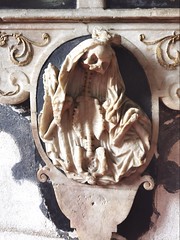
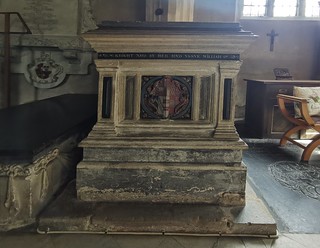
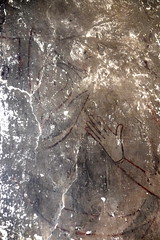
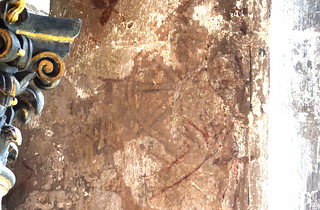
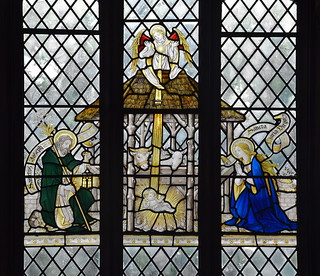
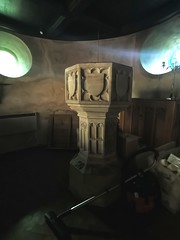
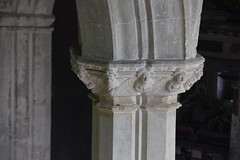
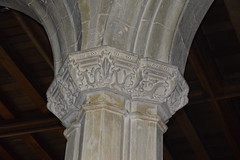
Between the two great tombs are two smaller tombs without effigies, to John Bourchier, Lord Fitzwarren, in 1556 and the notably plain black marble-topped memorial to Sir Edward Gage, 1707. On the end of the arcade, facing north-west towards the grand Bourchier tomb is a mural monument to Thomas, Lord D'Arcy, who died in 1614. He kneels, but the most striking thing about it is the roundel relief of a skeleton wearing a shroud. This is so similar to that on the 1619 memorial to Laetitia Moseley a few miles off at Ousden that they must surely be by the same workshop. There are a few later and simpler memorials at this end too, including that to the last of the Rokewode Gages set in the floor beside the modern altar, and one to Edmund Wood, Sir John Wood's son and heir who died before him. The nave seems quite spacious and even empty compared with the busy chancel, but this is a fortunate foil to the splendour of the 15th Century arcade with its carved capitals, a relatively unusual thing in Suffolk. One has a host of angels running around it, another clusters of oak leaves. Birkin Haward thought it likely to have been the work of Hawes, the master mason of Occold. The tall perpendicular windows opposite have glass which is oddly set, seeming too high. It is by FC Eden and was installed when this was the Wood family's private chapel in the 1920s. There are two scenes, one depicting the Nativity and the other the Crucifixion, and I couldn't help thinking that they both look rather inanimate compared with Eden's customary lively style. The other modern glass is below the tower, roundels set in circular windows by Paul Quail, an artist that I don't always warm to on a large scale, but his little details like these are more successful. One commemorates the Assumption Convent School 1952 - 1974 and the Hengrave Ecumenical Community 1952-2005. A cross stands among fallen leaves, and behind it the words that they all may be one. Below the roundels stands the 15th Century font. Cautley pointed out that the base is another font, turned upside down. The current setting probably dates from Herbert Green's restoration. As grand as the 15th century architecture and the 16th and 17th Century memorials are, there are older survivals. On the splays of a window on the south side of the chancel are two faded wall paintings, early 14th Century in style. The easterly figure is St Catherine, for although she has almost disappeared from sight we can still clearly see the wheel that she holds in her hand in the style of the contemporary figures at Little Wenham in the south of Suffolk. The other figure is more mysterious. It appears to be wearing a cape and gesturing towards a shield that it holds in its other hand, and on the shield there appears to be a cowled head. It doesn't take much imagination to think that it is a knight.
When I first visited this church in the 1990s it was used for the daily offices of the Sisters (this was of course the singing we had heard), and for mass on Sundays. The local Anglican parish of Flempton and Hengrave also used it for a eucharist celebration on Friday mornings. It was a busy place. After the community left and the church was sold, this activity came to an end, but the church does remain in use of a kind and it is immaculately well-kept and cared for. In general it isn't open to visitors, but then, that has been the case for much of its life. When Cautley came this way in the 1930s he began his report with the warning that this interesting small building is no longer the parish church and is only accessible to the public by permission of Sir John Wood. Clearer than it is today, he noticed the painted inscription over the south doorway asking for prayers for Sir Thomas Hemegrave, 1419 and his wife, who rebuilt the church. Sir Thomas is too late to have been the apparent knight in the chancel wall painting, but could it be one of his predecessors? Cautley was not generally a fan of post-Reformation memorials, or of the Reformation in general come to that, but he thought those here very fine and interesting. What Cautley doesn't mention, but Arthur Mee of all people does, is that Hengrave has a remarkable sequence of 16th Century Flemish glass panels depicting scenes from Genesis and from the Christ story. However, they are not in the church but in the oratory chapel in the Hall, for the Hall itself has its own rich religious and social history thanks to its successive recusant families. The Kytsons gave shelter to the Elizabethan madrigalist John Wilbye, although there is no evidence that Wilbye ever conformed to their Catholic faith. The Gages were notable for importing from their continental connections and growing in their Hengrave orchards a sweet green French variety of plum. This was already known in France as the Claude Reine, but the story goes that the labels were lost from the seeds in transit. They became known as Green-Gages, thus not only introducing the fruit to this country, but also inadvertently giving a new word to the English language. |
Simon Knott, September 2022
Follow these journeys as they happen at Last Of England Twitter.






|
||||||||||||||||||||||||||||||||||||||||||||||||||||||