At the sign of the Barking lion...

St Peter, Hepworth

At the sign of the Barking lion...


www.suffolkchurches.com - a journey through the churches of Suffolk


Hover to read captions, click to see enlarged images:


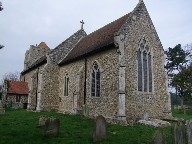
Room at the top?

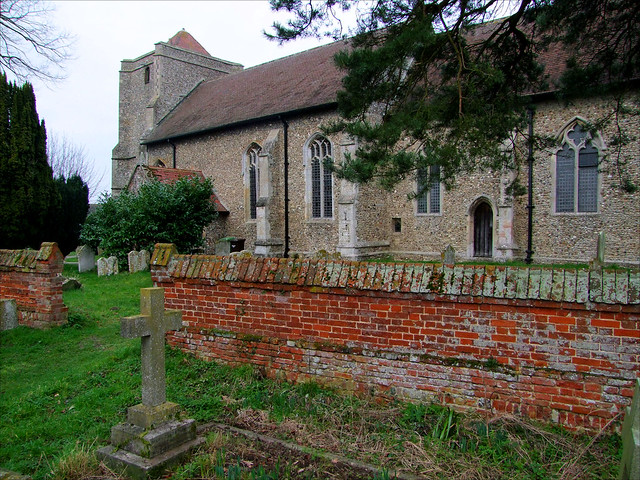
the south side...

...and the north.

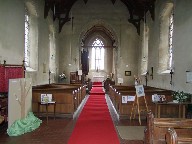
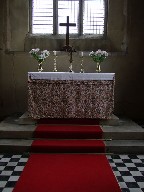
Looking east, beyond the nave altar.

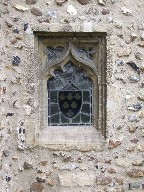
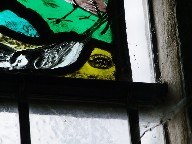
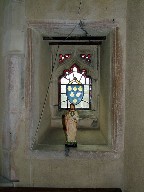
Glazed low-side window.

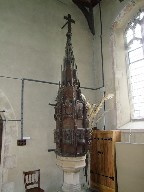
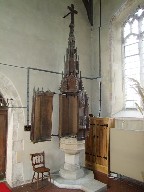
The amazing font cover.

Ready to baptise.

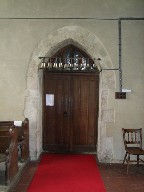
The doors when closed.

The font cover on its 1880s base.

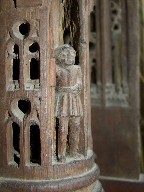
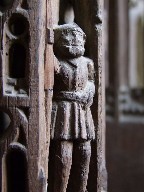
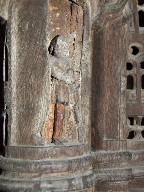
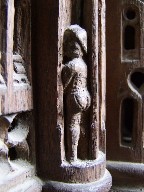
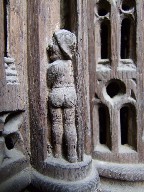
Font cover detail.

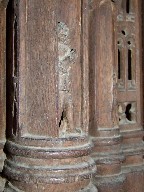
Font cover base II.

Font cover base III.

The towering splendour of it all.

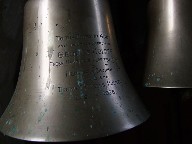
handbells, no longer rung.


Corder's neat 1898 refurbishment of St Peter.

It was a glorious Spring day, the Saturday of Easter week 2003. I was cycling through the narrow, lost lanes of north Suffolk between Redgrave and Hepworth. This is a distance of some five miles, but I didn't see a single car, or even another human being, apart from a man walking a huge dog in the fields by Hinderclay.

The lanes forked and joined meaninglessly; or, at least, without meaning for the 21st century. In years gone by, they must have connected long-forgotten hamlets, and separated strips of now-enclosed land. What we see today is merely an echo of what George Ewart Evans called the pattern under the plough.

All around me, across the fields and on the horizon, were churches. Some had bold, square towers rising above the trees; others were gleaming flint shells, huddled in distant hedgerows. Some were old friends that I recognised and greeted: Hinderclay, Thelnetham, Market Weston and Hopton. Others were across the Norfolk border, mysterious and remote. Once, I heard a clock striking midday across the green barley.

I resisted their enticements, and forged on. But I was filled with a sense of continuity. In these burgeoning spring fields, there was still beating a heart of old; the unforgotten rhythm of Christianity, as it was when these were built as Catholic churches, and as it is now in the care of gentle Anglican faith communities. The churches seemed to pin the land down, stabilising and guarding it, embracing and healing the lives led around them. It was a reassuring image in Easter week.

I had found the churches between Diss and here full of treasure and fascination; not the kind of treasure that thieves would want to steal, but the priceless symbols of our present life, and survivals of our past, recalling what we were, and how we came to be. At Palgrave I had sat, gobsmacked, by the faces on the ancient Norman font, but had also loved the millennium banner that the people of the benefice had come together to make. At Thrandeston and Burgate in the same benefice, ancient carvings and golden brasses had enhanced churches that were living, breathing engine houses of gathered faith communities, contributing to a feeling of the numinous, and a sense of the presence of God.

At all three churches, I had met the churchwardens; they were welcoming and friendly, completely unsuspicious of this mad cyclist photographing the interiors of their churches. Instead, they talked quietly about their parishes, the challenges and the triumphs. I sensed in all three of them the privilege they felt in being stewards of their buildings for future generations. They also seemed conscious of their responsibility towards visitors and pilgrims, the demand upon them to 'welcome the stranger within the gate'. My only problem was that they had detained me for longer than I had intended or expected.

After this lonely ride, I was surprised by how large the village of Hepworth was. I came in from the north, where the big houses are, and former Hepworth Hall; but as I headed up the street, the houses became smaller, modern, and gathered together. This was a community of ordinary people, leading busy lives.

After about a mile, I saw a sign leading off to the church, and followed it. Soon, I was on the edge of a tight, raised churchyard full of headstones, and St Peter stood in the middle. The church looks rather curious; there are a couple of good reasons for this. The tower is shortened because it was unstable in 1677 - you can see the date on the western side. The metal banding is an early 19th century attempt to stop it collapsing completely. But the event that really shaped the current St Peter happened in 1898 - Mortlock tells us it was on Easter Monday. On that day, the thatched church, as it was then, was almost completely destroyed by fire. J.S. Corder of Ipswich was chosen for the rebuilding; he did exciting things at Swilland, but here it is all very safe.

Except, perhaps, for the most curious feature of St Peter. It is right at the top of the stubby tower. Up here, there is a little pyramid, as at Bromeswell. But this one has a delightful dormer window in it, facing west. You can only see it from the road, the parapet hides it close up. I fantasized that there might be a little room up there, with someone living in it. Corder had a thing about dormer windows in towers, and the one at Swilland is exotic, to say the least.

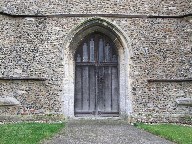
I went to try the church door - but it was locked. This wasn't a great surprise. Unlike in east Suffolk, where most churches are open, the churches up here tend to be locked with keyholders. I couldn't really see any reason for St Peter to be locked; it is at the heart of a busy village, surrounded by protective houses and good neighbours.

I looked around for the keyholder notice; but there wasn't one. I was particularly keen to get into St Peter. Partly, this was to see the remarkable medieval font cover, which somehow survived the fire (yes, I know, this would look rather suspicious to an insurance company if it happened nowadays) but also because I had experienced such friendly churches on my journey so far, and I wanted this to continue.

I had noticed that the Rectory was a few doors away. I went and knocked, but there was no reply. I tried the house immediately beside the church, but they were out, except for a large alsatian that made clear its intention of eating me if it got through the glass door. A man working in the garden beyond said he thought the key would be at the Rectory. After trying a couple of other houses, I reluctantly gave up, and continued my journey.

I was disappointed, but shortly arrived in Wattisfield. This is in the same benefice as Hepworth (there are four parishes altogether), and this was also locked without a keyholder. For the first time, I felt a bit cross. As at Hepworth, the church is in the middle of a busy village, but there was no keyholder notice, no indication that a friendly welcome might be on offer. In addition, Wattisfield had a special lambing day on, and visitors were coming in from miles around. What a golden opportunity! But it was missed.

I had recently been talking to Rosemary Watts, Church Tourism Officer for the Diocese of Lincoln, who is also secretary of the Churches Tourism Association. She told me about all the exciting plans being made all over the country to develop tourism in rural areas, by encouraging parish churches to be open acts of witness. She had told me that National Churchwatch, an organisation run by a retired policeman and supported by Ecclesiastical Insurance, the main church insurer, says that locked churches are more likely to be broken into, vandalised, and even to have something stolen from them than churches that were regularly opened.

When I got home that night, I wrote an e-mail to the Rector who has Hepworth church in his care. I wondered why the church was kept locked without a keyholder, as most Suffolk churches don't do this. Almost straight away, I had a reply, from his wife, Gillian Fulton. She wrote to me:    

Dear Simon

you are very welcome any Sunday to one of our services when of course you would be able to see inside the church building as well as meet local christians.                 

With kind regards, Gillian Fulton

Well, fair enough. Although I don't agree with her desire to keep St Peter for the use of the Sunday club, she is entitled to her opinion. However, in the longest PS I've read in a while, she added that she was a lay member of the church who gets very tired of people thinking that church buildings are a free for all  and expect  the 500 folk in our village to foot all the cost of S. Peter's. Most of us are out at work all day and cannot be unpaid keyholders/ guardians. Theft/vandalism is a problem but chiefly insurance policies are invalid if the building is unlocked and unmanned....Do you leave your house open all day when away from home,  or your car? If you had knocked at the rectory my husband would no doubt have spent an hour of his time....unpaid, to show you around and be helpful. If he were not in then he was helping someone elsewhere. Having 4 parishes is a job that allows little free time. I doubt if one can assess which churches are struggling to survive...I suspect most in our part of this diocese are and owe their existence to a very hardwoking and dedicated few who cannot necessarily be around 12 hours every day to man a church. The message the local community gets is from the people that live within it and not from the building. If you knew these parishes well you would realise that the christians are well involved, respected and maintain a sound christian witness., I find this reassuring and I hope you do too.

My first thought was that this is exactly the kind of pompous nonsense that is leaving Christianity dying on its feet in places like this. The sense of an exclusive club in a besieged building is inescapable.

Mrs Fulton would probably be surprised to learn that I agree with her; villages like Hepworth cannot be expected to be financially responsible for their medieval churches. In the long run, that responsibility must be taken away from the Church of England, and the stewardship placed in the hands of local trusts funded by the state. The Church of England can then get on with the job it is meant to do – being the body of Christ to the people of God. In most cases, the local trusts would be made up exactly of the people currently doing the same job, the Parish Councils, although I got the impression from Mrs Fulton's letter that the Parish of Hepworth would be glad to be relieved of responsibility for its building.

Certainly, if, as she suggests, she doesn't think a medieval Parish church is a spiritual touchstone for people who are not members of it, but is no different in character to my house or my car, she would be happier with a modern building. Then perhaps the current parish church could take on other community roles, and could be open to Hepworth residents, strangers and pilgrims who would love, cherish and value it.

And, incidentally, she is wrong about the insurance rules. The Guidance Notes on Locking Up from Ecclesiastical Insurance start If at all possible, your church should be left open during the day.

I passed on my thoughts about Hepworth to Rosemary Watts. And then I thought - how sad! I've lived in Suffolk long enough to feel defensive about it. I know how warm and welcoming ordinary Suffolk people are, and it grieves me to think that somewhere there might be someone whose only experience of our hospitality is Hepworth church.

About a month later, I was out cycling these lanes again. The temperature was well into the eighties - it was the last day of May. Coming through Hepworth, I thought I might try the church again, just on the off-chance.

It was open! I stepped inside, only to be greeted by a black dog tied on a lead to one of the bench ends. It flew to the end of its lead, barking as loudly as it could. I had an insane thought, just for a second, that it was a trap, but the dog turned out to belong to a very nice lady who was cleaning the church, and was as soft as a bag of marshmallows (the dog, not the lady).

I asked politely if I could take some photographs of the font cover. Well, she was very enthusiastic, rushing to show me how it opened, and explaining how it had been rescued from the fire. She obviously loved the church dearly, and knew a lot about it. This pleased me very much.

The great font cover is amazing. Not as tall as Ufford's, and the paint was removed in the 18th century, but it is remarkable in that so many of the figures have survived (the ones at Ufford at 19th and 20th century replacements). There are two ranges - the upper range consists of niches, and the figures have gone. But the lower range consists of a landscape of castles and battlements - you see the backs of small, naked people going in through small doorways, and emerging as knights from larger doorways, sword in hand, to do battle with the world, the flesh and the devil. I guess it is meant to represent the power of baptism. The double doors open at the front (it is no longer telescopic) and there is a 19th century cross clumsily added to the pinnacle. I took lots of photographs (which didn't impress the dog much, I can tell you) with more enthusiasm than accuracy. The font, by the way, is an off-the-peg job, probably of the 1880s.

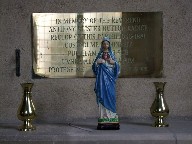
Beyond a nave altar like the one you can see through the window at Wattisfield, the chancel is a fine example of early 20th century High Church solemnity, still retaining Art Nouveau cross and candlesticks and a choice red carpet. There is a sweetly arched low-side window not unlike the one at Stanningfield, but this one is neatly glazed. A curious feature is the set of handbells suspended on a rod across the tower arch. They were given to the Parish in the 1920s, but unfortunately they are no longer in use.

I took great pleasure in signing the visitors book, and writing in the address of this site. I was the first person to sign it in 2003. The last entry was in December 2002, in a child's handwriting - they gave their address as 'Hepworth church'.

The kind lady was waiting to lock up, but she offered to stay for longer if I needed more time. She showed me the oil lamps on standards towards the west of the church. Apparently, they are used at Christmas time, and must create quite an atmosphere. She also told me that there really is a little room at the top of the tower! Apparently, you have to walk between the bells to get to it, but I'd have to ask the Rector if I wanted to go up there. I decided it would be best to save this for another time; I didn't want to push my luck, or whatever it was.

I chatted to the lady about her dog, who was now investigating my feet very enthusiastically. It had belonged to her son. Her own dog had died on Christmas Day, which was very sad; but her son had recently moved to a place where animals weren't allowed, so he had asked her to have it. She told me that the dog was excellent company. "God moves in mysterious ways", she said.

"He certainly does that", I replied.

St Peter, Hepworth, is just to the north of the A143 Bury to Diss road between Stanton and Wattisfield. The Parish appear not terribly keen on you going inside. If you are desperate to do so, contact the Rector, John Fulton, on jwfulton@ukonline.co.uk. Alternatively, try and catch it when it is being cleaned.


this site supported by commission from amazon.co.uk