St Margaret, Herringfleet

www.suffolkchurches.co.uk - a journey through the churches of Suffolk
|
St Margaret, Herringfleet |
|
|
||
www.suffolkchurches.co.uk - a journey through the churches of Suffolk |
||


Follow these journeys as they happen at Last Of England Twitter.
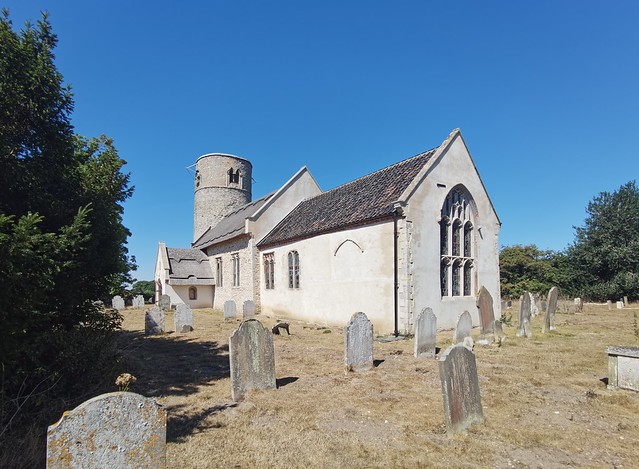
| This charming little church sits
on a rise above the road with just a farm for company,
and it was a pleasure on a sunny day in the summer of
2022 to come back to this special place. The round tower
is one of East Anglia's earliest, with Saxon
bell-openings which, while the style certainly carried
over for a while after the Norman Conquest, place the
tower no later than the mid- to late-11th Century in
construction. The Norman church against the tower
probably went up as part of the same long campaign, and
its south doorway survives, but it in turn was largely
rebuilt in the late 13th Century, a busy period for
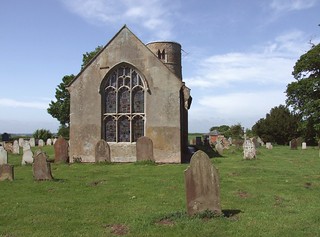
church-building in this part of East Anglia. The
Perpendicular east window was put in at the end of the
medieval period. The thatched roofs of the nave and the
porch have both been renewed since my previous visit some
fifteen years ago, and all in all the church has an air
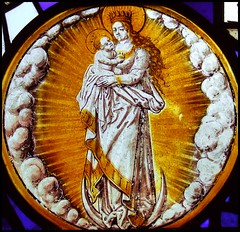
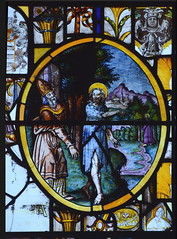
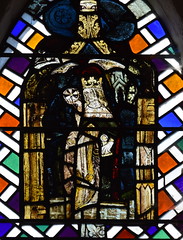
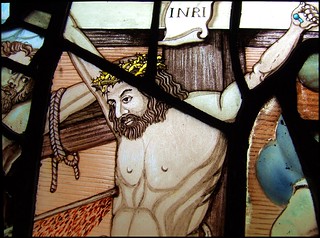
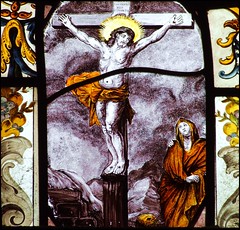
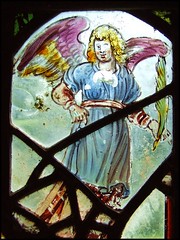
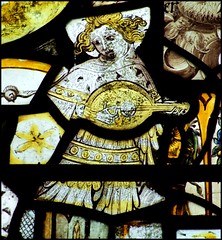
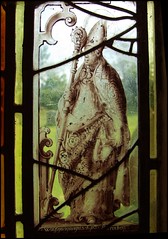
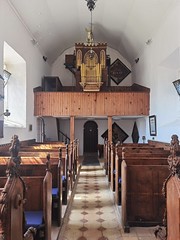
of being very well looked after. Entry is through the south porch, and you step into a church which is singular in character, for not only was the major refurbishment here carried out in the 1820s, which is to say it was earlier than the restoration of almost any other Suffolk church, but the church received the close attention of several generations of the Leathes family of Herringfleet Hall from the late 18th Century onwards. The font sits up by the chancel arch. The benches date from the 1820s restoration, and most unusually their ranks continue up into the chancel, where the pulpit is set just in front of the altar rails. This is essentially a High Church Prayer Book arrangement, the altar and pulpit taking equal precedence in those days before the sacramental teachings of the Oxford Movement returned chancels to liturgical use. For the great majority of churches it had been the pulpit that had been the main focus of Anglican worship for more than two hundred years, and soon churches would be reordered with a focus on the altar, but here we see a change beginning, a brief fashion if you like that has survived hardly anywhere else. The sense of the chancel here being a church within a church is emphasised by a notable collection of fragmentary medieval and continental glass which fills the east window and the windows on the south side of the chancel. Interspersed among the continental pieces are some earlier English medieval panels, as well as a few panels in a 'continental style' that were clearly painted later. The settings of the glass on the south side includes the garish bands of coloured glass that were popular in the late Georgian period. This tells us that the glass was almost certainly set here by the workshop of Samuel Yarrington of Norwich who was active in Norfolk and Suffolk churches in the first three decades of the 19th Century. The later panels are likely the work of the glass and enamel painter Robert Allen of Lowestoft, who often worked with Yarrington and supplied glass to suit the style of his projects.
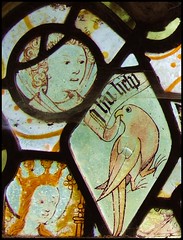
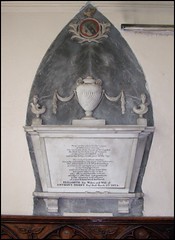
Much of the glass was acquired by John Francis Leathes, Lord of the Manor and resident at the Hall after the death of his father in 1817. Leathes was an enthusiastic antiquarian from an early age, and James Bettley, revising the Buildings of England volume for East Suffolk, tells us that he visited the Rhineland after taking part in the Battle of Waterloo. Some of the glass has been identified as coming from the Franciscan priory at Cologne. Leathes must have made the restoration of the church a priority after inheriting the Hall, and the chancel appears to have been pretty much as it is now by 1830. Mortlock romantically thought that the older English glass may have come from St Olave's Priory, but if Yarrington was involved it was more likely acquired from the glass dealer JC Hampp of Norwich, who did a brisk trade in old English and continental glass. Subjects include saints, Biblical scenes, classical figures, heraldic devices, and intriguing fragments along with the complete roundels around which the fragments are largely arranged. The two most memorable pieces to English eyes are probably the 14th Century panels of St Catherine and St Margaret, the earliest glass here. Intriguingly there are several late 15th Century fragments of birds holding scrolls on which are inscribed the words in English Jhesu Merci and Jhesu Help. Identical quarries can be found across Suffolk at Great Whelnetham. A gallery was added to the west end of the nave in the 1860s, and is home to an exquisite gilded organ, as if a precursor to Ninian Comper's later work at Lound a couple of miles away. Underneath the gallery at near floor-level, and unfamiliar in such intimacy, are the hatchments to John Francis Leathes' parents George and Mary. His grandfather, another John, had died in his forties in the 1780s, and his memorial is the one moment of grandeur in the church, an elegant urn on a sarcophagus set on the north wall of the chancel. John Francis Leathes's 1847 memorial sits quietly beside it. The Leathes family had acquired the Manor in the 18th Century, and along with it the impropriated living, for this church was a donative. This meant that there was no incumbent, no rector or vicar, but the Leathes family paid a chaplain to take the services. Since this was not necessarily a permanent post we might expect that the man would need to act very much to their liturgical taste. At the time of the 1851 Census of Religious Worship he was William Henry Clarke, who was paid an annual stipend of a hundred pounds, about £20,000 a year in today's money, and seems to have earned his wage because a high proportion of the parish attended his Sunday afternoon sermon that day. In the churchyard outside there is a beautiful early 20th Century terracotta cross, with stylised angel figures holding what appear to be Mercedes Benz logos, but which are actually symbols of the Holy Trinity. The Morning Stars Sing Together says the inscription at the top, and So He Bringeth Them To The Haven Where They Would Be. It was raised for a young girl who died in 1906, but her inscription is now hidden, as the memorial has sunk into the soft Lothingland soil. |
Simon Knott, September 2022
Follow these journeys as they happen at Last Of England Twitter.






|
||||||||||||||||||||||||||||||||||||||||||||||||||||||