| |
|
St
Margaret, Heveningham Heveningham,
pronounced Hen-ing'm, is, of course, most famous
for its Hall, the biggest, grandest stately home in
Suffolk. Heveningham Hall was built for the Dutchman
Gerard Vanneck in the late 18th century. Robert Taylor
was the architect, and Capability Brown laid out the
Park. Despite falling into disrepair during an
inheritance dispute in the 1980s, it looks magnificent
from the Huntingfield road, one of England's stateliest
and longest Georgian frontages. It is worth noting that
Heveningham is not the closest village to the Hall.
Huntingfield spreads beneath its frontage, and Cookley
and Walpole are also close at hand. This is a land of
many small villages, many churches, but few people.
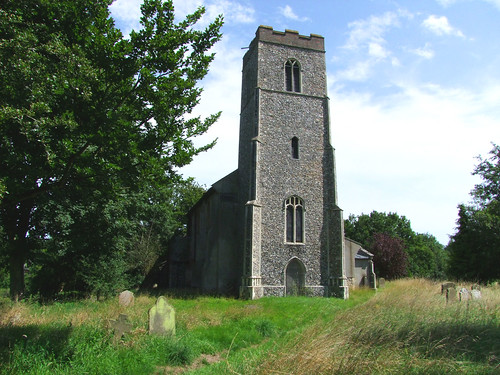
Heveningham church is much older than the Hall. St
Margaret sits on a hilltop site close to the old Roman
road, two facts that suggest great antiquity. Farms of
the estate surround the village. The church of today is
largely Perpendicular, the brick clerestory quite late,
perhaps 1530s. It calls to mind the fine brick tower of
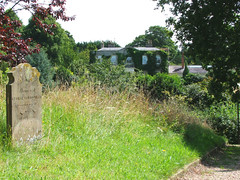
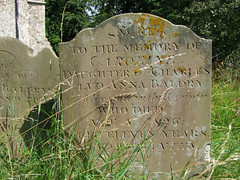
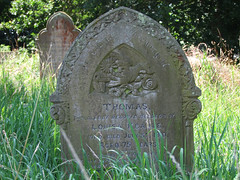
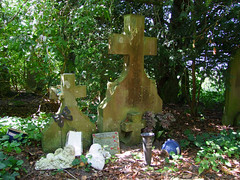
the church at neighbouring Ubbeston. The graveyard is
pleasingly wild. But all in all this is rather a serious
building, despite the clerestory.
The Victorians were busy here, as we shall see, but your
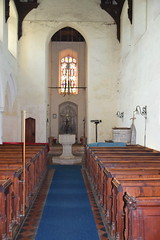
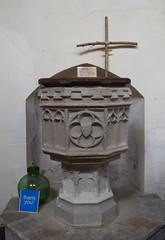
first sight on setting foot inside is of two fonts. The
Victorian one sits in the expected place, but beyond it
there is an elegant and rather singular late medieval
font which was brought here in the early 1980s from
Ubbeston when the church there was sold off by the
diocese. The hammerbeam roof above is also late medieval,
and a pretty contemporary painted image niche is set at
the east end of the south arcade. Beside it lies the
rather grim oaken effigy of a knight, Sir John
Heveningham. It dates from about 1450, and supposedly
once had a partner, his wife. The story is that these two
effigies were thrown out into the churchyard during the
19th century restoration, and were consigned to a
bonfire. Sir John was rescued, but his wife succumbed to
the flames. Only one other wooden effigy of this age
survives in Suffolk, across the county at Bures. The most
notable feature of the nave is the early 19th Century
manorial annex pew built for the Huntingfields of
Heveningham Hall set on the north side, the reused
Jacobean pews still facing the pulpit rather than the
altar in the pre-Ecclesiological manner. One pleasing
detail if you look inside is that the annex has its own
fireplace.
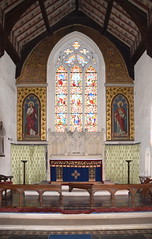
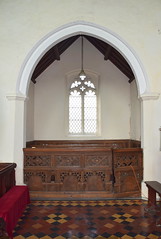
The Huntingfields of those staunchly protestant days
would have been appalled by the high Tractarian makeover
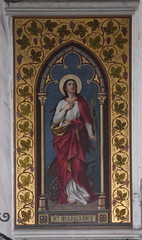
of the chancel that their descendants paid for. The high
reredos is flanked by large paintings of St Margaret and
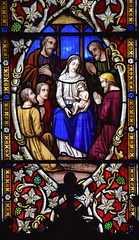
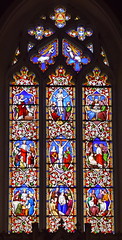
St Edmund. The sanctuary glass, depicting angels on the
south side and scenes from the Bible in the east window,
is said to be the work of Ann Owen, the wife of the
rector of Heveningham in the 1850s and 1860s. Can this
really be true? I only ask because this church is less
than a mile away from Huntingfield, where the rector's
wife, Mildred Holland, more famously redecorated the
roofs and ceilings in the 1860s. If it is true, then were
these two women colleagues or rivals, one wonders? The
Heveningham glass does have a charming naivety to its
line, but surely the sheer technical feat of the east
window suggests a major studio at work rather than an
amateur who has no known work anywhere else. I suspect
the most likely answer is that Ann Owen had a strong say
in what the windows should depict, and may even have
provided drawings for the designs, and I wouldn't be at
all surprised to learn that they are actually the work of
the William Wailes workshop. The church leaflet claims
that Owens' neighbour and perhaps rival Mildred Holland
was also responsible for the painting of the sanctuary
here, but this is clearly not the case, for not only is
it not in her style, it dates from the late 1890s. But it
all makes for a nice story.
|
|
|