e-mail: simon@suffolkchurches.co.uk
St Nicholas, Hintlesham
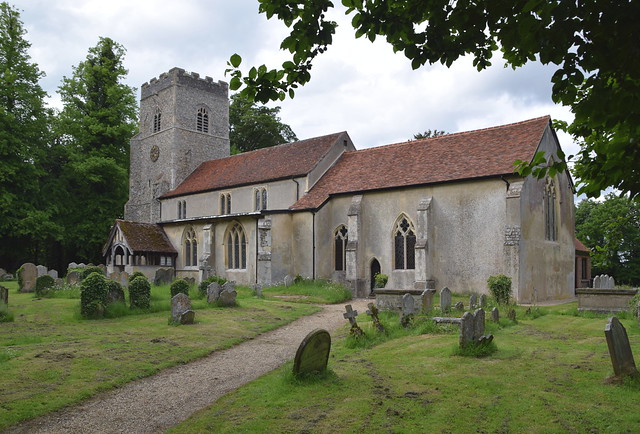
| I had passed this big
church regularly for 15 years before I ever went in. It
stands on the busy A1071 Ipswich to Sudbury road in
Hintlesham village, near where the road goes through a
series of gutwrenching 90 degree turns to circumnavigate
the pile of Hintlesham Hall. The Hall was once the home
of the Timperley family, and now, since Robert Carrier
bought it in the 1970s, one of the county's most famous
(and expensive) hotels.
Languid and serene, St Nicholas puts its feet up. Decorated, west of Ipswich. |
| On this bright spring
morning, the churchyard was full of greenness, and a
richness I has not previously seen this year. On the
south side of the church, ivy clusters enthusiastically
over ancient graves, and looks very good. So often it is
cleared. The grass was dark and luscious, the trees were coming into leaf, and in the air was a fecundity of which sex guru and one time resident of this parish, Henry Havelock Ellis, would doubtless have approved. A modern porch hides the flint chequers of a typical Decorated south wall; and this, we will find is a typical Decorated church, and therefore not typical at all for Suffolk. The door opens into a dim, mysterious interior, which is refreshingly unsanitised. |
Ellisian fecundity. |
Beyond the font, a modern rood. |
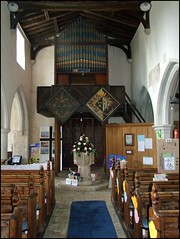
There is a great sense
of age about the squarish nave and wide, open chancel.
Much clutter seems to have been cleared, and an altar
moved towards the nave as if in the approved Vatican II
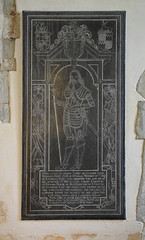
manner. A large, incongruous tree branch sticks up from a bucket, with a priest's stole hanging from it. Around the chancel are some excellent memorials to the Vesey and Timperley families, all restrained and interesting. The best is the large table-top one to Nicholas Timperley, bolted now to the north wall. The Timperleys were recusant Catholics, and seem to have reached some accomodation with the authorities that didn't involve them being hung, drawn or quartered, although they did lose all their property in the end. Unlike the Kytsons at Hengrave, of course, who seem to have had the power to negotiate themselves out of even this position. Curiously, the church guidebook, dated 2000, refers to the Timperleys as 'papists'! Perhaps the writer didn't realise that this is a term of abuse. |
| The squint
in the north wall of the chancel shows that the vestry was once a chapel, possibly a chantry
to the Timperleys. It would have been converted to
secular use in the 1540s. We can see here what once must
have been at Little Waldingfield and Sternfield. The stairway to the roodloft in the south wall is one of the best preserved in Suffolk, and its Tudor brick outline is excellent. It is interesting to see how far back the upper exit is set from the chancel arch. It must have been a big one, clearly intended for regular liturgical use. The Tudor brick shows that this stairway is late, and suggests the importance of the roodloft on the eve of the Reformation. An image niche in the north aisle would have accompanied an altar against the screen. It now contains a modern image of St Nicholas, perhaps not completely different to that which it would have contained 500 years ago. The font is typically East Anglian; in good condition, and set rather gloomily under the organ gallery. Elswehere, paintings, memorabilia and pictures are all nice little touches. |
A tree in the chancel (and why not?) with monuments behind to Veseys - Charles above died in 1657, Thomas below in 1679 - and to the right, the Timperleys. (Thanks, David!) |
The outline to the rood loft stairs, with churchcrawler electrocution trap inside. |
I wandered around to
the secluded north side of the graveyard, where the
gravespace was extended in the 1920s, apparently a gift
of land from the adjacent pub. The modern graves in their
trim rows are rather characterless, but it is good that
Hintlesham people can still be buried in their own
village. This has been a joint parish with Chattisham for about 350 years, and the churches stand about a mile apart from each other, separated by a valley of meadows and woods. The Victorian school building is still in use for its original purpose, still using the names of both villages; it is one of the smallest in Suffolk. There is also a modern Community Hall, again bearing the names of both villages. This busy place has a half-decent pub, as well as a garage, a rare thing in the outback these days. Of course, this isn't really the outback. A brisk stroll eastwards will bring you, in thirty minutes or so, to the edge of Ipswich, and the Chantry housing estate, Suffolk's largest. Nowadays, the Timperleys would find the name of that estate rather ironic, I think. he church guide, which I mentioned earlier, is really rather good. It is informative and often amusing (if slightly eccentric on the subject of the Reformation). It costs £2.50, one of the most expensive I have come across. But this seems to me a realistic price to pay, and I hope they sell lots of copies. |
St Nicholas, old Father Christmas himself, today as always. The saint they couldn't take away from us. |
| TIt seems to me that
most church visitors are prepared to pay more than most
churches charge for their guides. If every Suffolk church
made the same effort to be open as St Nicholas, and had
as good a guide on sale at as sensible a price, then all
churches would be better off, both in terms of people and
of money; and I should be a happier, if slightly poorer,
man. St Nicholas, Hintlesham, is on the main A1071 Ipswich to Sudbury road. I found it open, and a sign suggested that it is open every day. |