All Saints, Holbrook

www.suffolkchurches.co.uk - a journey through the churches of Suffolk
|
All Saints, Holbrook |
|
|
||
www.suffolkchurches.co.uk - a journey through the churches of Suffolk |
||



Follow these journeys as they happen at Last Of England Twitter.
| The Shotley Peninsula is a
pastoral scattering of gentle hamlets along high hedged
lanes which thread over hills and through woodlands.
Other settlements line the Orwell estuary, the full drama
of the wide water and forests beyond constantly on show.
The road along the northern shore is a busy one, as is
the Ipswich to Manningtree road which cuts the Peninsula
off from the rest of Suffolk, but otherwise this is an
introspective, secretive landscape, especially on the
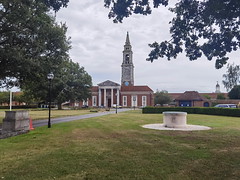
southern side. No wonder people long to live there. The Peninsula has only two places of any real size. There is broad functional Shotley itself at the eastern tip, and there is Holbrook to the west, a rather more prosperous proposition. Holbrook is home to the famous Royal Hospital School, a sprawling 1930s neoclassical confection designed for the sons and daughters of the Navy. Its campanile tower is a landmark for miles around. You can see it from north Essex and from tower blocks in the centre of Ipswich. Holbrook's
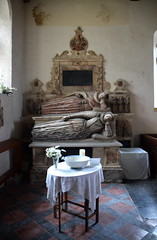
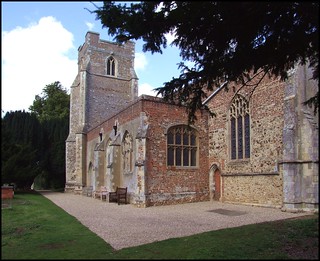
church sits beside the main street, behind a high hedge.
At first sight, the arrangement is a bit odd. All Saints
has one of the south towers commonly found in the Ipswich
area, and the nave to the north is broadly contemporary
with it. But a small, low south aisle was built at the
start of the 16th Century running eastwards of it, and
the effect from the outside is now of a small church with
a big north aisle. In fact, there is a 19th Century north
aisle beyond the nave, the work of Diocesan architect
Richard Phipson. It has a slightly awkward juxtaposition
with the nave at the west end, with an angled doorway.
The nave west window appears to be made of terracotta.
Also memorable from the exterior is the clerestory,
somewhat hidden by the south aisle, but picked out
beautifully in red brick. All in all, full of interest.
In 1586, Margaret Clitherow, the
middle-class wife of a York butcher, was accused of
treason against the state. This was a catch-all charge
designed to root out Catholicism. She was told, as all
martyrs of the time were, that the charges would be
dropped if she renounced Catholicism, and conformed to
the Anglican church. This she refused to do, and also
refused to enter a plea, saying that "having made no
offence, I need no trial". Failure to make a plea
was a capital crime in itself, of course, and Clenche's
sentence was that you shall return to the place from
whence you came, and in the lower part of the prison be
stripped naked, laid down upon the ground, and so much
weight laid upon you as you are able to bear, and thus
you shall continue for three days; the third day you
shall have a sharp stone laid under your back, and your
hands and feet shall be tied to posts that, more weight
being laid upon you, you may be pressed to death. |
Simon Knott, December 2020

Follow these journeys as they happen at Last Of England Twitter.
Amazon commission helps cover the running costs of this site