This parish is on the edge
of the lovely town of Halesworth. The name is to
differentiate it from Holton St Mary, away in the
south of the county, but in 19th Century
directories the parish here is referred to simply
as 'Holton'. Nowadays, it is home to one of the
famous Bernard Matthews' turkey products
factories, the biggest employer for miles.
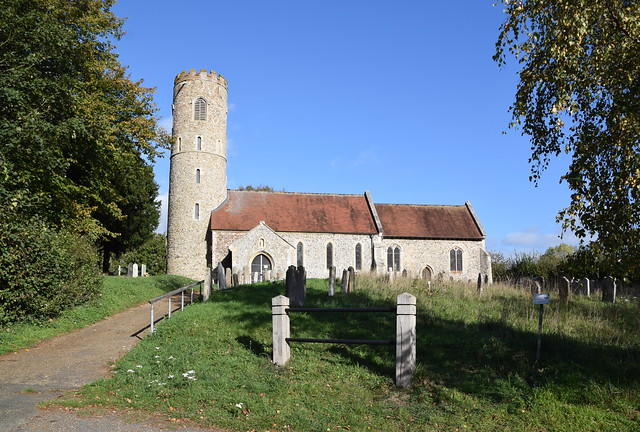
The church is on the main road, but set well back
from it, at the top of a sloping churchyard. St
Peter sits there, looking beautiful.The round
tower is in two stages, and one of Suffolk's
tallest, giving the impression that this is a big
church, which it isn't. It's a dear little
building, and open every day. A modern statue of
St Peter sits in the porch niche, and then there
is a beautiful Norman inner doorway, probably the
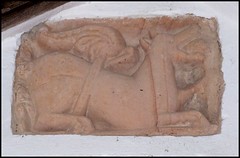
age of the lower half of the tower. Above it is a
most curious Norman stone carving. It shows a
mythical beast of some kind, apparently winged,
and holding something in its mouth. These things
are more common to the west, but relatively rare
in East Anglia where there seems to have been a
will in late medieval times to do away with older
superstitious imagery. I have heard it described
as a winged bull, the evangelical symbol of St
Luke, but I do not think this can be right. For
others, it may be a dragon, and a dragon with a
child in its mouth is the symbol of St Martha,
which would be unique in East Anglia and unusual
in England. But I think it is a wolf whose tail
becomes a tree of life above its back, and not
wings at all, and who is eating the leaves of
another tree. A symbol of resurrection, perhaps?
Similar images can be seen elsewhere in East
Anglia at Santon Downham and Birchanger.
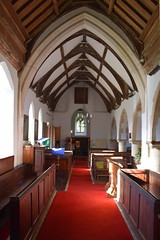
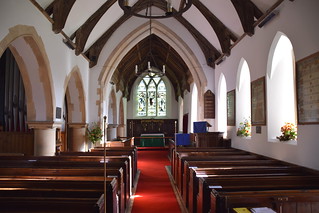
You step in to a pleasant and sentimental
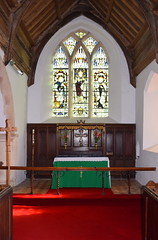
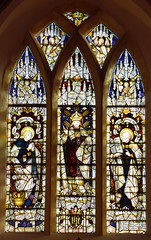
Victorianised interior. There's a grand window by
Kempe & Co depicting the Blessed Virgin and
St Peter flanking Christ in Majesty, not a
workshop I am terribly fond of, but it is one of
their lushest works in the county. The north
aisle gives the nave a sense of squareness. The
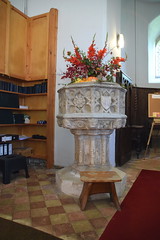
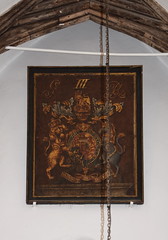
font is old, there is a Georgian royal arms, but
the overwhelming sense is of the 19th Century.
Looking up this Parish in White's 1844 Suffolk, I
was pleased to discover that the Rector at the
time was the splendidly named Reverend Worship.
He must have been one of those who transformed St
Peter into the church we see today.
Simon Knott, November 2018
Amazon commission helps cover the running
costs of this site