| |
|
 |
|
Horringer, also
known as Horningsheath, sits on the
eastern side of Ickworth Park, but there
is no Ickworth village now. Ickworth
House, perhaps the most significant late
18th century building in England, is now
owned by the National Trust. Ickworth's
redundant medieval church of St Mary sits
in the grounds, and although it is not in
the ownership of the Trust it is fiercely
guarded by them from anyone not willing
to pay seven pounds for the privilege of
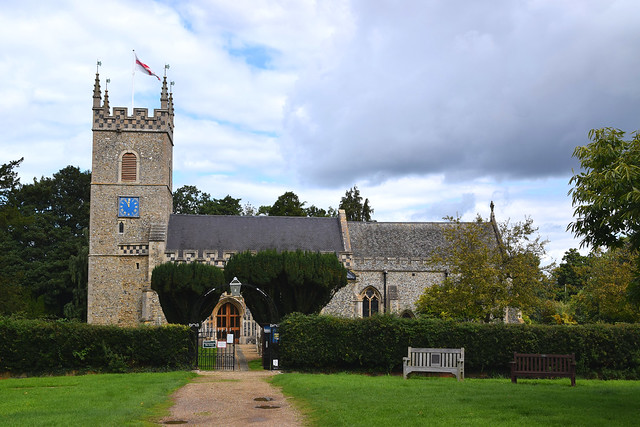
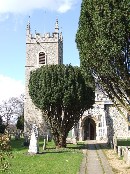
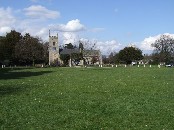
seeing it. But Horringer's church of St
Leonard is still in use, and sits at the
eastern gates of the Park, a bold and
familiar landmark to travellers on the
adjacent main road. As with several other
churches around here, St Leonard has
suffered the full force of the
philanthropy of the Hervey family, the
Earls of Bristol. The whole structure was
almost entirely rebuilt in 1818 to
provide a grand entrance statement to the
Park, all except the tower, the top of
which had been rebuilt 100 years earlier.
During the 19th century, the church was
rebuilt and extended several times; the
chancel came in 1867, and the furnishings
are mostly of the 1880s. The tower was
restored again in the 20th century, so
there's not much evidence here of the
medieval life and liturgy of the place -
or so you might think at first.
|
In fact, the
virtually unlimited resources of the Herveys
meant that everything was done to as high a
standard as possible, and the reputation of the
family as art collectors was enhanced by what was
preserved. Thus, a holy water stoup in the
entrance, and the integrity of the 15th century
Horsecroft chapel has survived, even though its
fabric is wholly modern. The nave roof is
original, and the fixings for the doom tympanum
are still in place above the chancel arch. Also,
there is a large hook, which Mortlock thinks may
have been used to secure the rood, or even the
Lenten veil; or about a hundred and one other
things I suppose, not least likely of which would
have been a candelabra.
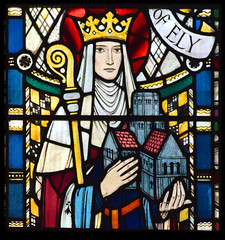
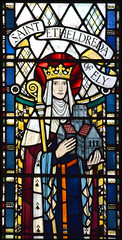
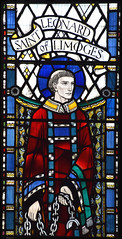
The church is full of light and space, and the
restrained seriousness of the 1946 east window by
Joseph Nuttgens is excellent. It depicts the East
Anglian patron Saints Etheldreda and Edmund
flanking St Leonard and the Blessed Virgin.
  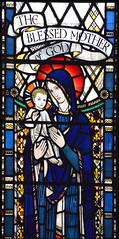 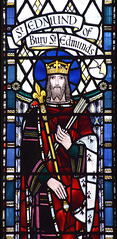
The window
replaced 19th Century glass blown out in the War,
and is poised in serious expressionism just
before we all became infected with Festival of
Britain excitement.
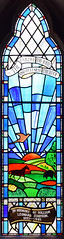
| The 1980s glass in
the Horsecroft chapel is perhaps a little
more parochial, but this quiet little
space is so intimate that it does not
diminish it. The chapel was probably
originally intended as the chapel for the
hamlet of Horsecroft, after the church
there was demolished. There's a
splendidly ghoulish skull on a late 17th
century memorial reset against the
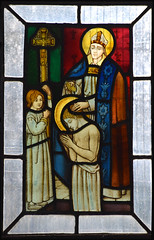
arcade. The
1870s glass to the west of it is by
Clayton & Bell, but rather more
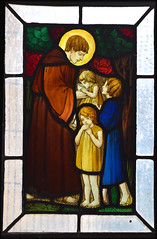
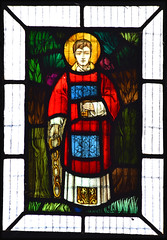
interesting is the sequence of panels set
in the window to the west of the south
doorway, depicting scenes related to St
Leonard in a pleasing naive style,
perhaps from the first decade of the 20th
Century. It would be interesting to know
who they are by.
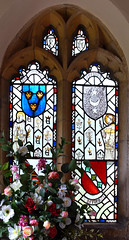
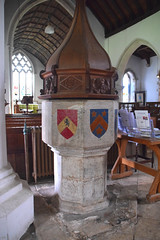
The medieval font has modern heraldic
shields painted on it; repainted, but
perhaps to the original configuration.
They show shields of local
pre-Reformation landed families - it is
to the credit of the Herveys that it
doesn't show theirs (they've only been
here since the 17th century). All in all,
a splendid church.
|
|
 |
|
|
|