| |
|
Iken is one of
those fabulous spots that some people think of as their
favourite Suffolk place. Others come across it by
accident, as if it were a happy secret. And there must be
many people, I suppose, who do not even know that it
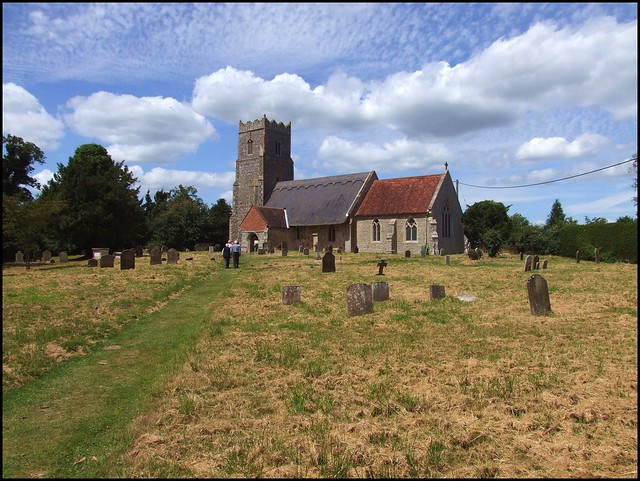
exists. The little thatched church on its mound jutting
out into the wide River Alde is part of the panoply of
Suffolk mysticism, an element in an ancient story of the
birth of England, of grey mists and sad, crying wading
birds swinging low over the mudflats, as if this were a
piece of Benjamin Britten's chamber music made flesh.
You may have seen this church without ever visiting it.
Its tower is the one you can see in the distance across
the marshes from Snape Maltings beyond Barbara Hepworth's
Family of Man, and there is another sight of it
on the main road to Aldeburgh. But these two
civilisations are far away, and the isolated church and
the dubious delights of shopping in the craft shops of
the Maltings seem to have nothing in common.
I hope I can begin to convey an impression of what this
place is like. Iken, pronounced eye-k'n, is one
of Suffolk's most extraordinary places, and anyone who
has ever been here will not easily forget it. Here, the
River Alde snakes through mudflats and around islands.
The reed beds shiver and flow in the silence, and the
avocet and curlew cry out in their isolation. As the
seasons turn, and even as the day passes, it can seem
different. Light plays exquisitely on the silver water,
or the wind comes from far away, and on a cold winter's
afternoon there are few places I'd rather be.
But I had not been back to Iken for years. And then it
was a bright, frosty day in January 2020, and it was
generally agreed by all that I needed some fresh air. So
we drove up to Snape Maltings, parked, and wandered up
through the marshes alongside the sleepy River Alde to
Iken. It was bitterly cold, and the footpath once you
left the boardwalk was a sea of slippery mud. But there
were quite a few people about and we greeted each other
cheerfully, and eventually the path emerged in the lane
just before the turn off to Iken church.
I was walking with my son James, and it brought back a
memory of almost twenty years before. On a gorgeous day
in November 2000 we had set off from Snape in the same
way with my friend Malcolm, Jimmy's godfather. We took
the same path through the marshes, following the river
eastwards. Jimmy, then seven, was soon in a world of his
own, playing games in his head with the wilderness of
reed beds and thickets. After about half a mile, the
pathway enters the marshes, and is carried through the
mudflats by a mile or more of duckboards, the reeds and
creeks encroaching on both sides. I suggested to Jim that
it might not be such a good idea if he was to step off
the boards, as this would lead to sudden death - or, at
least, very muddy trousers.
Taking the way of least resistance, the pathway veers
from side to side, so that every time I looked up the
tower of St Botolph was in a new position. We reached the
edge of the winding river again, and you could see at
once how the church and its two neighbouring houses are
on the end of a spit that sticks out into the marsh, St
Botolph itself on a little knoll at the end. A narrow
road runs along the spit, the only way to the church,
unless you have a boat; and even then, you could only
reach it at high tide, for at other times the river
drains to a silver thread, leaving a vast shimmering
expanse of grey mud to be picked over by wading birds. As
the river fills again, you are sometimes rewarded with
the sight of a marsh harrier, looming over small
creatures forced higher and drier by the rising water.
  
There is also the
other designated footpath from Snape to Iken, as I said
earlier. It cuts straight across the marshes, island
hopping across the muddy creeks. You could only do it at
low tide, and I think that in winter you could not do it
at all. When we reached the point where it was supposed
to join the path we were on, there were 20 metres or so
of shiny, lethal mud spreading where it was marked on the
map. We gazed at it. I imagined trying to cross it, and
thought to myself that I would get about three, perhaps
four metres. I simply wouldn't stand a chance. My
children would come at low tides, to see the bony,
skeletal hand protruding from the flat mud.
"Look!" their mother would say. "There's
Daddy!" I could tell that Malcolm was slightly
disconcerted to see a footpath marked on a map disappear
into grey nothingness. But then, he's from Derbyshire,
he's used to the permanence of stone, not coastlines that
melt with the seasons.
From here, the full drama of St Botolph catches your
breath. It is an ancient site. Well, that's easy to say,
of course, and true of many churches. But the site of St
Botolph really is ancient; you are looking at a place
where there has been a church for almost 1350 years. This
is almost certainly the spot where St Botolph came ashore
in AD 654, and founded his monastery. Some people will
claim the same honour for Boston in Lincolnshire, but
don't listen to them. This place was then Icanho, and St
Botolph and his monks set out across east Suffolk to
evangelise the pagans under the direction of Felix, first
Bishop of East Anglia, from his Cathedral at Dumnoc,
probably Walton Castle. Botolph died at or near Burgh,
where he was buried, probably in an attempt to exorcise
evil spirits. There is a case made for Burgh being the
setting for the dragon's lair in the Anglo-Saxon epic Beowulf,
probably written in Suffolk. The corpse was later
translated to Bury, where the monks knew a pilgrimage
opportunity when they saw one.
The church as we see it today is in three parts. The most
ancient bit is the nave, albeit restored. It dates from
before 1200. The chancel, like all others in England,
fell into disuse after the reformation. By the 18th
Century it was ruinous, and was demolished and rebuilt in
1853, and looks all of this date. Its 20th Century
sanctuary panelling is rather lovely. The tower is a
proud one of the mid-15th Century, very much in the
Suffolk style.
The church sits in its pretty churchyard across a private
road. This caused a considerable problem a few years ago,
as we shall see. The funny thing is that, although this
churchyard is surrounded on three sides by the marshes,
and the river spools around it like a cord of mercury,
the Alde still has six miles to go to reach the open sea
from here. A mile to the east, it reaches Aldeburgh. At
St Botolph's time this was the river mouth, but now the
river turns back inland, and heads south. As if this
wasn't contrary enough, it changes its name to the Ore.
After running parallel to the coast for three miles, it
reaches Orford, where it formed a natural harbour in
medieval times. But that, too, is now blocked, and the
river slinks westward of Havergate Island for another two
miles, coming out to sea at Shingle Street, just north of
the Deben estuary. This is a secret world, full of hidden
creeks and inlets. About twice a year, the local papers
report that coastguards have caught boats on this river
attempting to avoid duty by running tobacco or alcohol
ashore. The field immediately to the north of the
churchyard contained two Highland cattle, surprisingly.
Well, it certainly surprised me. It surprised seven year
old Jimmy even more, he thought they were yaks. The sky
had changed, a grey leaden colour seemed to have
condensed out of the icy blue. We stepped inside.
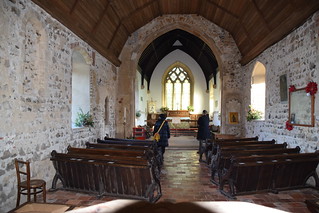
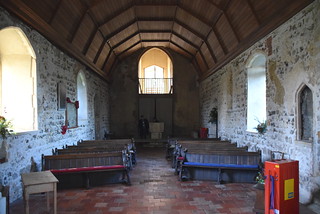
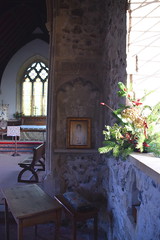
Low benches lined the north and south walls (today, these
have been replaced by ranks of angled 19th Century
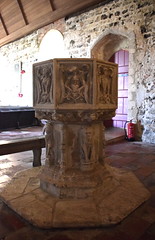
benches, too mundane to be appropriate). To the west is
the great font, a good example of the 15th Century East
Anglian style. The angels that alternate with the
evangelistic symbols carry the Instruments of the
Passion. Beside it, another large object is hardly
discernible in the darkness. The walls to north and south
are blackened, calcified. The plaster has almost all
gone, and we are left with the rubble core, common to all
Suffolk churches, but normally hidden. What happened
here?
On the afternoon of the 4th July 1968, a gardener
clearing the churchyard lit a bonfire to burn rubbish.
Sparks from it caught the thatched roof of the nave, and
within minutes the whole place was alight. In this remote
spot there was no prospect of a speedy rescue, and the
church completely burned out, leaving a shell. It took
twenty years for repairs to be completed to the extent
you find them today, because a dispute over access meant
that materials had to be carried by hand from the road,
for vehicles were not allowed through into the
churchyard. First, the chancel was restored for use as
the parish church. An ill-fitting partition separated it
from the ruins. Later, a roof was put on the nave, and
the font (which had been removed to protect it from the
elements) was returned. But the interior of the nave
could not be protected, and for a decade or more it was
exposed to the Suffolk winters. And that is how you find
it today.
On my first visit, I noticed that the person before me in
the visitors' book had written a true taste of the
medieval! Poetic, but nonsense of course. In the
Middle Ages, this church would have been alive with light
and colour, of the flicker of candles and the smell of
incense. The walls would have been covered with brightly
coloured paintings, the bare shadow of one still
surviving behind a glass screen on the south wall today.
No, what we see today is more primal, ageless. The
architect of the restoration was Derek Woodley, also
responsible for the magnificent extension at Kesgrave All
Saints.
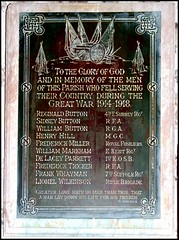
On the south wall is the war memorial. It is startling to
realise that this tiny hamlet lost ten men in the First
World War. There can barely be that many men living in
the whole parish today. With your back to the nave, the
chancel is of a homely, dull character. Johnson's
engraving of 1818 shows it in ruins. There is a picture
of this in the excellent guidebook and surreally another
picture shows the church after the fire, exactly the
opposite of Johnson's engraving, with the chancel whole,
but the nave in ruins. Only the tower stands in both, and
that was restored as part of the post-fire work. And
that's where we come to the most interesting thing of all
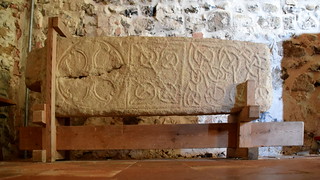
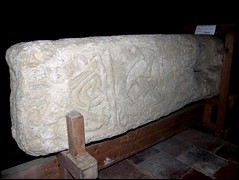
about Iken, for the large object by the font is nothing
other than part of a Saxon cross, discovered in the
superstructure of the tower when it was restored. It is
the bottom half of a cross that must have been about
three metres high, and the tenon that connected it to the
crossbar survives. It probably dates from the 9th
Century, and may have been raised on the site as a
commemoration when the community was re-established after
the Vikings had destroyed the original monastery. The
most interesting side faces the wall unfortunately, for a
curled dragon bites his own tail, but keeps his beady eye
on you.
Today, the tiny
congregation regularly use the chancel for services, but
the nave has become a haven for pilgrims, who make their
ecumenical way here in droves if the visitors book is
anything to go by. And I'm sorry to harp on about the
visitor's book, but another mistake made by people
leaving comments is to describe the cross as 'Celtic'.
This is, I think, a result of the way we have been
conditioned in the modern era to think of the Celts as
'New Age' artists and mystics, and the Saxons as dull,
plodding farmers. This is, of course, also nonsense, as a
sight of the Sutton Hoo treasure in the British Museum
will show immediately. Saxon art was gorgeous. It was
intimate and intricate, mysterious and beautiful. All too
soon, the Normans would come along with their big ideas
and corporate imagery, but it was the Saxons who built
the English imagination, and anyone who tells you that
the work here at Iken is Celtic should be disavowed of
that notion.
We wandered back outside to the east of the church, and
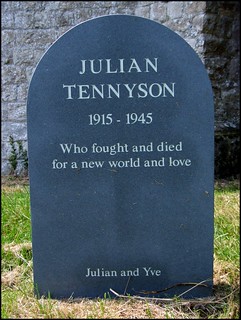
the memorial to the writer Julian Tennyson Who fought
and died for a new world and love. Tennyson's most
famous book is Suffolk Scene, a moving 1939
evocation of the county on the eve of the outbreak of
War. He was just 23 years old when he wrote it, and it is
a young man's book about an ancient county, one of the
most memorable books written about Suffolk in the 20th
Century. Sadly, Tennyson did not survive the war whose
storm clouds he had noticed, being killed in Burma
shortly before it ended. He was a grandson of the famous
19th Century poet, although that is one of the less
interesting things about him. I had been pleased to come
across this stone newly erected some fifteen years ago,
and once again it set me thinking about what Tennyson
would find different about Suffolk if he saw it today,
and what he would find unchanged. When he left to fight
he left a request that if he should die a memorial should
be placed in Iken churchyard. This request was not
fulfilled at the time, but it was carried out by his
daughter at the start of the current century when she
found reference to it in her father's papers after her
mother died. And Iken is a beautifully appropriate place
for him to be remembered, for to return here is to return
to where the story of Suffolk Christianity began. Across
the shifting, shimmering mudflats, the failing light
enfolds a beating heart, a pilgrim church where St
Botolph's journey has come full circle.
Simon
Knott, January 2020
Follow these journeys as they happen at Last Of England
Twitter.
 
| |
| |
|
|
|
|
|
|
|
| |
|
|
|
|
|
|
|
|
The Churches of East
Anglia websites are
non-profit-making, in fact they
are run at a loss. But if you
enjoy using them and find them
useful, a small contribution
towards the costs of web space,
train fares and the like would be
most gratefully received. You can
donate via Paypal.
|
|
|
|
|
|
|
|
|
|
|
|
|
|
|
|
|
|
|
|
|
|
|
|
| |
|
|
|
|
|
|
|
|
|
|
|
|
|
|
|
|
|