| |
|
St
Andrew is one of the Saints, a group of twelve
remote, scattered and traditionally lawless
parishes not far from the Norfolk border. There
is a sense in which St Andrew is in the
Saints, but not of them: it looks away
from the others to north and east for the other
parishes in its shared benefice. There is no real
village here, but that is par for the course with
the Saints of course: only three of them have a
proper village in their parish. St Andrew has
more houses than most, but they are scattered
around commons, separated by winding hedged
lanes. All in all, the parish is rambling and
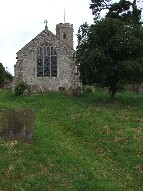
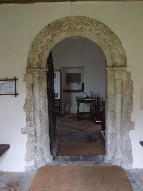
incoherent, and somewhat difficult to grasp. This grand
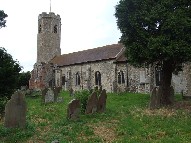
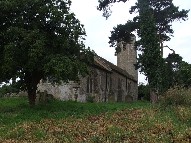
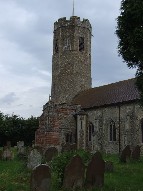
round-towered church sits at a bend in the road
with the former rectory for company. As is common
in this part of East Anglia, the tower has an
octagonal bell stage, and although some round
towers were built from scratch in the 13th and
14th centuries, it is likely that this top was
built onto a Norman tower, probably
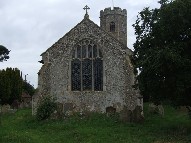
contemporarily with the body of the nave, which
despite the acquisition of later Perpendicular
windows is essentially a long Norman church. The
chancel was probably added at the time the tower
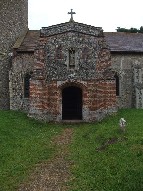
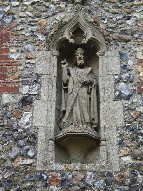
was topped off. A good modern statue of St Andrew
gazes out from the niche on the porch, which was
built right on the eve of the Anglican
Reformation. The graveyard he looks out on is a
delight: there has been almost no clearance of
the older gravestones, and it must be a
genealogist's dream.
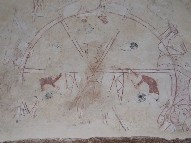
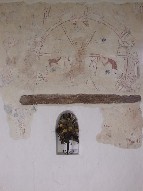
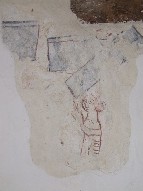
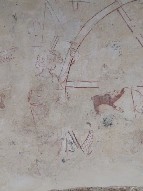
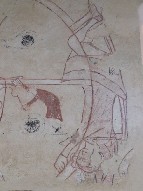
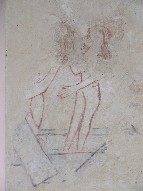
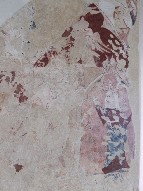
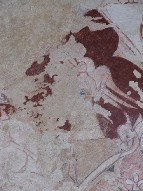
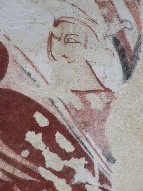
In December 2001, workmen undertaking a repair
to the south wall uncovered a remarkable scheme
of wall paintings. They bear a similarity to the
14th century wall paintings at nearby North
Cove, but
what makes them unusual is the main subject, the
depiction of a wheel of fortune. It is the only
known example in East Anglia, although it is
possible that the painting on the south wall at Barton
Bendish St Mary in Norfolk may show something
similar. The wheel of fortune is a variation on
the usual Judgement scene, with a seated figure
at the top, and two other figures apparently tied
to the wheel, one rising and the other falling.
The image of a wheel of fortune was a potent one
in late medieval times. It was derived from a
work called the Consolation of Philosophy,
by the 6th Century Roman philosopher Boethius. By
the 13th and 14th centuries, this book was the
most widely copied work of secular literature in
Europe, central to a university education and
formation for the Priesthood. As such, it
informed and infused English medieval
Christianity, particulary at the time of the
Black Death and afterwards.
Famously, Boethius
has Fortune tell us that inconstancy is my very essence;
it is the game I never cease to play as I turn my
wheel in its ever changing circle, filled with
joy as I bring the top to the bottom and the
bottom to the top. Yes, rise up on my wheel if
you like, but don't count it an injury when by
the same token you begin to fall, as the rules of
the game will require. This fatalism is also
seen expressed in such more common wall painting
scenes as the Three Living and the Three Dead,
where the noblemen out hunting are reminded by
corpses in various states of decay that as
you are, so once was I, as I am so you must be,
therefore prepare to follow me. The
suggestion is that it is of no use to store up
earthly treasures, but the wheel is also intended
to remind the viewer of the temporality and
uncertainty of these things, and that it is far
better to concentrate the mind on higher
thoughts.
In the 15th century, there
was a move away from classical mysticism towards
an enforcement of the orthodoxy of the Catholic
Church, mainly because of the way in which the
increasing wealth of a rising middle class was
paying for reminders of the significance of
praying for the dead at that time of pestilence
and disease. These wall paintings were probably
covered up during the 15th century, a century or
so before the protestant iconoclasts came along.
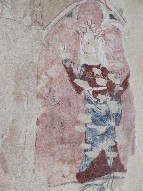
Around the wheel are other figures, including the
dead rising from their graves, and east of the
window are a queen and an angel, probably part of
a larger scene. The pitting in the figure of the
queen is almost certainly not iconoclasm, but
simply the way that the surface has been prepared
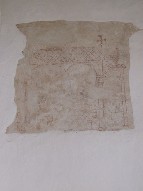
for a covering of plaster. A curiosity on the
wall opposite is an architectural drawing of a
Romanesque building, which may well predate the
scenes on the south wall.
The wall paintings are of
such significance that the story of their
discovery reached a national audience. But
Ilketshall St Andrew wasn't finished with
extraordinary events, because a year or so later
the church was struck by lightning, not once but
twice. It took until 2006 for the building to be
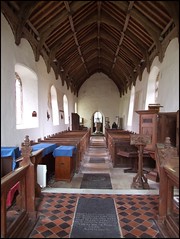
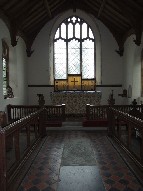
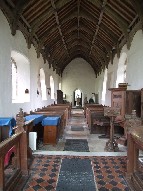
reopened, and what a transformation! You step
into a clean, bright, long church, which is
obviously well-loved and cared for. At the west
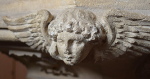
end of the south side is a 16th century bench
back carved with cherubs and the large initials
JE. behind it, the 15th century font looks most
imposing on its pedestal.There is a pleasing
feeling of a rustic 19th century restoration, as
if the blacksmith and the plough boy would still
be thoroughly at home here. The great royal arms
of Charles II were thoroughly repaired and are an
outstanding example of the confident carved work
of the Restoration period.
|
|
|