St John, Ilketshall St John

www.suffolkchurches.co.uk - a journey through the churches of Suffolk
|
St John, Ilketshall St John |
|
|
||
www.suffolkchurches.co.uk - a journey through the churches of Suffolk |
||


Follow these journeys as they happen at Last Of England Twitter.
| This area of north-east Suffolk is
home to the Saints, a dozen medieval parishes all styled
as either Ilketshall or South Elmham. These days all the
churches of the Saints are open to pilgrims and strangers
every day, but that hasn't always been the case and I
can't help recalling the occasion of my first visit here
back in 1998, when I needed to collect the key from the
nearby farmhouse. It was the home of the churchwarden,
and she was very enthusiastic. "Of course! What
should I do? Do I have to come with you?" "Umm, no, not really", I said.
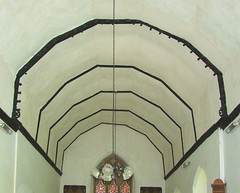
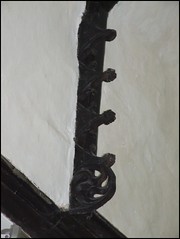
"What do you usually do?" If you are on a bike or on foot then the church is best approached from Ilketshall St Andrew, along a deep, narrow lane hemmed in by hedgerows, a rare thing in the Saints. You pass the former rectory, one of those grand Victorian piles which in years gone by must have provided such a contrast to the rest of their humble parish. At the time of the 1851 Census of Religious Worship the resident was Charles James Hutton, who was paid £330 in tithe and glebe a year for his efforts, a little under £70,000 in today's money. Not bad for a parish of just 72 souls, although in fairness to the Reverend Hutton he could claim an average Sunday attendance of 40 people, by far the greatest proportion of the parish population of any church in this part of Suffolk. By contrast, the average at neighbouring Ilketshall St Lawrence was just 30 out of 203 parishioners, which was much more the going rate around here. Hutton's successor was The Reverend CF Tarver, who was wealthy enough to make the rectory even bigger. James Bettley, in the revised Buidlings of England, tells us that Tarver was tutor to the young Prince of Wales, later Edward VII, and in later years the young Prince was sent to stay with Tarver at the rectory to remove him from temptation. The church sits up on a mound at the junction of the roads, a designated wildlife area. On one occasion I recall fighting my way through the nettles to the north of the chuch while investigating some tombchests that had sunk into the ground, and found that I began to do the same myself. The tower is 14th Century, and quite plain. The church was mostly renewed in the 19th Century, the porch as recently as 1908. Indeed, a lot happened here in the 19th Century, and then not a lot afterwards. Perhaps as a thank you to the Reverend Tarver for his care of the Prince of Wales, the Royal Family paid for the 1860s restoration of the chancel which includes glass by Cox & Sons before Buckley joined the firm, and which is very much in the cathedral style made popular by William Wailes in the previous decade. A lancet of St John the Baptist was installed by Jones & Willis half a century later on the eve of the First World War. The only other glass is a collection of 18th Century decorative glass in the upper lights of a window, and you can't help wondering if the church had more of it before the Victorians came along - or, indeed, if it gives us an insight into what many churches were like at the time. An interesting survival is the
cusping on one of the roof braces, which Cautley thought
formed part of the canopy of honour to the rood. The
banner stave locker beneath the tower is one of England's
tallest. The royal arms is from the brief reign of
William IV, last of the Hanoverians, the lion and unicorn
both full of life, the former grasping the shield as if
to tussle with it, the latter looking on in admiration.
The ledger stones are also memorable. By the south
doorway one tells us that Thomas Coleman lived to a
good and vigorous old age, a good example of an Early,
Constant and Reverent devotion in God's House of Prayer.
It goes on to tell us that he was of true Hospitality
and daily Charity, of Paternall Care, wise Conduct and
Household Government, of strict Temperance and most
unspotted Chastity, and that these were the vertues of
his youth and the blessings of his age. However, all
good things come to an end, and on 18th February 1695, at
the age of 79, under the generall decays of Nature,
without sigh or groan, he fell asleep. |
Simon Knott, December 2020







You can also read a general introduction to the churches of the Saints.
Follow these journeys as they happen at Last Of England Twitter.
Amazon commission helps cover the running costs of this site