| |
The great
anti-Catholic hysteria in England lasted a little over
two hundred years. The Elizabethan state machinery gave
it birth in the later years of the 16th century,
successfully turning the popular religion of the English
into a foreign thing, to be feared and despised. During
these early years, those who had retained the Catholicism
of their forefathers were penalised, and increasingly
persecuted, until practice of the Faith was itself
punishable by a grisly public death.
Catholicism underwent a false spring in the years after
the Restoration of 1660; at that time, a chapel was built
in Ipswich, and it was even possible for the Jesuits to
open a school in the ruins of Bury Abbey. The Glorious
Protestant Revolution of 1689 put an end to that,
however; during the 18th century, the Church was again
outlawed as a treacherous superstition.
The end of persecution began, ironically, with an attack
on Catholicism abroad. In 1789, the people of Paris rose
up against their masters. This violent and traumatic act
is viewed by many historians today as the defining birth
moment of the modern age. One of the targets of the
French Revolution was the Catholic Church, and hundreds
of French Priests sought refuge abroad, many in England.
They met with a broadly sympathetic welcome, not least
because the English State was living in fear of a
Revolution itself.
However, there was something else; it was only nine years
since hundreds of innocent Catholics had been killed in
the London pogrom of 1780, the so-called Gordon Riots. In
reaction, there had been a thawing of the hysteria; a new
warmth, born, perhaps, out of shame. The Priests were
taken in by sympathetic families. One Priest, Pere Louis
Simon, came to Ipswich, to the home of Mrs Margaret
Wood,a Catholic woman living in Silent Street. At that
time, an Ipswich Catholic wanting to attend Mass had to
travel to Bury, or to one of the homes of the landed
Catholic families, the Gages of Hengrave or the Rookwoods
of Stanningfield. Pere Simon began celebrating Mass in
Margaret Wood's house in Silent Street, and continuing to
do so when she moved to Carr Street. It was the start of
an unbroken celebration of Mass in the town that has
lasted more than 200 years up to the present day, a
healing of the break of the Reformation more than 200
years earlier.
Ipswich, it must be said, was a staunchly Protestant,
non-conformist town; even today, Anglican worshippers are
in a minority. There was still a certain amount of
anti-Catholic prejudice, and the Reform laws giving
Catholics equal rights were still almost 40 years away.
Eventually, the upheaval in France was over, and Pere
Simon returned to settle his affairs, and sell a small
amount of property inherited from his family. He returned
to Ipswich with the proceeds. He would spend the money,
and the rest of his life, re-establishing a Catholic
presence in his adopted home.
He bought five acres of land on Albion Hill, part of the
heathland of what was then the eastern outskirts of town.
The Woodbridge road ran beside it, and Pere Simon built a
cottage, set back from this road. Its neighbours were an
18th century house to the east, and the Albion Mills to
the north and west. Inside the house, he prepared a
chapel, the first permanent home for the Blessed
Sacrament in Ipswich since the Reformation. Eventually,
when the time was right, he extended the cottage
eastwards by building a church.
It was dedicated to St Anthony. It was the same width as
the cottage, with an entrance facing on to Woodbridge
Road. The doorway was placed in such a position that it
was obscured by existing trees, to enable the Faithful to
come and go unobserved.
St Anthony was consecrated on 1st August 1827 by Dr
Walsh, the Vicar Apostolic for the Midland Region. Vicars
Apostolic were, effectively, Bishops-in-waiting, as the
Hierarchy had not yet been restored to England and Wales.
This would not happen until 1850; in fact, use of the
church for the celebration of Mass was technically
illegal, since Catholics did not receive the right of
free assembly for worship until 1829. They had been
specifically excluded from the Act of Toleration of 1691,
and it was less than 40 years since Catholicism had
itself been decriminalised by the Act of 1778. The church
had a raised sanctuary, and a sacristy was later added to
the south of it. The church reached the boundary of the
adjoining 18th century house.
One of the reasons that the site on Albion Hill had been
selected was that it was near to the Barracks, which
housed a large number of Irish soldiers. But after the
Reform Act of 1829, the number of Catholics in Ipswich
grew, and it quickly became obvious that the church was
not big enough. And so, in 1838, Pere Simon and Margaret
Wood raised the funds for the construction of what would
be the first large Gothic revival church in the county of
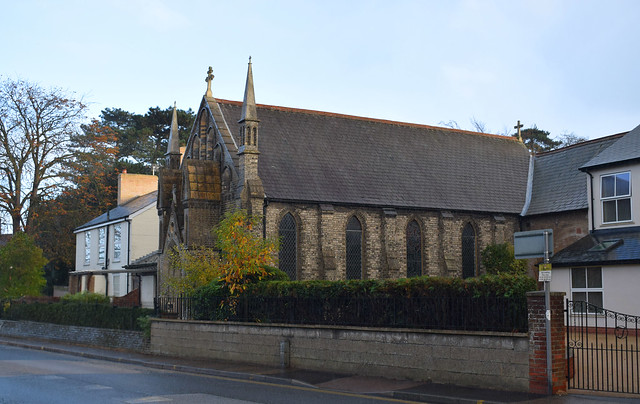
Suffolk. It was eighty feet long, in the Early English
style, and built across the church of St Anthony so that
the old church formed the transepts of the new.
The sanctuary was built to the south, with the other end
of the church forming the main entrance, a liturgically
west front onto Woodbridge Road. Because the new church
was so close to the road, the windows had to be protected
with iron railings, so that the congregation could not be
stoned during Mass. Remarkably, the railings survive to
this day. The new church was consecrated on 10th October
1838, and dedicated to Our Lady of Grace. This was the
dedication of the pre-Reformation shrine of Our Lady of
Ipswich, destroyed by the state authorities in 1538,
exactly 300 years before. Our Lady of Grace marked the
return of the Church to Suffolk in all its glory, and it
is a pity that the dedication was reduced in common usage
to simply St Mary.
And then, Pere Simon died. His friend Margaret Wood
followed, shortly after. But they had done enough to
re-establish the Faith in Ipswich. The story of the
Catholic revival in England is a well-known one; suffice
to say, Ipswich shared in its ups and downs. From 60,000
Catholics in England at the time of the 1778 act, there
were more than a million by 1850. Ipswich experienced a
similar growth in its Catholic population; after the
death of Pere Simon, it was served by priests from Bury
and Withermarsh Green for a few years. And then in 1850,
the restoration of the Catholic hierarchy placed the town
in the Diocese of Northampton. The new Bishop appointed a
permanent Parish Priest, Father Kemp, in 1854. He
established a second Mass centre in the Parish in 1860,
right in the centre of town. This was St Pancras, and it
was built right in the most populous part of St Mary's
Parish, the Rope Walk/Cox Lane slum area. In a much more
confident red-brick Gothic style than its mother church,
it is in fact only part of what was planned by its
exuberant architect, George Goldie, to be the Cathedral
of a future Diocese of East Anglia.
1860 was also the year that the Religious of Jesus and
Mary arrived in England, from their base in Lyons. A
teaching order, they lived in the house that Pere Simon
had built, and set up two schools on Pere Simon's five
acres of land, probably as part of the same architectural
commission as St Pancras, since Goldie was the architect.
The Sisters would survive and prosper, and they still
live in the house to this day, although the last School
of Jesus and Mary was demolished in 2002. A modern parish
primary school sits beside the site
But we are more than a century ahead of ourselves, and St
Pancras would never be completed, never become the
cathedral. Indeed, the new self-confidence of Ipswich
Catholics would prove to be a little misplaced. The other
Ipswich churches had maintained an amount of
anti-Catholic feeling, continuing to preach the 'No
Popery' sermons that had dissuaded civic dignitaries from
attending the opening of Our Lady of Grace in 1838. The
firebrand Protestant ministers whipped up a storm which,
one night in November 1862, turned into an anti-Catholic
riot.
Crowds rampaged through the streets of Ipswich, attacking
known Catholic businesses and homes. Their main targets
were the two churches, and also the convent, which they
besieged, attacking it with rocks and iron railings.
Every window in the building was smashed. The Blessed
Sacrament had been brought from Our Lady into the
relative safety of the Convent chapel, and the community
kept vigil through a night of violence and destruction.
As is so often the case, the attack was the catalyst for
increased warmth and toleration. The local press
denounced the actions of the mob as a disgrace, and local
dignitaries visited the community with messages of
sympathy and support. Father Kemp became an increasingly
popular and well-known local figure. By the end of the
19th century, the Catholic presence in Ipswich had itself
become a part of the establishment.
In 1919, the Diocese of Northampton made St Mary and St
Pancras into separate parishes, the border between the
two being just to the west of the railway bridge outside
St Mary. Ipswich had expanded eastwards, engulfing the
medieval parishes of Rushmere and Kesgrave, and in 1931
St Mary acquired a new Mass station with the construction
of the church of the Holy Family and St Michael at
Kesgrave.
In the 1930s, the Parish acquired the 18th century house
to the east of the church. This became the Presbytery.
The Jesus and Mary schools continued to prosper, and the
centenary of the arrival of the Order was celebrated in
1960 with the building of a new school chapel.
The old church was no
longer really large enough to accommodate the needs of
parishioners and school communities in this densely
populated part of the town. It is unfortunate, with
hindsight, that the schoolchapel was built on the eve of
the Second Vatican Council's liturgical reforms. Five
years later, its design would probably have been quite
different. It is a beautiful building, and was just what
the Catholic community of Ipswich needed at the time.
However, by the time the reforms came to fruition, Pere
Simon's five acres of land contained, not one, but two
substantial pre-conciliar churches.
In 1976, the Diocese of East Anglia was formed. One of
the last actions of the Northampton See was to designate
the school chapel as the new Parish Church of St Mary.
There are several reasons why this happened. It was the
larger building, and more suited to liturgical needs;
maintenance would be cheaper, and the Sisters were now
withdrawing from the management of the school. But people
have an emotional stake in the buildings in which they
have seen their families baptised, married and buried, so
it would be strange if the decision was not
controversial, or even a little acrimonious. The Polish
community had recently installed, at great expense, a
beautiful stained glass window in the old church, and
there was simply nowhere for it to go in the new church.
Well, the new church has become well-loved; there is, in
any case, no way that the old church could have
accommodated the current average Sunday Mass attendance
of almost a thousand people, spread across several
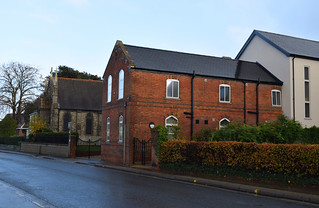
masses. And so, the old church was converted into a
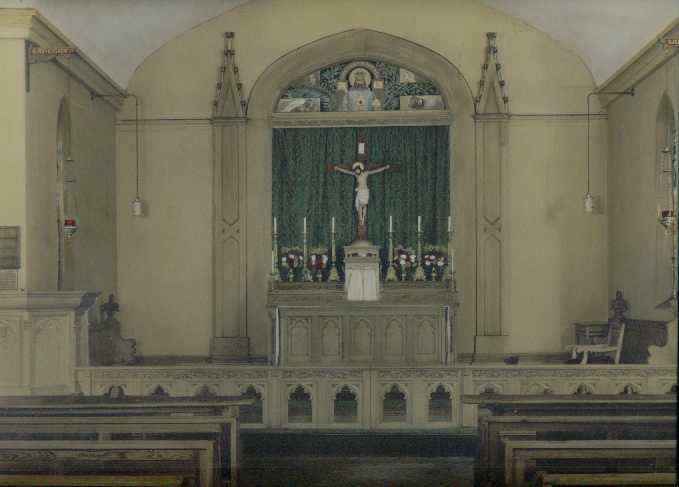
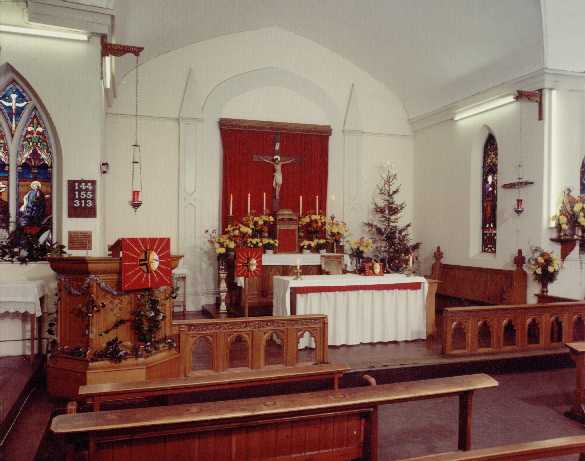
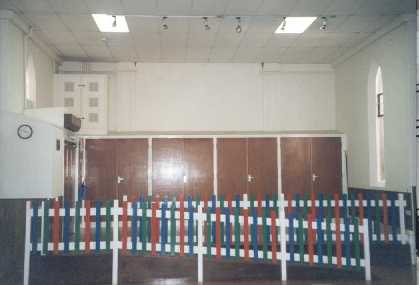
parish hall. The three photographs below show the
liturgical east end of St Mary's as it was when
photographed in the 1930s, the 1970s and the 1990s.
 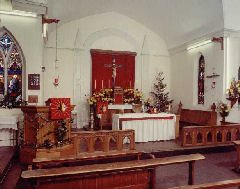 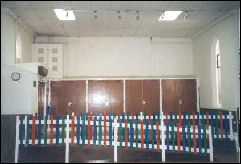
The fixtures and
fittings were removed; the high crucifix was brought into
the new church. The old communion rails, no longer
required under the revised liturgical arrangements, were
incorporated into the front row of seats in the new
church. The stained glass windows went their separate
ways; Mary of the Annunciation went into the Presbytery,
an Old Testament Prophet into the modern Primary school,
and most of the rest into the library of Goldie's School
of Jesus and Mary. When this closed in 1996, they were
transferred to St Joseph's College in South Ipswich. The
only remaining glass in the building is the Polish
Community's window to Our Lady of Czestachowa, still in
the middle of the west side. Several of the pews from the
old church have also been retained in the building in its
new use.
The east transept of Our Lady of Grace was converted into
a meeting room, the 'Pere Simon Lounge'. This had been
the sanctuary of the original St Anthony, and still
retains the fixings for the altar canopy from its days as
the Blessed Sacrament chapel of Our Lady. The space to
the north of it, the former graveyard, was filled in with
toilets, a kitchen, and another meeting room, the Deanery
Lounge. A stage was fitted where the main sanctuary had
been, and cupboards built at each end. In 1998, when a
pre-school playgroup began to use the building, this was
fitted with colourful safety rails, and an access deck
for wheelchairs and pushchairs.
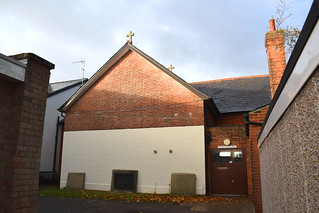
The former main entrance became a fire exit, a new
entrance being constructed to the south, so that entry to
and from the hall is within the campus. This is all well
done, although a less attractive and successful part of
the conversion is the low tiled roof, fitted to conserve
heat and accommodate strip-lighting. Enough remains to
show that this was once a church, including the
wall-mounted memorials to Pere Simon and Mrs Margaret
Wood. It is humbling to stand beneath them, and remember
these two people who, almost on their own, restored the
Catholic Faith to Ipswich after more than two centuries
of exile.
Simon
Knott, 1999, updated November 2016
|
|
|