| |
 |
|
On January 8th, 1297, a
royal wedding took place in Ipswich. Princess
Elizabeth, daughter of King Edward I, married the
Count of Holland. Fitch, in his annals, records
that Edward I stayed in the town for the ceremony
with 'a splendid court', and that the three
minstrels were paid 50s each for their
services.The wedding took place, not in any of
the parish churches of the town, but in one of
England's major shrines of Marian pilgrimage; a
shrine to which we may presume Edward I had a
special devotion. This was the Shrine of Our Lady
of Grace, also referred to in contemporary
records as Our Lady of Ipswich.
This wedding is just the earliest record we have
of a royal occasion at the shrine. Thereafter, a
succession of visitors come here on pilgrimage,
culminating in the early 16th century, when the
pilgrimage cult was at its height. Between 1517
and 1522, both Henry VIII and Catherine of Aragon
made journeys to the shrine, set beside the
Westgate in the parish of St Matthew. Other
visitors included the local dignitary Cardinal
Wolsey, and the future saint Thomas More.
It is hard for us to understand today the part
that Mary played in the medieval economy of
grace. Contrary to popular belief, there is
considerable (and growing) evidence that the
people of rural medieval England had an
articulate and sophisticated understanding of the
nature and purposes of intercessionary prayer.
Although there may have been abuses, when people,
in some sense, offered 'worship' to images of the
Madonna, this was not a general practice, or even
a common one. Mary was seen as a focus of prayer;
contemporary images of medieval people frequently
show them carrying their rosary beads. |
To have some
understanding of the role of Our Lady in the hearts and
minds of medieval Suffolkers, we need to look at the
church in southern Europe today. The spectacular
processions, the colourful images, the celebrations and
devotions would all have been a part of medieval Suffolk
life. Fundamentally, the people of medieval Suffolk, in
all their daily trials and tribulations, in the midst of
their suffering and expectation of an early death, saw
Mary as being on their side.
A surprising amount of evidence of the medieval affection
for Mary survives in Suffolk, considering how this cult
outraged the reformers of the 1540s, and was attacked by
Puritans and Anglicans throughout the 17th and 18th
centuries. A brief survey of churches with entries on
this site will find the rosary dedication at the base of
the tower at Helmingham, the Hail Mary monograms on each
side of the tower at Stonham Parva, the so-called Doom
painting at Cowlinge, where Mary tips the scales in
favour of sinners, and many more. About half of the
medieval churches in Suffolk are dedicated to St Mary.
Although Nicholas Orme's seminal survey English
Church Dedications has shown us that many current
Anglican dedications are well-meaning 18th century
inventions, will evidence proves that many of the Suffolk
dedications to Mary are correct; except that the
dedication would usually be to a Marian solemnity or
devotion, most commonly the Assumption. This dedication
has been restored correctly by the Anglo-catholics at
Ufford. Of the churches not dedicated to Mary, all would
have contained a Marian shrine.
These shrines were most commonly at the east end of the
south aisle, and were often restored by the Victorians as
a 'lady chapel'. Some of these shrines became famous as a
result of reports of their efficacy. Some became so
popular that they were translated to buildings of their
own. This is probably how the shrine of Our Lady of Grace
came to be, although its actual origins are lost in the
mists of time.
There were four churches within a stones throw of the
shrine, of which two, St Mary Elms and St Matthew,
survive today. Edward I's visit to Ipswich came two
hundred years after the founding of the greatest English
Marian shrine at Walsingham, about sixty miles from
Ipswich. We may assume that the fame of Ipswich grew in a
similar way to that of Walsingham.There were other major
shrines in Eastern England at Kings Lynn, Ely and
Lincoln; in Suffolk, we know that pilgrimages were made
to Bury, Woolpit and Sudbury, amongst others.
The fame and influence of the Ipswich shrine reached its
peak in the early years of the 16th Century, after an
incident known as the Miracle of the Maid of Ipswich.
This occured in 1516 and was held in renown all over
England in the few short years left before the
Reformation intervened. The popularity of the Miracle, in
which Joan, a young Ipswich girl, has a near-death
encounter and experiences visions of the Virgin Mary, was
widely used by the Catholic Church as a buttress against
the murmurings of reformers.
The late Dr John Blatchly, in his book The Miracles
of Lady Lane showed convincingly that the font in
nearby St Matthew's church was paid for by the Rector
John Bailey to celebrate the Miracle of the Maid of
Ipswich, and the visit to Ipswich of Henry VIII and
Katherine of Aragon soon afterwards. The panels of the
font depict events in the devotional story of Mary,
mother of Jesus. These five reliefs, and a sixth of the
Baptism of Christ, are amazing art objects. They show the
Annunciation to the Blessed Virgin with Gabriel unfurling
a banner from which a dove emerges to whisper in Mary's
ear; The Adoration of the Magi, with the wise men pulling
a blanket away from the Blessed Virgin and child as if to
symbolise their revelation to the world; the Assumption
of the Blessed Virgin, with Mary radiating glory in a
mandala, which four angels use to convey her up to heaven
in bodily form; the Coronation of the Queen of Heaven,
the crowned figures of God the Father and God the Son
placing a crown on the Blessed Virgin's head while the
Dove of the Holy Spirit races down directly above her;
and the Mother of God Enthroned, the crowned figure of
the Blessed Virgin sitting on the left of and looking at
(and thus paying homage to) her crowned son on the right,
who is holding an orb.
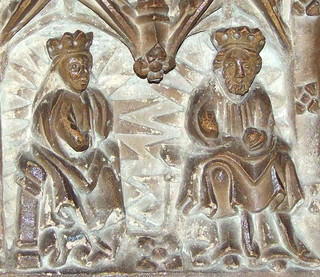 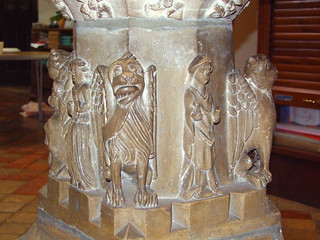
Dr Blatchly thought
that the panel of the Mother of God Enthroned was a
representation of Katherine of Aragon and her husband
Henry VIII, which I think a little unlikely, although of
course it could be both, one representing the other.
Remarkably, two of the four figures around the base are
probably intended as Joan, the Maid of Ipswich, and John
Bailey the Rector himself.
In The Miracles of Lady Lane, which Dr Blatchly
co-authored with the historian Diarmaid MacCulloch, there
is a fascinating if somewhat convoluted account of the
battles between Bailey and Cardinal Wolsey, who was
trying to consolidate his power in Ipswich by taking over
the Shrine of Our Lady of Ipswich, which was in the
parish of St Matthew. It is the kind of thing Trollope
would have written about if he had been around in the
16th Century. Bailey's celebration of the Miracle was
partly a way of competing with Wolsey for fame and
influence, but Bailey's death in 1525 left the way open
for the Cardinal, who in his turn would completely
over-reach himself and fall in his own way.
The book is memorable as a picture of the incredible
religious fervour in Ipswich in the early years of the
16th Century, enthusiasms that would spill over into
passion and violence. Blatchly notes that the sequence of
at least some of the Marian images on the font was
replicated by a sequence of inns down the mile of
Ipswich's main street, now Carr Street, Tavern Street and
Westgate Street, which led to the shrine. One of the
inns, the Salutation (ie, Annunciation) at the start of
Carr Street, survives in business under the same name to
this day. But in time of course Ipswich would become
well-known as the most puritan of towns in the most
puritan of England's regions.
The focus of any Marian shrine would be the statue of
Mary, most often with the infant Christ on her knee. When
the reformers of the 16th century set out to break the
hold of the Church on the imagination of the people,
statues of Mary and the saints were the first things to
go. Poor William Dowsing, who inspected Suffolk churches
for 'superstitious imagery' 100 years later in 1644, is
often blamed for the destruction of these statues; but
his meticulous journals do not suggest that a single one
of them had survived to his time.
The shrines were suppressed in the spring of 1538, and
Sir Charles Wriothesley, in his Chronicle, writes that
in the moneth of July, the images of Our Lady of
Wallsingham and Ipswich were brought up to London with
all the jewelles that hang about them, at the Kinge's
commandment, and divers other images... because the
people should use noe more idolatrye unto them, and they
were burnt at Chelsey by my Lord Privy Seal. Wodderspoon,
in his memorials, records that (Thomas) Cromwell...
caused this image of Our Lady to be pulled down from her
niche, and after despoiling the effigy of its rich
habilements and jewels... it was conveyed to London and
destroyed. John Weever, writing a century after the
event, reports that all the notable images, as the
images of Our Lady of Walsingham, Ipswich, Worcester, the
Lady of Wilsdon, the rood of grace of Our Lady of Boxley,
and the image of the rood of St Saviour at Bermondsey,
were brought up to London and burnt at Chelsey, at the
commandment of the aforesaid Cromwell.
This is a particularly folkloric account, since we know
that several of the images mentioned were not burnt at
Chelsea, but were destroyed elsewhere. There is no
evidence that any of the surviving reports are by
eye-witnesses, and although there are many other reports
of the burning, all are circumstantial, and most seem to
be based on Wriothesley's Chronicle. Stanley Smith, in
his majestic The Madonna of Ipswich, concludes
that the conflagration took place at Thomas Cromwell's
house at Chelsea on 26th September 1538, under the orders
of Bishop Latimer, and before the eyes of the Lord Privy
Seal. The Ipswich statue certainly made it to Chelsea.
Thomas Cromwell's steward wrote to him that he had
received it, with 'nothing about her but two half shoes
of silver'. This report will be crucial, as our story
develops.
In general, where a Marian shrine was not in a parish
church, the building that had housed it did not survive
for much longer. During the 17th and 18th centuries,
several legal documents, especially those dealing with
the transfer of ownership of land, make reference to the
remains of the Shrine of Our Lady of Grace. John Waple
bought land 'at the south end of the La. chapel wall' in
1566. In 1650, Edward Bartle was granted 'land on which
once stood a chapel, called the Lady of Grace chapel,
land whereon a stable is now built'. In 1761, a Mr Grove
visiting from Richmond reports that 'there is scarce one
stone left upon another'. Of course, the terrible irony
of this is that we can use these land documents to
pinpoint exactly where the shrine of Our Lady of Grace
was. Another advantage to locating the shrine is that the
general layout of streets in the centre of Ipswich has
changed little since Saxon times, despite the best
efforts of Sixties town planners.
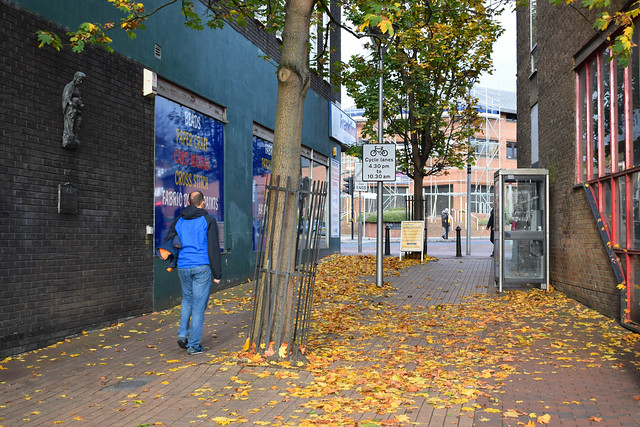
The shrine, then, was just outside the west gate of the
town wall. This was demolished in 1782, but photographs
exist of a rather fanciful reconstruction put up for the
Jubilee celebrations of 1887. The gate stood in Westgate
Street, just beyond where a footpath now cuts through to
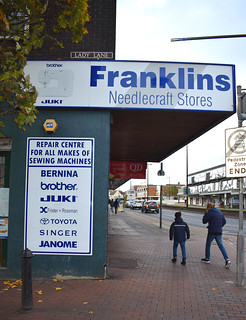
the Wolsey Theatre. The shrine stood on the next corner,
where a Sixties block once housed a Tesco supermarket,
but now contains a number of dismal discount stores. The
narrow road to the left here is called Lady Lane, and was
certainly called that in 1761, although I cannot discover
if this name was contemporary with the shrine.
We can also form some idea of what the shrine looked
like. Stanley Smith records surviving wills which
bequeathed items, including, in 1498, a porch and glass
for the east and west windows. There was almost certainly
a burial ground; this is referred to in a land transfer
document and a will, and human remains were found on the
site in the early 20th century. When Tesco was built in
1964, chunks of church masonry were discovered on the
site; however, we should remember that, after the
Reformation, rubble from many demolished religious
buildings (of which Ipswich had plenty) were used in the
construction of other buildings.
What appears to be a pilgrim's token was also found near
the site; but, as Stanley Smith points out, pilgrim's
tokens from many shrines have been found around
Walsingham, and there is no reason to believe that this
particular medal originally came from Ipswich.
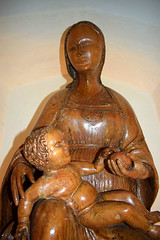
In Lady Lane itself, a small statue was put up in the
early 1990s as a memorial to the shrine; it replaced a
1960s plaque.
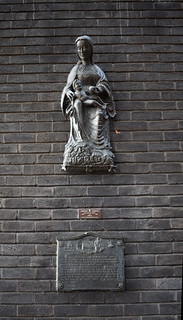 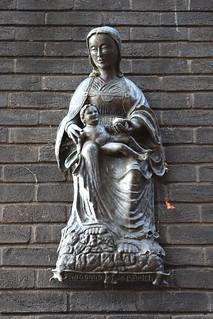 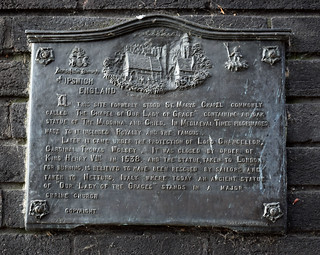
This statue repays
close inspection, because the story gets slightly more
exciting at this point. Despite the conflagration at
Chelsea in 1538, there is some evidence that the statue
of Our Lady of Grace survived, and still exists today;
and that this memorial statue is a true copy of it. In
the Italian city of Nettuno, most famous perhaps for its
harbour of Anzio, there is a shrine to Our Lady of Grace.
There is a story that the image there was brought to
Nettuno from England during the Jubilee year of 1550.
There is some evidence in the town archives to support
this. And the town archives also mention Ipswich.
It wouldn't be that improbable. Western mainland Europe
is full of statues and sculptures produced in England
during the 12th and 13th centuries. Many of them must
have been exported at the time; Nottingham alabaster
work, for instance, was greatly prized throughout Europe.
But much probably went abroad at the time of the
Reformation. It must be remembered that the Reformation
in England placed quite a low priority on the new
teachings of Luther and Calvin; they were the job of the
theologians. But the state, which enforced the
Reformation in England, was more concerned with wresting
political power from the church, and enriching itself on
the wealth of the churches, shrines and monasteries. It
achieved both of these goals extremely successfully; the
first is shown by the fact that there was no religious
war in this country, and the second by the fact that the
Tudor royal family amassed riches beyond its wildest
dreams, much of it to be squandered by Elizabeth I and
James I on high living and piratical expeditions to the
'New World'.
There was no evangelical agenda on behalf of the English
state as there would be 100 years later under Oliver
Cromwell. It is hard to imagine William Dowsing selling
images abroad, but there is a great amount of
circumstantial evidence that the cronies of Thomas
Cromwell and Thomas Cranmer in the 1530s and 1540s did
exactly this. It was a pragmatic approach; they wanted
rid of images, and they wanted to accrue the wealth of
the church. That said, the Nettuno legend records that
the statue was rescued from the flames by secretly
Catholic sailors, who spirited it safely abroad. I think
the sales story outlined above is more likely, though.
The Nettuno image was identified as English as early as
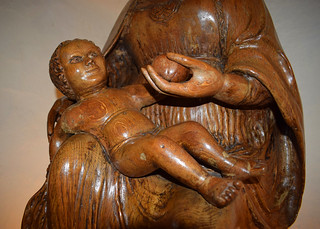
1938 by an historian of 13th century iconography, Martin
Gillett. He felt that considerable changes had been made
to it; Mary's head had been replaced, and the posture of
the infant Christ changed. The throne (no longer in
existence) was a 19th century replacement. But the folds
in the material, the features of the Christ child, the
position of the infant on the right knee rather than the
left, and the carving style, all strongly suggest an
English origin. And then war intervened. Anzio and
Nettuno were the site of some of the fiercest fighting
during the Allied landings in Italy, and the statue was
seriously damaged. During its restoration in 1959, an
antiquated English inscription was found below the
Madonna's right foot: IU? ARET GRATIOSUS (thou art
gracious).
This supports, as Stanley
Smith says, the local dedication of Madonna della
Grazie. The inscription had been overwritten
SANCTA MARIA, ORA PRO NOBIS, probably in the late
16th century.
Interestingly, no other major English Marian
shrine was dedicated to Our Lady of Grace. Even
more striking, when Martin Gillett first examined
the statue in 1938, it was wearing two half shoes
made of English silver, just like those described
by Thomas Cromwell's steward 400 years before.
Obviously, there is a great yearning for it to be
true. I think, on balance, that the statue at
Nettuno probably is the statue of Our
Lady of Ipswich. Other people seem certain of the
fact; hence the replica in Lady Lane.
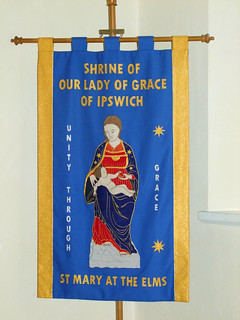
The Guild of Our Lady of Ipswich is an ecumenical
group formed in the 1980s by people from the
Catholic church of St Pancras and the Anglican
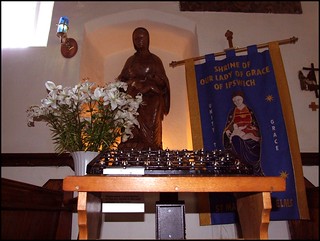
church of St Mary Elms. They have re-established
Marian shrines in both these churches, and meet
monthly. They have also re-established the
procession which Cardinal Wolsey instituted from
St Peter (by his college) to the site of the
shrine. They make this walk every year on the
date of its predecessor, 7th September. Even more
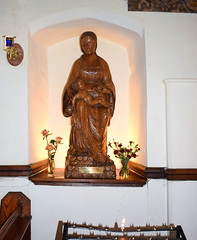
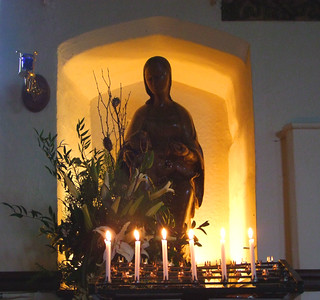
excitingly, they have also placed a replica of
the Nettuno statue in the church at St Mary Elms.
It was dedicated with great ecumenical ceremony
under the watchful eye of the Guild in September
2002. |
|
 |
Simon
Knott, 1999, updated November 2016
|
|
|