| |
|
 |
|
I’m not a great reader
of newspapers, but if ever I buy one of
those big weekend ones, they always seem
to contain a horror story about someone
who moves from the noise and dirt of
London or Birmingham to a rural idyll,
only to find themselves shunned as an
outsider by the natives. Not only does
the village post office not sell
carpaccio, they get stonewalled in the
village pub. It’s not a price worth
paying for decent schools. Within six
months, they’re packing the Range
Rover and hightailing it back to the big
city, relieved to return to civilisation. Some English
counties do not accept incomers easily. I
think Suffolk does, partly because the
people are so easy-going. Mind you, this
may change as more and more villages,
especially on the coast, fall victim to
second-home owners. New arrivals add to
the economy and cultural life of a
village, but nobody wants to live beside
an empty cottage for ten months of the
year. I am not from Suffolk originally,
but certainly feel as if I belong here.
It was one of the proudest moments of my
life when the local radio station
described me as an ambassador for the
county. But when I’m out on the
western border, I get a yearning that
reaches me nowhere else; the call for
home. I am Cambridgeshire-born and bred;
for generations, my family were fen men
and women, outlaws and vagabonds before
the great draining, survivors and
schemers after it. Culturally and
politically, the Fens have always been a
place apart, the South Armagh of England.
|
The strange landscape of my
ancestors haunts me now. I grew up in the bustle
of the city of Cambridge, but my thoughts still
turn north of it to the flat land. And south-east
of the Fens, the graveyards of the
Cambridgeshire/Suffolk border are full of my
mother’s maiden name.
Kentford is about as close
to Cambridgeshire as you can get; to the north of
the churchyard, the busy A14 marks the border.
Kennett station, 300 metres away, is in
Cambridgeshire. Often along this border,
adjoining parish centres merge, as if ignoring
the vagaries of Saxon bureaucrats; in their
names, Kentford and Kennett reveal themselves as
two parts of the same whole.
As with all the Newmarket
hinterland, Kentford looks to Cambridge more than
it does to Ipswich and Norwich. For two
centuries, Cambridge was the poor cousin of the
three, but the high-tech developments of the last
twenty years have completely reversed this, and
houses around here cost twice as much as they do
in east Suffolk or south Norfolk. More than that,
this area is wooded, and hilly; a landscape that
seems to stop at the border. Basically, Suffolk
is prettier than Cambridgeshire.
At one time, Kentford high
street was the main road from Cambridge to
Ipswich, Norwich and the seaside. If you grew up
in the sixties and seventies like I did, and
lived so far from the sea, you’ll know that
you didn’t get to see it very often. I
remember summer mornings, still cold from the
hour, the excited coach escaping the sleepy city,
the whole pleasure of the day ahead contained in
it. I remember Kentford as the first hill we
reached, as if entering a foreign country.
You’d know for certain now what a wonderful
day it was going to be. Perhaps because of this,
the sun is shining whenever I visit Kentford, as
if a powerful memory lingers on, like a charge or
a charm. Perhaps the sun always shines in
Kentford.
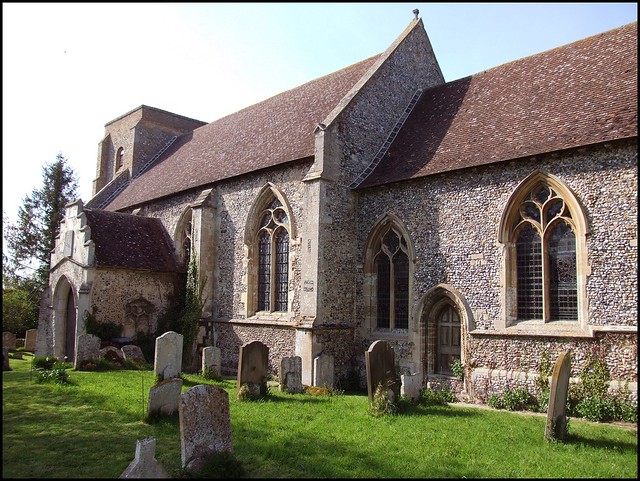
Today, the village is
completely bypassed, but St Mary still sits at
the top of the hill in the little graveyard.
There is a pub a bit further east, and a shop
along the road to Moulton. With the
station and A14 nearby, it’s no surprise
that this is increasingly a commuter village, but
it still seems to have a considerable life of its
own. I’m very fond of it; today, Kentford is
often still the start of a journey for me, if I
take my bike on the train to Kennett, and spend
the long day cycling through the lanes back to
the coast. There is still an excitement.
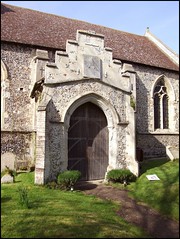
St Mary is not a big
church, and its tight hilltop graveyard means
that you could easily miss it if you were driving
through. Best not to drive; medieval Suffolk was
not designed for cars. Just inside the church
gate, there is a fine early 18th century grave,
and in general a genealogist would spend a happy
hour here. The building is largely 14th century;
its rather ideosyncratic appearance is a result
of a considerable 18th century renovation. It has
been left a largely lovely building, attractive
in an otherwise fairly workmanlike village.
The church is ordinarily
kept locked, and the key is at the Cock public
house. So, this is a church to visit in pub
opening hours. And, since parking is near
impossible on the village street, you can park at
the pub, refresh yourself with a pint, and then
wander over to the church. You let yourself into
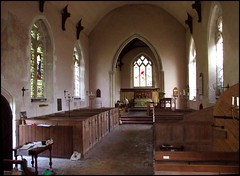
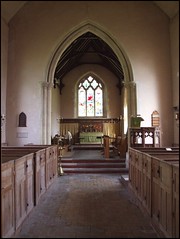
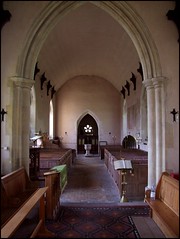
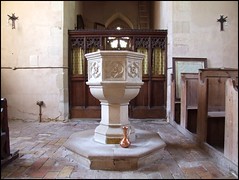
a delightfully atmospheric space, a brick floor
with simple, rural furnishings, a seemly High
Church chancel and a silence brewed God knows
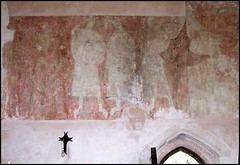
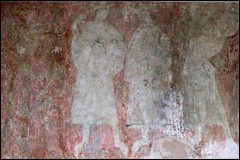
how long. Directly opposite is the great
treasure of the church, one of the few surviving
medieval wall-paintings in East Anglia of the
Three Living and the Three Dead. Three hunting
courtiers encounter a trio of skeletons in the
woods; As I am so you shall be, observes
the first. Rich and poor come to the same end,
points out the second. Just in case there is any
doubt, no one escapes, declaims the
third. This church used to have other wall
paintings, but all have now been plastered over,
awaiting a kinder, gentler age when money is
available for the restoration of such things.
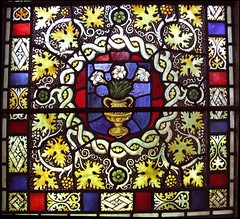
Another
interesting feature of the church is the good
range of early 20th Century glass, all of it
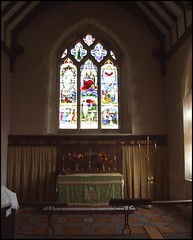
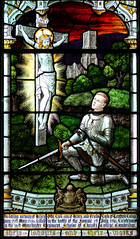
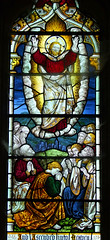
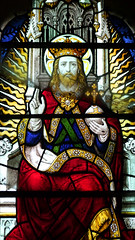
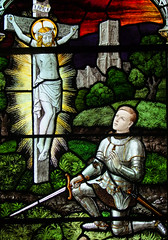
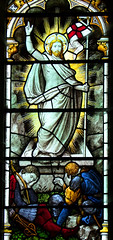
unsigned, unfortunately. The most striking is the
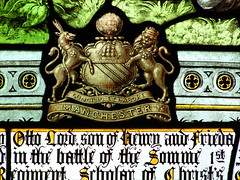
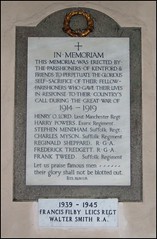
east window of about 1920, a memorial to Henry
Otto Lord. Henry Lord was a lieutenant in the
26th Manchester Regiment amd, as the window
points out, a Scholar of Christ's College,
Cambridge. Born on the 29th May 1896, he was the
eldest son of Henry and Frieda Lord of Kentford
Lodge, and was killed on the opening day of the
Battle of the Somme 1st Juy 1916, a few weeks
after his 20th birthday. The boy is depicted in
shining armour kneeling before the cross, while
other panels of the window depict the
Resurrection, the Ascension, and Christ in
Majesty. It is extraordinary to think that it was
produced less than a century ago.
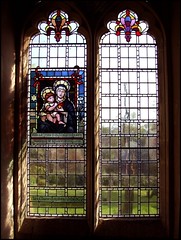
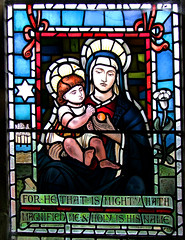
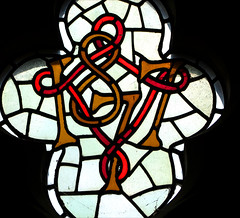
Perhaps
the best of the glass is in the chancel north and
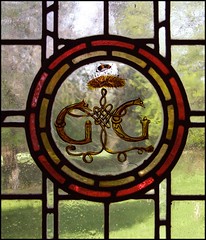
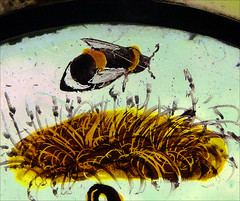
south windows. A stunning roundel of a bee
collecting pollen surmounts the monogram GG. Who
was that, I wonder? A delightful panel opposite
depicts an icon of the Blessed Virgin and child,
with a verse from the Magnificat. It is all
utterly enchanting, and perhaps makes what I am
about to tell you next all the more concerning.
Shortly
after the first entry for this church appeared in
2002, I received an e-mail from the parish clerk.
I had been unable to get inside, and bemoaned
this fact. She told me, rather unnervingly, that Kentford
church had almost been lost to us. It had sunk
about as low as it is possible to go without
actually disappearing from sight; the last PCC
had given up eight years previously, and the
congregation had fallen to zero. The church was
closed for a year, pending the possibility of
redundancy. However, an energetic new Rector had
arrived in the Benefice, and rapidly increased
congregation numbers in each of his five
parishes.
So, the garden of faith was
flowering again at Kentford, but the chance of
redundancy still existed. The people in the
parish were working hard to make survival a
proposition. By 2002 they were up to two services
a month, which I see they are still maintaining
in 2013, and the congregation was up to about
twenty people. The locals were busy organising
fund-raising events, tracking down the old parish
bank accounts, and generally giving this pretty
little church a fighting chance.
| It is easy to say that the
Church is the people, not the building,
but St Mary is a good example that a
church building is the engine house of a
gathered faith - it would be wonderful to
see Kentford church move towards a
position where it was open during the
day, and people could be encouraged to
stop a while, for rest and reflection.
Churches where this happens find it can
be a way to grow their congregations;
after all, some people may come back on
Sunday. And, according to ChurchWatch, a
locked church is twice as likely to be
broken into as an unlocked one, twice as
likely to be vandalised, and even
slightly more likely to have something
stolen from it. But there’s
more to it than that, of course. A locked
church is a dead church, both spiritually
and culturally. People who no longer have
the touchstone of an open church have
their faith privatised, however strong it
is. Those without faith have no access to
it. At Kentford, there is a chance for a
Church to pull back from the brink, and
for a building to play its part in being
the body of Christ to the people of God.
|
|
 |
|
|
|