St Edmund, Kessingland

www.suffolkchurches.co.uk - a journey through the churches of Suffolk
|
St Edmund, Kessingland |
|
|
||
www.suffolkchurches.co.uk - a journey through the churches of Suffolk |
||


Follow these journeys as they happen at Last Of England Twitter.
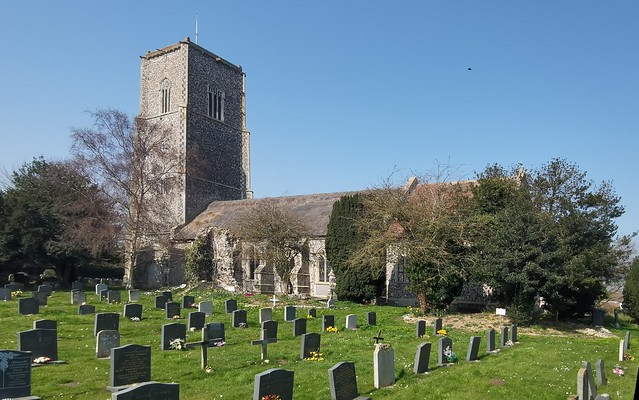
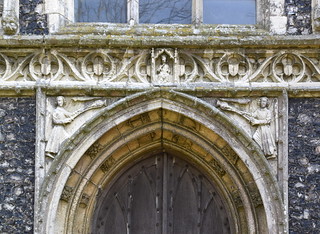
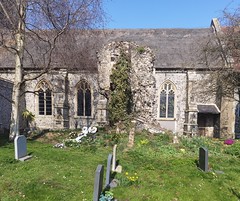
All along the East Anglian coast you find them, these medieval churches with their tall towers, and Kessingland has one of the tallest. Perhaps they served as beacons and marking points to ships at sea. Kessingland's tower has much in common with the one to the south at Walberswick. James Bettley, revising the Buildings of England volume for East Suffolk, suggests that the master mason was the same person, Richard Russell, and that it was probably begun in the spring of 1436 or 1437. Within twelve years it was broadly complete, an extraordinarily short time for such a vast structure, although there was obviously still work to be done. Peter Northeast and Simon Cotton transcribed a large number of wills and bequests towards Kessingland church, including several in the 1450s to the emendation of the bells and to the reparation of the bells and the like. These continued into the 1470s and 1480s, when Agnes Bramfeld, for instance, left 20s to the emendation of the bells, and as late as 1512 Margaret Childerhous left half a noble to the reparation and making of the bells, so as Simon Cotton points out it seems likely that over this period of half a century the ring of bells was being improved and added to. However, there were also a number of bequests during this period to the tower itself. This may explain the remarkably rich west doorway, its two angels censing the enthroned Blessed Virgin, with two large image niches above. The rebuilding of the nave and south aisle seems to have proceeded along with the tower, and by 1467 Margery Whyte was leaving money to paint one panel of the candlebeam (which is to say the rood screen) and then in 1474 Thomas Bery left 6 marks to a glass window to be newly made and put in the chapel of St John, so we can assume that by then this great building was pretty well complete. All in all, the church benefited from a large amount of late medieval money. Despite the replacement of its parapet with a brick top, probably in the 17th Century, the tower seems particularly impressive given that it stands against what is a fairly homely thatched church. This is because the church we see today is what little remains of the lavish display of those days. Time has not been kind to either Kessingland village or its church. The sea has come calling, as it has on so many villages around here, taking houses and lives. And it was the people themselves who took down the south aisle and chancel, finding them expensive to maintain, and in any case unnecessary for the new congregational liturgy of the Church of England. A large buttress from the west end of the aisle stands forlornly in the churchyard, and the date of 1578 on the current south porch probably tells us when this demolition occured. Something similar happened at nearby Covehithe and Walberswick. By the 1690s the church was in such a poor state of repair that it had to be largely rebuilt, and the north side dates mostly from this time. The south side was, as Pevsner puts it, restored to a more medieval appearance in the 1860s, and in 1908 Walter Caroe rebuilt the chancel. And yet, this continuing process of adapting and rebuilding gives the church a character all of its own. Unusually for Suffolk
you enter the church from the west, through that splendid
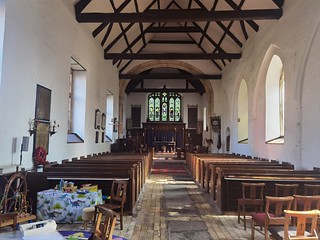
doorway and under the tower. The interior that unfolds
before you is equally as homely as its exterior, a long
and inevitably fairly narrow space with brick floors that
focuses on and leads towards Caroe's high, flattened east
window, very much in the fashion of its time. The south
arcade was filled in, and those windows in the Decorated
style added in the 1860s (the work of Richard Phipson
perhaps?), but several late 17th Century square, domestic
windows survive on the north side. The reason is
explained by a wall inscription: This Church was put
Out and Rebuilt by the care of John Campe and Thomas
Godfrey Gent. in the Year 1694, and Finished in 95. Campe
and Godfrey were the churchwardens responsible for
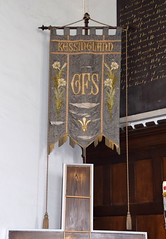
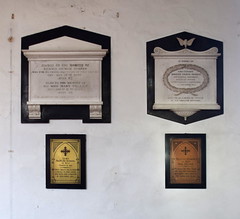
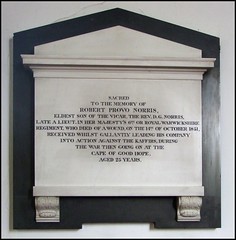
overseeing the rebuilding of the church. A curiosity on the north wall of the nave is that there are two separate memorials to Robert Provo Norris. He was killed in the first South African wars of the 1850s at Waterloof, Kaffraria, today a suburb of Pretoria. One of the memorials was erected as a mark of esteem by his brother officers. The other was set here by his family, and notes that he died of a wound... received whilst gallantly leading his company into action against the Kaffirs, during the war then going on at the Cape of Good Hope. The late Peter Stephens, with whom I visited this church on one occasion, had spent some of his school days in South Africa, and noted quite how offensive the term Kaffir would have been considered there even in the 19th Century. Below them are two simple brass memorials to women of the Herring family, an appropriate local name. Benjamin Britten's opera Albert Herring got its name from a Suffolk grocer's shop that Britten passed regularly between Aldeburgh and Ipswich. One of the plaques remembers Millicent Herring, at rest Xmas Eve 1907. I don't usually mention banners in churches, but some notable ones survive here, including two for the Girls Friendly Society. This was a movement begun in 1875 by Mrs Mary Townsend, and it was designed to befriend and support unmarried girls coming out of the countryside to work in service in the towns. One of the banners here has the letters TMF, short for Townsend Members Fellowship. The TMF was what the GFS girls moved on to when they were older. The Girls Friendly Society still exists as an organisation working with young women in some Anglican parishes, today known as as GFS Platform. What a lovely thing that they have survived. Simon Jenkins once said that Anglican parish churches were the greatest folk museum in the world, and to see these banners still in place certainly feels like a touchstone to the past of Kessingland parish, like so much here. To enter this building is to enter the story of an English coastal parish. Simon Knott, April 2022 Follow these journeys as they happen at Last Of England Twitter. |




|
||||||||||||||||||||||||||||||||||||||||||||||||||||||