| |
|
Follow these journeys as they happen at Last Of England
Twitter.
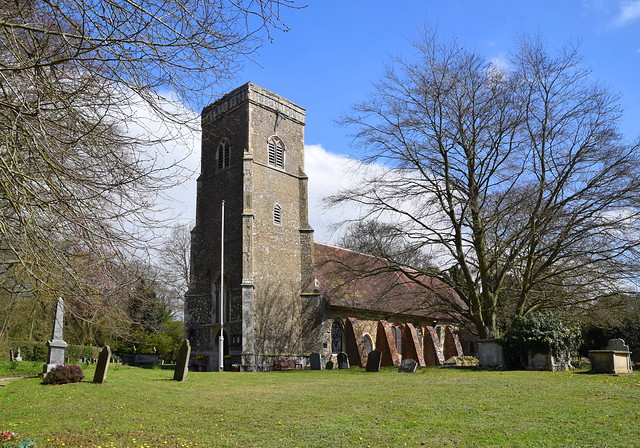
This always seems to me as remote a spot as
any I have found in Suffolk, and you would not think that
we are barely three miles from either Saxmundham or
Leiston. The church stands about a mile west of the
village of Coldfair Green, which is home to the great
majority of the parish's inhabitants, and the first time
I ever came here, in the 1990s, I had found it up a
sodden, muddy lane. Just beyond the church, the lane was
flooded, but the church was set slightly above the road,
in a characterful graveyard. Its only company was an old
farmhouse across the way. The situation is as remote
today, but when I returned next in July 2011 it was on
one of the hottest, driest days of the year, and the
magnificent copper beech and walnut trees to the south of
the church were in full leaf.
I came back on a day in April 2019 to find the churchyard
already verdant, the warmth of spring shimmering across
it, even if the great trees were still to come into leaf.
Sam Mortlock remembers the sound of a stream below rising
up through the woods, and in the 1930s Arthur Mee was
entranced by a nightingale in the churchyard. No
nightingales today, and I couldn't hear a stream after
the driest winter in years, but this was still a lovely
spot, and I again felt an immediate fondness for it.
There are several suggestions that this building is
basically Norman at heart, not least the blocked door to
the north. Early 19th century buttresses rather disrupt
the south wall, but the array of windows between them are
charming. There is a fine 15th century tower, with
headstops grinning into the west door. North and south
doors are both now blocked, and unusually for East Anglia
you enter through the west door into the area beneath the
tower.
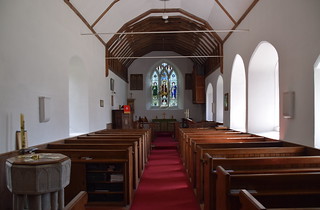
There is a striking sense of the very late 19th and early
20th Centuries here, that brief period during which the
Church of England in general, and the High Church
movement in particular, reached the zenith of its
influence and power before the slow falling away in the
decades after the First World War. Symptomatic of the
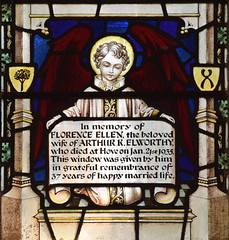
triumphalism of those times are two windows. The one in
the south side is of the risen Christ, which is signed by
the Arts and Crafts Movement firm W.B Simpson & Sons.
It dates from 1910, and I think it is their only work in
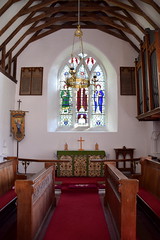
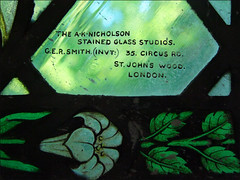
Suffolk. To the east is the 1930s glass by GER Smith for
the A.K. Nicholson Studios, showing Saint Lawrence and
the Blessed Virgin flanking Christ the King, thus
revealing something of the churchmanship of St Lawrence
at the time. It is interesting to see their rather grave
style of that decade, without the airiness which would
enter the workshop's work after the Second World War.
A beautiful Art Nouveau candelabra hangs from the chancel
roof, and the feeling of the period is further enhanced
by two memorials which are in copper rather than brass,
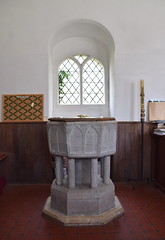
perhaps the work of a local artisan. The font is a fine
example of the type mass-produced from Purbeck marble
towards the end of the 13th century, of which several
survive in this area. it is set on a colonnade and a
matching modern octagonal base. The screen fencing off
the belfry platform was probably part of the roodscreen.
The royal arms perches rather awkwardly on top, and would
perhaps once have hung from the ceiling at the point
where it becomes the scissor-braced roof of the chancel.
Further east, behind the pulpit, are a pair of brasses up
on the chancel wall. They show John and Margaret Jenney,
who paid for the building of the tower, and they were
presumably reset here at the time of the 19th century
restoration. It's always a pity not to find these things
still in situ on the stone floor, not least because if
there is ever a fire here the Jenneys will run down the
wall like melted butter. A delightful detail you might
not otherwise notice is the Mothers Union banner. These
were usually bought in kit form and embroidered locally,
but someone here decided to go a stage further. The
centre of the banner is hand-painted, depiciting the
Blessed Virign and child in front of Knodishall church.
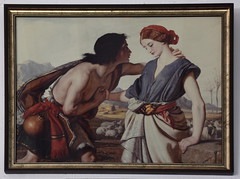
The most famous possession of the church was the painting
The Meeting of Jacob and Rachel by William Dyce,
the great early pre-Raphaelite. It was donated to St
Lawrence in 1948, but the picture hanging above the
pulpit now is a life-size photograph of it, because the
parish sold the original in the 1980s to pay for
essential repairs. This seemed to me an eminently
sensible thing to do, although it did occur to me that I
might not be leaving any of my extensive art collection
to the parish of Knodishall now.
Simon Knott, May 2019
Follow these journeys as they happen at Last Of England
Twitter.
|
|
|