| |
|
 |
|
It was one of those
bone-crunchingly cold days in February
2013, and I was shaking off the effects
of flu in a somewhat unconventional
manner by standing in sub-zero
temperatures outside Colchester station
in north Essex waiting for my friend John
to pick me up. It wasn't John's fault;
I'd caught an earlier train from Ipswich
than I'd planned, without really thinking
about having to wait at this end.
Fortunately, John is always on time in an
old-fashioned, well-mannered kind of way
- as, indeed, are all the people I make
regular excursions with. How on earth do
they put up with me? We headed out of
Colchester towards the hills of south
Suffolk, crossing the county border at Nayland
and soon entering the parish of
Leavenheath. I
remembered vividly coming this way
before, more than ten years ago. It was the wettest
day of the Autumn of 2002, which is
saying something. We were on our way to
Sudbury after spending the morning in
Colchester. There had been times during
the morning when I simply could not see
my hand in front of my face, let alone
any buildings, but near Nayland the rain
stopped, and a few minutes later a
cunning plan had occured to me.
|
In
this corner of Suffolk, there was only one
Anglican church that I had not photographed, and
I mentioned this casually to my chauffeuse. She
took it as a challenge - "Let's find it
then!" - and so we started to look for
Leavenheath church. I knew the parish well - or
thought I did. The main Colchester to Sudbury
road runs through it, and I must have done this
same journey a hundred times. It was only when I
started looking for St Matthew that I realised I
hadn't ever really noticed Leavenheath
before. There is no village centre, no main High
Street leading off into shops and housing
estates. There are modern houses, but
they are on the road to Bures; otherwise, the whole
place is nothing more than a scattering of
gathered cottages and farmsteads. And there is a
good reason for this; Leavenheath is not really a
village, or even a parish, at all.
The Leven
Heath, as it was, is a vast area of open
land that spreads itself between Nayland, Polstead, Boxford and Bures. Apart from the A134, it
is only dissected by narrow lanes, some of which
get blocked by the sandy soil washed out of the
fields in heavy weather. I assume that it was all
used for grazing sheep until the late 18th
century, when it remained one of the few
unenclosed places in Suffolk. Not for much
longer: enclosure brought settlement, and
settlement brought the established church out of Stoke
by Nayland,
in which parish most of this place actually is.
At the cost of £400 9s 5d, (about £80,000 in
today's money, a bargain then or now) the new
church was constructed in red brick, and
consecrated on the morning of the 13th September,
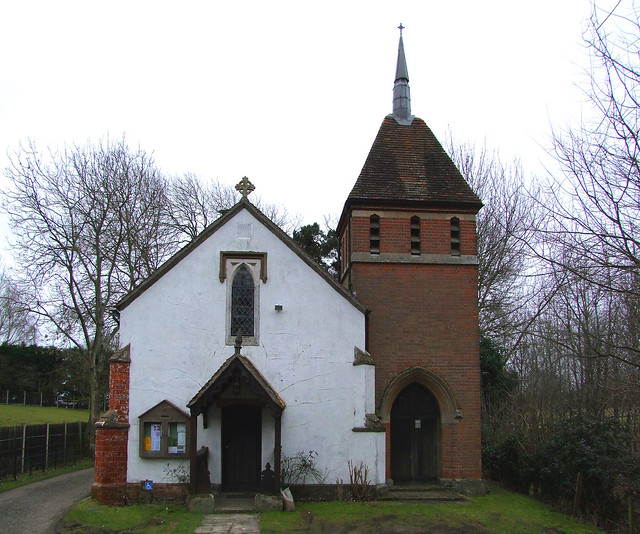
1836. It was a little towerless chapel, much in
the contemporary style, with few of the trimmings
that the growing sacramentalism of the next few
decades would demand. Broadly speaking, it is the
part of the present church to the north of the
tower, although I think that the lovely white
frontage, porch and buttressing must be later,
for reasons that I will explain in a moment.
The
architect was G R French, and an intriguing
passage in White's 1844 Directory of Suffolk
notes that it was built near the site of an old
Quaker burial ground. Since such things were
usually beside meeting houses, perhaps there was
already a Friends' presence on the Heath before
the Anglicans came along. The new church had the
status of a chapel of ease to the mother church
at Stoke by Nayland, but was provided with its
own minister, the fiery evangelical Harold Curry,
who, White tells us, had his own adjoining house
- this must be the one to the rear of the site,
now a private house. The minister was also
provided with two acres of land, and a 3% return
on £1,100 in stock.
By
the time of the 1851 census of religious worship,
the little chapel was maintaining morning and
evening services, with an average attendance of
120 for the first and more than 200 for the
second. It must have been a tight fit. So much so
that, in 1880, Mortlock tells us that the
architects Satchell and Edwards were called in to
extend the building. They built the splendid bell
tower with a wide south aisle behind it, and
extended the original church eastwards with the
addition of a chancel. These are strongly in the
Tudor style, even with the addition of wide
Perpendicular windows, and so I think they must
also have been responsible for the frontage now
in place on the original church, with its porch,
all of which is fully Tudor in style. For
example, the lancet window above the entrance
matches a double one in the south wall of the new
chancel. The use of unnecessary buttressing would
have been fully in keeping with the style of the
1880s. So, we may assume that the architects
completely transformed this place.
So,
where was it? We headed west from Nayland, looking at both sides of
the road for a clue as to where the church might
be. I fully expected to have to drive off into
the middle of nowhere, but just when we had
almost reached Assington, I saw it, right beside
the road in a dip, surrounded and hidden by great
chestnut trees. I must have driven past it so
many times, but I had never noticed it before.
The little garden in front of the church is a
paradise for conker-hunters. I had never seen
such a density of the beautiful brown seeds in
one place - they carpeted the wet ground like
jewels. I reached down and pocketed one, an
ornament, a keepsake.
St
Matthew was not open that day, but for the last
few years it has been open every day, the west
door propped open in a friendly, welcoming way. I
was pleased about this, because such relatively
insignificant and unimportant churches are all
too frequently left locked from one Sunday to the
next. But there is something of great interest at
Leavenheath that I had long wanted to see, and
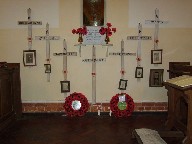
that is the collection of WWI cemetery crosses,
one of the largest collections in East Anglia.
John and I stepped inside, and were pleased to be
met by the very churchwarden who had contacted me
to let me know the church was now kept open,
several years before. The cold day was gloomy, at
it took a moment to adjust our eyes to the
interior, but when we did it was to see a
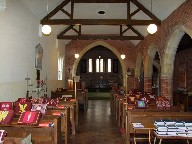
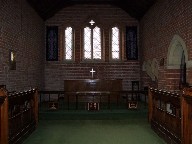
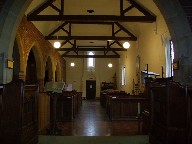
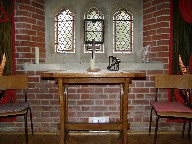
pleasant, red brick space, the eye drawn
eastwards to an apse, and the war memorial the
main feature on the north wall.
When
the dead of the First World War were gathered
together to be buried in military cemeteries in
northern France, the temporary wooden crosses
that had marked their graves were replaced by
more permanent stone markers. The families could
apply to have the original grave markers sent
home, and often these were displayed in the
village church, perhaps with a photograph of the
dead. They are terrible things to see - almost
all of them were young men in their late teens
and early twenties, and all of them must have
been well-known to everyone else in the village.
Over the years, many of the crosses have
disappeared, perhaps taken back by families, or
more likely discarded as an irrelevance. But St
Matthew still contains seven of them; only Old
Melton,
near Woodbridge, has more. And Leavenheath
retains some of the photographs of the young men
too. In these dark days, they are a reminder of
the horror of war, and should be a constant
reminder to us that no good will come of it.
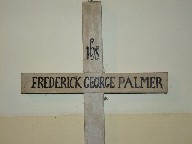 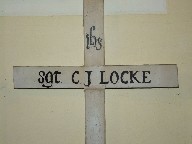
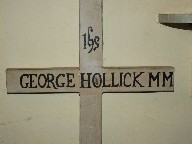
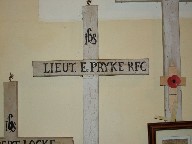
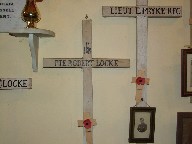
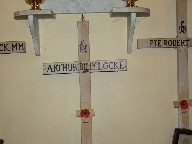 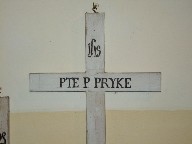
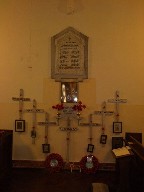
The
crosses flank the parish war memorial, creating a
kind of shrine effect. They have all been
repainted and relettered, which in a way is a
shame, but it does give them a strange sense of
community, a reminder that in such a tiny place
they would all have known each other, and many of
them will have gone off to war together. There
are three Lockes, two Prykes, a Hollick and a
Palmer. Oddly, the three Lockes all have their
surname spelled the same way on the crosses, but
on the memorial only one of them has the final E.
Charles John Locke was a serjeant in the Suffolk
Regiment - as, indeed, were two of my
great-grandfathers. He was killed on the 10th
September 1916, and is buried in Abbeville
military cemetery on the Somme. He was the son of
John and Eliza Locke of Leavenheath. Arthur
William 'Billy' Lock was a private in the Suffolk
Regiment, and was killed on 18th November 1916.
He was 24 years old. Billy was the son of Thomas
and Mary Ann Lock of Leavenheath, and is buried
at Choques Military Cemetery in the Pas de
Calais. Robert Lock was also a private in the
Suffolk Regiment, the brother of Mrs Hasler of
Castle Hedingham. He was killed on January 18th
1918, and is buried at Artillery Wood Cemetery
near Ypres.
GHJ
Hollick's cross includes the initials MM, for
Military Medal. he was the son of Mrs Louise
Hollick of Leavenheath, and was killed just a
month before the end of the War. He is buried at
Guizancourt Military Cemetery at Gouy on the
outskirts of Rouen, a long way behind the front
line and suggesting that he died in hospital.
Edgar Pryke was a Lieutenant in the Royal Flying
Corps, who was killed over France on 30th
November 1917 (the war memorial gives the year
wrong). He was 22 years old, and a resident of
London, although originally from Stowmarket. It
isn't clear what his connection with Leavenheath
was. Percy Pryke was a private in the Hampshire
regiment, and was killed during the attack on
Gallipoli on 13th August 1915, according to the
CWGC database, although the war memorial gives
the date as the 14th. He is remembered on the
Helles memorial above the Bosphorus. Frederick
George Palmer died a few weeks after the War
ended, in Cairo, Egypt, on the 17th December 1918
(18th on the war memorial). A Private in the
Suffolk yeomanry, he is buried in Cairo Memorial
Cemetery. He was the son of George Palmer of
Spring Farm, Leavenheath.
| The crosses are a haunting
survival, a memory of the lost boys of
Leavenheath, but in another way this
church is a survival in itself, and they
would recognise it instantly if they were
to step into it today. Everything is
neatly kept and looked after, but there
is still a sense of its Edwardian heyday
before the boys went off to War. There is
a memorial in the elegant red brick
chancel to the Vicar who oversaw the
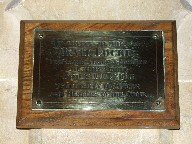
expansion of the church in the 1880s, and
a pleasing little modern brass to Kate
Locke, for some years a member of
this choir. She died in July 1915,
presumably a relative to one or more of
the Lockes commemorated by the crosses,
but her death was before the terrible
news of any of them could be sent home
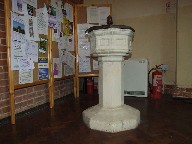
from France. An earlier survival is the
simple font, typical of the
pre-ecclesiological fashion of the early
19th Century. It was presumably installed
here when the church was very first
opened. I liked St
Matthew's church very much. It is simple,
seemly, and has a real sense of its place
in its local community.
|
|
 |
|
|
|