| |
|
 |
|
2008: in
the six years since I had last come to
Little Saxham I had been to most of the
churches in Norfolk. Embarking on a new
cycling tour of Suffolk in 2007, I felt
like I was visiting old friends, and All
Saints was a more familiar one than most,
because I have been here several times.
It is one of those churches where
everything seems to come together - the
setting, the survivals, the atmosphere,
the sense of Faith still redolent in
these cynical, secular days. It
was a reminder to me that, while Norfolk
has the lion's share of the grander
churches of East Anglia, the prettier and
more interesting ones are mostly in
Suffolk.
|
Not much had changed, and one thing
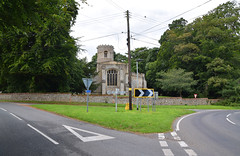
which certainly hadn't was the rat run of traffic
along the road from Bury. It is the one crimp in
a visit to this church, and afterwards it was a
relief to get off of the main road into the
backwoods around Great Saxham. Yet still, it felt
like I was leaving a friend behind, a place where
I had been happy: I remembered vividly a day in
the last high summer of the previous millennium
when I had stood in this graveyard as my two
little children tumbled around it exploring the
gravestones. Leafing back through the visitors'
book, I found that, even before that, my first
visit here had been in 1996. I looked at the
entry for a moment, wondering why my daughter's
name was not there with the rest of us, and then
realised foolishly that this had been before she
was even born.
2002: A month spent
cycling in central France had made me realise
quite how crowded Suffolk is. In the Sologne,
where Id spent a week, the villages were 10
miles apart, with long straight roads cutting
through forests to join them. There were none of
the comforting Suffolk sights of another church
tower on the next rise, or road signs to gentle,
familiar place names. None of the traffic, either
in the Jura, I had often gone an hour
or more without seeing a car, so the road from
Bury to the Saxhams was hellish a vicious
ratrun between high hedges. Well, at least there
still are hedges.
But Little Saxham is a handsome place, despite
the road forking here, agricultural vehicles and
4x4s thundering suddenly around corners concealed
by ancient yews. I made it across to the
graveyard in one piece, however, and let the
latch gate creak shut behind me.
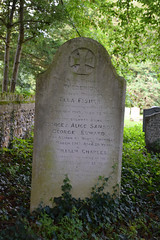
Genealogists reading this will be disappointed to
learn that Little Saxham has been pretty well
cleared of all its older gravestones. This
happened in many places in the 1960s, especially
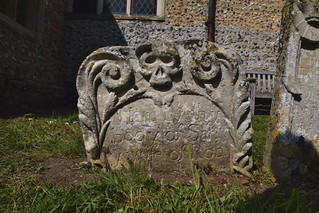
in smaller graveyards like this one. A few of the
older graves have been reset in a line to the
south of the nave, and the 18th century ones near
the porch are particularly worth examination. An
old photograph inside the church shows this
graveyard as it once was, an entrancing jumble of
priceless ancient memorials. Rather hard to get a
mower between, however, and so they are now gone.
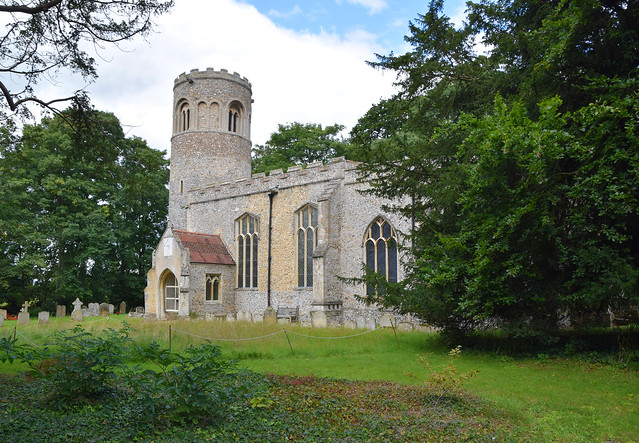
But the wide expanse of lawn does, at least,
offset Suffolks finest round tower, and
perhaps Englands. There are historical
reasons for others being at least as interesting,
but the aesthetic ones over-ride them. Mortlock thinks the
lower part Saxon, and the bell-stage Norman -
this is particularly worth a gaze, because so
many of Suffolk's round towers had their bell
stages rebuilt in the 15th century. The arcading
is terrific - nothing else in Suffolk approaches
it. The Victorians did very little here, and the
outside body of the church itself is still
broadly as it was on the eve of the Reformation.
Worthy of particular note is the Lucas chapel
(more often referred to these days as the Crofts
chapel) on the north side of the chancel. It was
built in the 1530s, just before such things
became theologically unacceptable.
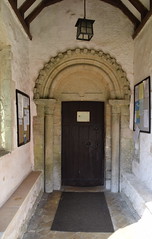
You step through a doorway that is
broadly contemporary with the tower top, and on
your left are two rather remarkable archways. The
first, on your left, is a low Norman arch,
roughly the same size as the doorway you have
just stepped through, but set barely a metre and
a half off of the floor. This has been variously
identified as a tomb recess, an aumbry, a safe
for valuables and a doorway into a lost chapel.
None of these seem right, and it seems more than
likely that it is the old north doorway, possibly
moved here in the 19th century, although to what
purpose is a mystery. Probably, it was
reconstructed simply to look like a tomb
recess - the Victorians went in for that kind of
thing. It may have been intended to echo
something similar in the chancel.
Beside it is one of the most
breathtaking tower arches in Suffolk - it is of a
similar scale to that at Stoke by Nayland, but here,
in such a small church, it is a tremendous thing,
perfectly beautiful, raising the eye heavenwards.
The doorway above it reminds me of the one at Thorington, where the
tower is not dissimilar, albeit over-restored. In
the tower arch beneath are panels of the rood screen; lions,
squirrels and eagles face each other off in the spandrels.
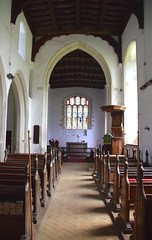
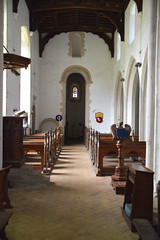
Turning eastwards, I was struck by
the quantity, and quality, of medieval woodwork -
it isn't hard to sort it out from the 19th
century stuff; broadly speaking, the newer
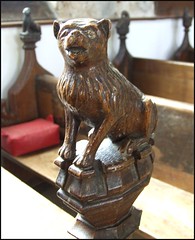
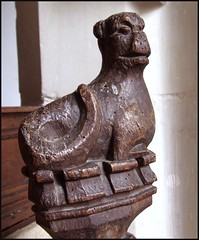
benches are on the south side. Of the medieval
bench ends, several are worth mentioning; a lady
at a prayer-desk may well be part of an
Annunciation, a dragon biting its tail looks
rather heraldic, and what is probably a lion
looks not unlike the cock-monster at
Stowlangtoft.
Mortlock thought that the entrance
to the rood stairs being six feet off the ground
suggested that it had once been used to store
valuables. This may be so, but I think it is far
more likely that it is giving us evidence of a
now-vanished wooden section of the stairs that
led down into the aisle, as at Denston. It is
worth taking a moment to look at the inside of
the chancel arch, because you can still see the
marks where the rood screen fitted before its
removal.
I stepped up into the chancel, which
is beautiful and plain. The gorgeous carved
communion rails were rescued from the abandoned
church at Little
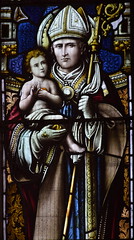
Livermere, and reset here. The 19th
century glass of St Nicholas, St Paul, St Peter
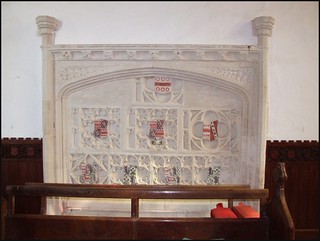
and St Edmund above is good. On the north side,
the curious memorial with its heraldic devices
is, in fact, the blocked up entrance to the Lucas
chapel, now the vestry. The shields come from the
tomb of Sir Thomas Fitzlucas, which once stood
inside.
The entrance to the vestry is from
the east end of the north aisle. It is kept
locked. However, it is worth contacting the
keyholder listed on the door, because, from its
days as the Lucas chapel, it contains the rather
magnificent tomb of William, first Baron Crofts,
in all its 1670s Restoration glory. The keyholder
was out the day I called, but this was entirely
my fault as I had been given their telephone
number beforehand, and had neglected to ring
ahead. Luckily, Michael Fitzgerald has come to
the rescue with the photograph which you can see
below.
Unable to see it
for myself, I admired the fine pipe
organ, and some fascinating photographs
of the church before its late 19th
century refurbishment.
St Nicholas is a
super building, one of West Suffolks
most interesting churches, full of
discoveries to be made by anyone who
isn't in a hurry. Not far off is the
lesser-known church of St
Andrew, Great Saxham,
full of colourful Flemish glass, a
refreshing dessert after this substantial
main course.
|
|
 |
|
|
|