St John the Baptist, Lound

www.suffolkchurches.co.uk - a journey through the churches of Suffolk
|
St John the Baptist, Lound |
|
|
||
www.suffolkchurches.co.uk - a journey through the churches of Suffolk |
||


Follow these journeys as they happen at Last Of England Twitter.
| Lound is a pleasingly
self-contained village in this area of scattered
parishes, and despite its position between the urban
sprawls of Lowestoft, Gorleston and Great Yarmouth it is
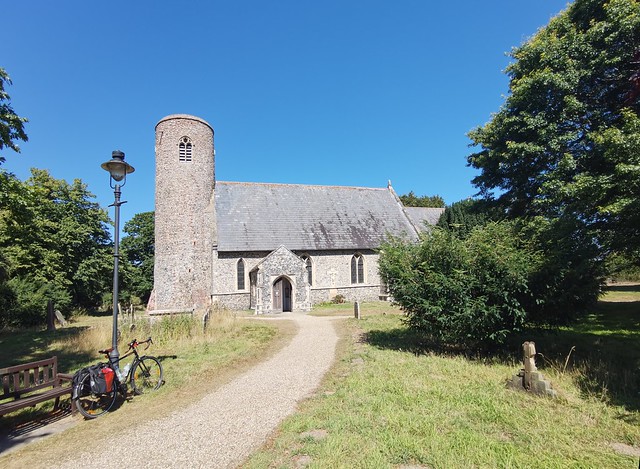
entirely rural in character. The church sits off the
village street, and as often around here it is
round-towered. The tower appears to have been completely
rebuilt in the early years of the 14th Century, and this
is probably a good date for the rest of the church as
well, although as James Bettley points out in his
revision of the Buildings of England volumes for
Suffolk, the details of the nave and chancel are all
of the 19th Century, the result of three successive
restorations. The most striking feature of the exterior
is probably the crucifixion war memorial set into the
south wall of the nave. It was the 1920 work of Ninian
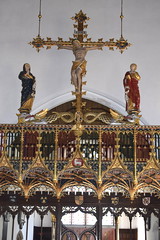
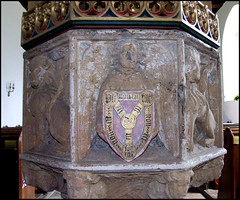
Comper, and it is a foretaste of things to come. If you do not know what to expect when you push open the south door and step inside, then you are in for a surprise. The Rector of Lound from 1908 to 1917 was the Reverend Booth Lynes, and at his behest and expense Ninian Comper was employed to transform the interior of this church to return it to its medieval arrangement, as Comper's biographer Anthony Symondson put it, going on to add that as a result it became far richer than it was in the Middle Ages. The first sign of this is the great gilded font cover which rises above the late medieval font, and the similarly gilded organ case above the west door. And then you turn to the east, and there is Comper's remarkable gilded rood screen.
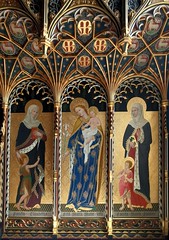
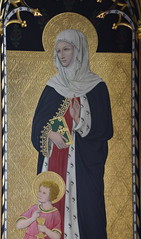
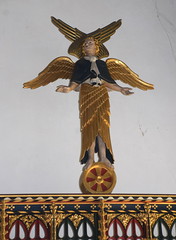
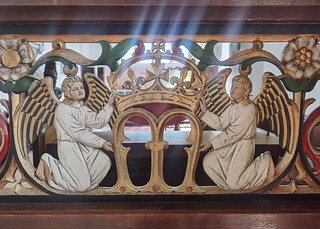
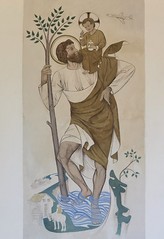
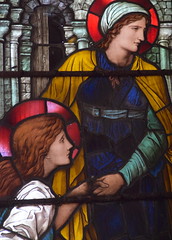
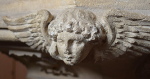
Comper used the surviving remnants of the medieval screen and then built it up with rood loft and rood group. Comper interpreted the rood as a 'Tree of Glory', and the cross is vine-like. Along the front of the rood loft are angel musicians and heraldic shields. These are a curious collection, representations including Edward III, who had been on the throne when the church was rebuilt, the Bishop of Norwich and the Lynes family. The G and M above the entrance represent King George V and Queen Mary, who were on the throne at the time of the screen's installation. At the south end of the screen is a lady altar, in the manner of those at Ranworth in Norfolk. The panels are a depiction of a Holy Kinship. St Elizabeth stands with the young St John the Baptist beside the Blessed Virgin and the Christchild, and then comes St Mary Salome with the young St John the Evangelist. Comper's work here at Lound was carried out between 1912 and 1917, and this makes it a snapshot of the apotheosis of Anglican ritualism. On the eve of the First World War, the Church of England was at its height as a national and sacramental institution, a position so powerful that it was able to offer both a mystical counterpoint to the experience of the War, and a focus and ministry for grief during and after it. But the Church would never be the same again. The old certainties had been destabilised by the War, and the social structure of England was changing forever. Never again would the Church of England hold such cultural and social power. The font and organ case at one end of the nave and the screen at the other act as a balance to each other, and the space in between is relatively simple, with two blocks of plain benches set far enough apart to create a sense of space. The font has a dedicatory inscription around the base recording that it was the gift of John Bertelot, the incumbent here towards the end of the 14th Century. The only intrusion in this space is Comper's wall painting of St Christopher set on the north wall in the traditional manner. This St Christopher is a jolly bearded fellow bearing a smiling Christchild. Fish swim in the water about the saint's feet, and beside a water mill on the bank a man stands with a heavy horse. The Rolls Royce being driven up the road behind the mill is a self-portrait by Comper, and when the painting was restored in the 1960s the elderly Comper ordered a passenger jet plane to be added, flying above the Christchild's head.
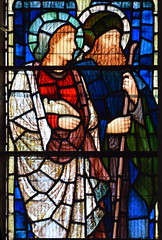
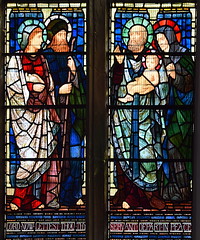
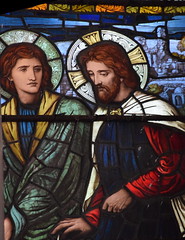
The screen dominates the church, and of course Comper's refurbishment here it is not to everyone's taste. But Betjeman loved it, and once when I was here with my friend John he told me a wonderful story. When John was young, he'd watched a television programme that Betjeman had made about East Anglian churches. One of the churches was Lound, and the way that Betjeman stuck his head through the rood screen to gaze at Comper's chancel made a deep impression on John. The following day, his careers teacher asked him what he wanted to do when he left school. "I want to do what John Betjeman does", John told him. To his eternal credit, the careers teacher suggested that John write to Betjeman, which he did. Betjeman replied, inviting John for tea at his Chelsea flat, and they became friends. At the time, Betjeman was involved in helping set up the organisation Friends of Friendless Churches, and after Betjeman's death John took his place on the board. Today John lectures on churches and church history, and leads guided tours to medieval churches all over England. And all this thanks to a television programme about this place and a wise, kind teacher. After the Reformation this must have been a very plain and simple church until the 19th Century Anglican revival came along, but in fact Lynes and Comper were not the first to try to beautify it. Beyond the screen is the chancel with its altar and riddel screen. The glass in the chancel is the work of the great Henry Holiday, and it was installed here between 1897 and 1905 by Lynes' predecessor. The most memorable glass is a window depicting the Presentation in the Temple. Mary carries two doves and Joseph beside her leans on his staff. They look on as Simeon holds the Christchild with a rapt expression on his face, Anna standing quietly beside him. Underneath are Simeon's words, Lord, lettest now thy servant depart in peace, according to thy word.
The illusion of permanence that the late 19th and early 20th Century Anglo-Catholic movement sought, and its desire to erase the wrongs of the Reformation by recreating a sense of continuity back to the early Church, are written here physically in Comper's furnishings. In those days the Anglo-Catholics were in the ascendant, and many firmly believed that, eventually, the entire Church of England would be like them. Then, it was hoped, the 'Roman' Catholics of England and even most non-conformists would recognise the truth of the Anglo-Catholic position, see the error of their own ways, and seek a return to the 'true' English Mother Church. But of course this did not happen, and it never will. I thought about what Roger Scruton
wrote about the Church of England in England: an
Elegy, his elegant meditation on the way this
country changed over the course of the 20th Century: The
English knew in their hearts that religion is a human
invention - the whole history of their Church reminded
them of this. The census of 1851 already showed that less
than half of them were regular worshippers - a figure
which dropped below a quarter in urban areas. Yet they
automatically put 'C of E' on any form inquiring after
their religion, and acknowledged the necessity of
religion in every ceremony in which their loyalties as
Englishmen were rehearsed. Their religion was a conscious
artefact. Like good manners, it did not bear too close an
interrogation. It was a collective polishing of the
world, and veneered the ordinary life of England in the
way that a smile veneers a face. |
Simon Knott, September 2022
Follow these journeys as they happen at Last Of England Twitter.




|
||||||||||||||||||||||||||||||||||||||||||||||||||||||