St Andrew, Marlesford

www.suffolkchurches.co.uk - a journey through the churches of Suffolk
|
St Andrew, Marlesford |
|
|
||
www.suffolkchurches.co.uk - a journey through the churches of Suffolk |
||


Follow these journeys as they happen on X/twitter and bluesky
| If you
did not know this church was there, you might never find
it. Marlesford village sits for a fleeting stretch on the
busy A12 hurtling traffic north from Ipswich. Leaving the
noise behind, the road quickly dissolves into a number of
pleasingly aimless lanes that meander up and down through
clusters of houses and copses. There is no real village
centre. At last you reach the church, set back and
standing high above a quiet lane to the west of the
village. It's an intensely rural spot, the woods and
fields folding away beyond the churchyard, the birdsong
and early sun-warmth in spring, The drowsy heat with its
lazy bees in summer, the woodsmoke of autumn, the chilly
near-silence of winter with its occasional squawk of
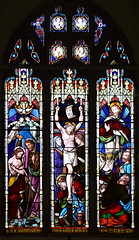
pheasants. It could be any time. This is a small church, with a pretty south aisle but no clerestory. James Bettley, revising the East Suffolk volume of the Buildings of England series, points to the arcade inside as evidence of the 12th Century church that was here, but otherwise it was entirely rebuilt in the late 14th and 15th Centuries, the nave and chancel first, then the tower. Simon Cotton records a will of 1473 of 40 shillings (about £2000 in today's money) from John Coppyng for the making of a new candlebeam, which is to say roodscreen, so we can assume that the nave and chancel were complete by that date. The sanctus bell turret on the nave gable appears to have been renewed, but it probably reflects what was there before. You step into an interior which balances perfectly an ancient space with an enticingly rustic 19th century restoration. John Coppyng's rood screen does not survive, but brick floors and white walls lead the eye through the 1890s furnishings to the chancel with its east window, a strikingly lively depiction of the Crucifixion flanked by the Baptism of Christ and the Ascension, by Cox & Sons in the 1870s. It's flanked by decalogue boards that James Bettley credits to Gilbert Sully of Chiswick, 1903. As he says, rather late for this sort of thing. The only other coloured glass in the church is on the north side of the nave, two windows depicting Christ welcoming the children and the Risen Christ meeting Mary Magdalene in the garden. They are both by Ward & Hughes in the 1880s, not a great period for what was by no means the 19th Century's best workshop, but on a sunny day they add a vibrant note to the interior. Fortunately, the south aisle is glazed entirely with clear glass, and it is the loveliest part of the church I think. It has its own little sanctuary, with modern wrought iron rails enclosing the sweetest little altar. At the west end of the aisle is the tall, dark 18th Century Marlesford Hall pew, a large and somewhat austere structure that allows the occupiers to take part while being largely cut off from the rest of the congregation. Up in the chancel, William and Avis Alston gaze severely from their 1640s memorial. The simple and wholly secular inscription tells us that it was erected by their eldest daughter, also called Avis. Further west is an early 19th Century memorial to Lemuel Shuldham, who at the age of 21 was killed in the Battle of Waterloo: Far in advance, within the right of the French lines, his body was found the next morning and buried on the spot. Above the inscription is a cornucopia of the paraphernalia of battle, a cannon, a banner, a cornet, and so on. But his memorial at least is not wholly secular, because the inscription goes on to say that the memorial was erected to preserve in his native village a record of one so early and nobly lost... in the blessed hope again to behold him in the beauty of immortal life. Coming back into the nave, the large lectern, which would be imposing if it were not so beautifully carved in a 17th Century style, is by Robert Thompson, the Yorkshire 'mouseman'. It was made in 1948, so it must have been one of his last works. Marlesford is probably best known these days for being the home village of Flora Sandes. She was born in Yorkshire in 1876, but her father moved to Marlesford to be rector here when she was nine. She spent almost the next thirty years living in this little backwater, where she seems to have made quite an impact, tearing around the local lanes in a French racing car which she had taught herself to drive. On the outbreak of World War One she joined the St John's Ambulance Brigade, and set sail with a group of other nurses to the Balkans. However, she became separated from them behind Serbian lines. For safety, she joined a Serbian regiment, and was soon promoted to the rank of Corporal. Shortly after her 40th birthday, she was seriously injured in a grenade attack, but recovered to reach the rank of Sergeant-Major and to be awarded the King George Star, the Serbian equivalent of the Victoria Cross. She retired from the Serbian Army in 1922 to run a hospital. At the start of World War Two she was interned by the invading Nazis, but then expelled, and she returned to Suffolk to spend the rest of her life. She undertook lecture tours in her Serbian Army uniform, and eventually died at the age of 80 in 1955. A small brass plaque in the chancel remembers her here, but her life is best known for being the subject of the book and film The Lovely Sergeant. It is the quite extraordinary tale of a remarkable woman. |
Simon Knott, March 2025
Follow these journeys as they happen on X/twitter and bluesky




|
||||||||||||||||||||||||||||||||||||||||||||||||||||||