| |
|
 |
|
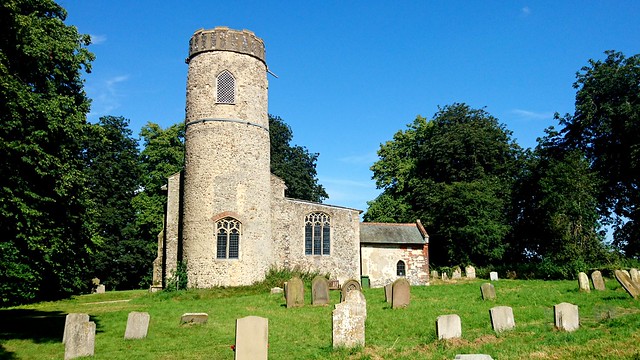
This gorgeous little
church sits hidden in the woods above the busy
Bungay to Beccles road. I have had a strange
relationship with it. I'd visited it half a dozen
times over the last twenty or so years, and I'd
never found it open, never found a notice telling
me where I might find the key. And yet, there is
something so special about this place, about the
church and its setting, so magical about this
ancient clearing, that my feelings were torn
between frustration and annoyance on the one hand
and a sense of wonder and delight on the other.
For here I felt sure, was something magical and
numinous, worth waiting for, worth being
frustrated by. And
then, on a cloudless day in the high summer of
2016, my mother died. I won't go in to the
succeeding fortnight of grief, sadness and
paperwork, because anyone who has experienced the
death of a parent will have undergone the same
journey through the same tunnel. But a few days
after the funeral, on the hottest Saturday of the
year so far, I slipped those surly bonds and
headed out into the quietly winding lanes of
north Suffolk.
I had not been to the
Waveney Valley in years. I had spent too much
time bogged down in exploring churches in the
outer reaches of Cambridgeshire and Essex, in
Kent and Lincolnshire, in the City of London. And
so, nearer to home, I escaped. Here, less than an
hour from my house, I cycled through familiar
ancient parishes that slept like lazy cats in the
unaccustomed heat. I sped through them, freed by
the air that rushed past me. The harvest was
underway, barley dust drifting from the fields,
the occasional urgent tractor and trailer
barrelling up the lanes.
|
I visited the new
Orthodox church of the Mother of God, Joy of All who
Sorrow, down on the bottom
road towards Ellingham. It was my first new Suffolk
church for almost a year. And then I came here, joining
the top road and flirting with the mad traffic for a few
moments before turning off with an excitement in my
heart. At the bottom of the track to the church was a
sign which read Church Open.
Mettingham was home to a college of
priests in the late middle ages. John of Norwich, owner
of Mettingham Castle, had founded it at Raveningham in
Norfolk in 1350, and it moved to the castle in 1394. It
had its own chapel, and although it may have provided
priests for the church there's no evidence that All
Saints was ever used for collegiate purposes. In any
case, the college was dissolved in 1542, and was already
recorded as a ruin twenty years later.
All Saints had already been around
a fair while before the college turned up. You see this
immediately as you climb the rough track that opens out
into the sheltered churchyard. This must be an ancient
site, raised as it is above a river route, and although
the tower is 12th Century the current church probably
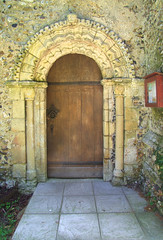
replaced something that was there before. The lovely
north doorway shows that a new church was built
contemporarily with the tower, but there was much more to
come in the medieval period. And then there was a late
restoration here, just before the turn of the 20th
Century, and so it escaped the worst excesses and
enthusiasms of half a century earlier.
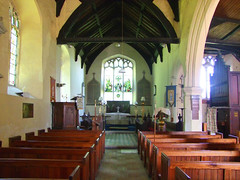
| You step through that
north doorway into the high-pitched nave, the
south aisle beyond. It is a simple, seemly
interior, slightly old-fashioned and a bit dusty,
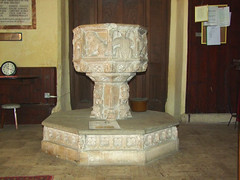
but none the worse for that. The font is a
typical late medieval East Anglian font, lions
supporting a bowl with angels and lions on the
panels. I instantly recognised a bronze plaque in
the south aisle from my recent explorations of
City of London churches - it is a Boer War
memorial to a local who fought with the City of
London Imperial Volunteers. The regiment supplied
an identical form of memorial for every member
who didn't come back from South Africa. The most
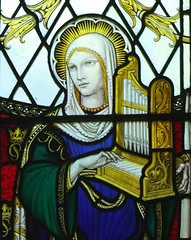
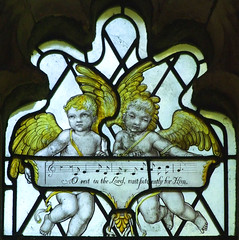
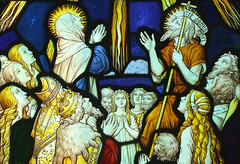
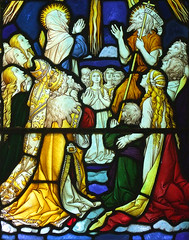
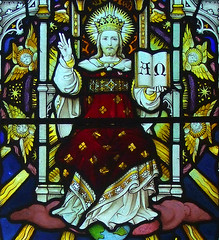
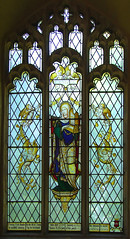
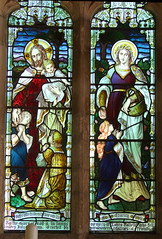
striking things about the church are the
Christopher Webb window of St Cecilia in the
north side of the nave, and another 20th Century
window in the south aisle depicting Christ in
Majesty with the Angels and Saints. Pevsner
doesn't mention it, Mortlock does but wonders who
it is by, and so do I. As so often in a country church, you
get the impression that it was once a bit busier
here, that this place was once more central to
the life of its community. Now the tide has
receded, and churches like All Saints are left
high and dry. The only possible way back from
this, of course, is to have the church open every
day as an act of witness and hospitality to
passing pilgrims and strangers, but the sign on
the noticeboard told me that All Saints is only
open on Saturdays, and only in summer. Still,
that's a start.
|
|
 |
Simon
Knott, August 2016
Follow these journeys as they happen at Last Of England
Twitter.
|
|
|