St Mary, Monewden

www.suffolkchurches.co.uk - a journey through the churches of Suffolk
|
St Mary, Monewden |
|
|
||
www.suffolkchurches.co.uk - a journey through the churches of Suffolk |
||


Follow these journeys as they happen at Last Of England Twitter.
| I love cycling in the area between
Ipswich and Framlingham, especially in spring, the still
unfamiliarly warm sun lighting up the gentle hills, the
air full of renewed birdsong and the honeyed fragrance of
rapeseed flowers. Monewden is at the heart of this
curiously remote-feeling area. It is a scattered parish,
and it would be hard to say that you were ever really in
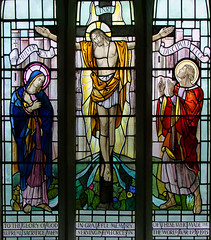
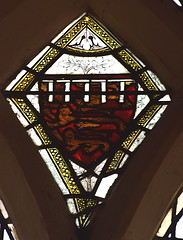
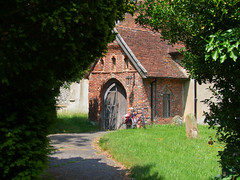
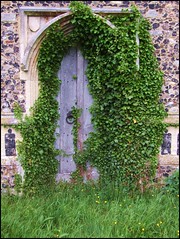
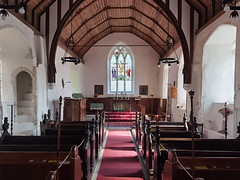
the middle of the village. The church sits on a ridge, and the graveyard is a velvet cushion set among the fields, tight enough to be secretive, rambling enough to make exploring it an excitement. Ivy crawls up the west doorway filling the arch. I suppose that it will have to be removed eventually, but for now it is simply beautiful, like a metaphor for the passage of time, as if this was Sleeping Beauty's castle, and a centuries-long slumber had fallen like snow on the heart of Suffolk. Monewden, pronounced Mon-er-d'n, has a church which is one of the loveliest of all small Suffolk churches. It is elegant and trim, and the tower, nave and chancel are all basically 14th Century. The beautiful little red brick porch was built right on the eve of the Reformation, and its niches would hardly be used at all before the images in them were taken out and destroyed by the Anglican reformers of the 1540s. Like many smaller East Anglian churches St Mary suffered neglect in the centuries afterwards, and it was not until 1906 that it was taken to task and properly restored to the state you see it in today. Because of this late date it has a special atmosphere, at once intensely rustic, but also with that charming Arts and Crafts feel that so successfully conveys the Anglo-Catholic triumphalism which was reaching a peak in the first decade of the 20th Century. The enthusiasm for ritualism in the Church of England was at its height, and the church was refurbished with this in mind, that the building had a sacramental purpose. The focus eastwards was enhanced here by one of the few wooden chancel arches in Suffolk. It is at once simple and elegant, and draws the eye towards Edward Woore's window of the Crucifixion, installed here after the Second War as a memorial to it. Up in one of the three lights of the tracery Woore reset a 14th Century shield, which James Bettley identified as being that of Thomas Bretherton, Earl of Norfolk. The other two lights are Woore's work, one incorporating 14th Century fragments.
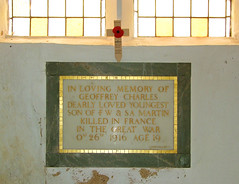
The window splay on the north side of the nave is deep, and the rood loft stairway climbs up from it. I think that it is lovely. It was as if all the turbulent history of the English Church had conspired to leave something so beautiful. When this church was newly restored, the young men of the village went off to the killing fields of France, and some of them never came back. There are six names on the war memorial, which must have made a significant impact on a parish where the population was never more than a couple of hundred. Opposite the memorial is the cross which marked the original battlefield grave of Sergent Cyril H Tarrant, 12th Bn - The Suffolk Regt. Cyril Harold Tarrant died in Flanders on the 29th of July 1918, and his body now lies in the Tournai communal cemetery in Belgium, not far from the French border. He was just twenty-three years old when he died. Opposite his cross there is a rather more elaborate memorial to Geoffrey Charles Martin. At the age of just nineteen Martin was killed in the Battle of the Somme in 1916. His body was never found, and he is one of nearly 80,000 lost boys remembered on the Thiepval Memorial to the Missing. Geoffrey Martin lies at peace, somewhere under fields which are now as quiet as those which roll and stretch across the parish he set out from, and to which he never returned. |
Simon Knott, September 2020




Follow these journeys as they happen at Last Of England Twitter.
Amazon commission helps cover the running costs of this site