St Andrew, Mutford

www.suffolkchurches.co.uk - a journey through the churches of Suffolk
|
St Andrew, Mutford |
|
|
||
www.suffolkchurches.co.uk - a journey through the churches of Suffolk |
||




Follow these journeys as they happen at Last Of England Twitter.
| Like many of the pretty
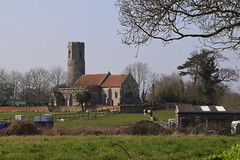
round-towered churches of north-east Suffolk, St Andrew
has a lovely setting in the narrow lanes that wind
between Lowestoft and Halesworth. The churchyard is set
high above the road, probably as a result of the track
cutting down over the centuries, and a path climbs to the
church from the west. The view from here is most unusual,
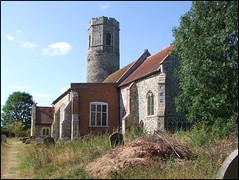
for your first sight is of St Andrew's Galilee porch,
uniquely in England standing against a round tower. It
seems to have been added in the 14th Century, but there's
a possibility that it might be older, as we shall see
inside. The church it stands against is probably 12th
Century in origin, the tower perhaps as early as the
middle of the previous century given the blocked round
openings. The 14th century octagonal bell stage is
similar to those nearby at Gisleham and Ashby, and came
at the same time as the rebuilding of the church. It is
claimed as Suffolk's tallest round tower, although it
must be said that Hasketon church makes the same claim.
But it is surely one of the most beautiful. The
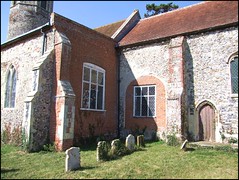
combination of Galilee and south aisle gives it a
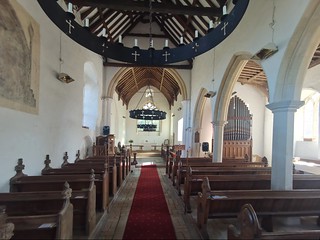
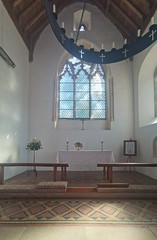
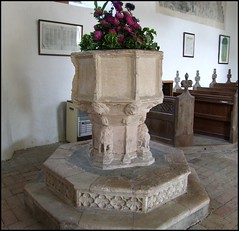
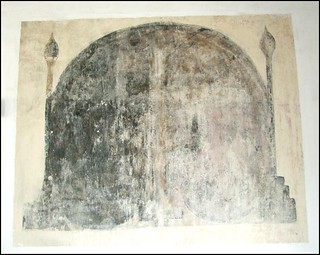
pleasing off-centre look. The south chancel chapel was demolished in the 19th Century, resulting in a startling brick wall at the end of that aisle, and a domestic window set in a brick-filled arch in the south wall of the chancel. But in a way this contributes to the sense of a lovely old building, a splendid sight across the fields. The south porch leads into the uneven brick floor of the south aisle, the nave beyond. This is a wide, plain interior, partly a result of the lack of coloured glass but also, it must be said, due to a major 19th Century restoration that has left it feeling somewhat scoured. Tucked into the north-west corner of the nave is an imposing font, similar to those nearby at North Cove and Gisleham because it has heads wearing headdresses supporting the bowl. What makes this one unusual, however, is that it has a dedicatory inscription to Elizabeth de Hengrave who died in about 1380. Despite appearances, then, this is a late 14th Century font rather than the 15th Century date you might expect for a font which is otherwise typically in the East Anglian style. On the north wall of the nave is a large black rectangular wall painting. It clearly once contained text, and it was perhaps a 17th Century decalogue, like those at Sweffling and Chediston. When Cautley came this way in the 1930s he claimed that he could still make out the outline of the lower part of a St Christopher wall painting under it, and even mentioned the scallop shells at his feet. But these have completely disappeared now, and it would take more than a little imagination to conjure up any trace of them. Arthur Mee also saw it in 1940, when compiling The King's England volume for Suffolk. At this time, the shells at the Saint's feet were so clear that Mee claimed to have spotted a monk peeping out of one (perhaps in the manner of the carving at Wordwell). When I 'd first read about it, I'd wondered if Cautley had actually seen the remains of Moses or Aaron, as on the decalogue at Chediston, but you can indeed still just make out the legs of the saint in the conventional place. Probably, the figure was whitewashed in the 15th Century, and then this bold signboard painted some two hundred years later, with the Ten Commandments and the words of the Apostles' Creed on it. I don't think it was a conscious attempt at iconoclasm. I am told that, in a certain light, you can still make out some of the words. One exquisite survival of the 14th Century rebuilding is a beautiful piscina in the south aisle, which Mortlock thought was probably to the chantry altar of the guild of St John the Baptist, which existed in the village before the Reformation. Across the church on the north wall of the nave is the unusual feature of a tomb recess with what appears to be a Norman canopy. Mortlock thought it might have been the 12th Century chancel arch, which was replaced in the 14th Century. James Bettley, revising the Buildings of England volumes for Suffolk, wondered if it might have come from the entrance to the galilee porch, which it would fit. Which is to say, of course, that the porch predates what was simply a 14th Century remodelling. Back in 1973, the poor condition of this church and its remoteness from civilisation made it one of the first in Suffolk to be scheduled for redundancy. The tenacity and energy of local people meant that this was not allowed to happen, and a programme of repairs was put in hand that continues to this day, for in 2022 several thousand pounds were spent on repointing the tower. Nearby Rushmere St Michael has also been saved from dereliction, so the locals around here really are to be congratulated. |
Simon Knott, September 2022
Follow these journeys as they happen at Last Of England Twitter.


|
||||||||||||||||||||||||||||||||||||||||||||||||||||||