Naughton
is a tiny village not far from Bildeston. A memory of a
visit some ten years previously came back to me as I
cycled the high, lonely road from Elmsett. It had been an
afternoon in late autumn, and I remembered passing small
groups of men in green carrying broken shotguns,
tired-looking dogs panting in their wake. The shoot was
obviously over. Now, on this day at the very start of
spring, I arrived in Naughton and remembered the place
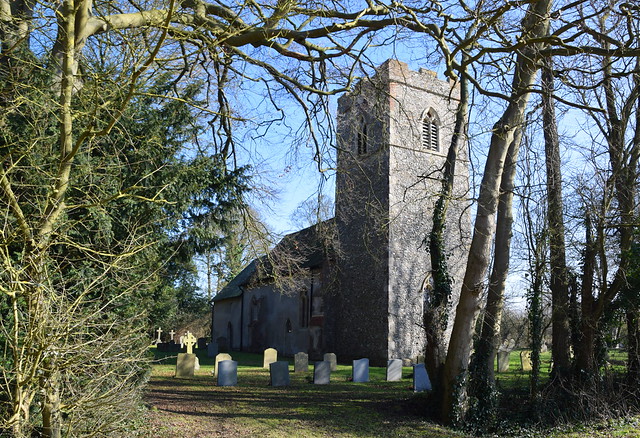
too, the church set back from the road in a small
tree-shrouded graveyard on the edge of the village green.
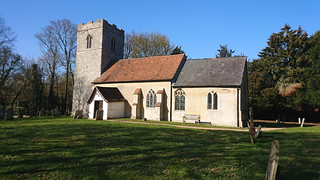
St Mary is small and pretty in its neatly clipped
surroundings. The battlements of the tower appear to have
been renewed, the rendering is recent, but other than
that the exterior probably hasn't changed a great deal
since the 14th century. I pushed open the south door, and
I must admit that my memory failed me at this point, for
I could remember nothing at all about the interior. I
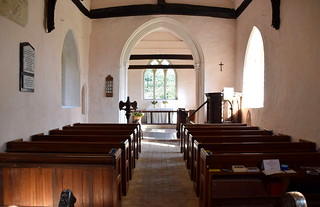
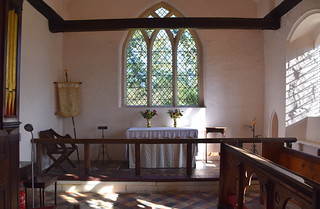
stepped into simplicity, a church full of light with
brick floors and a fine roof.
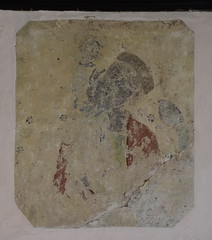
The most striking medieval survivals are the
wall-paintings. A bold St Christopher, in clean 14th
century lines, was uncovered in the 1950s.The Christ
child sits smiling on his shoulder, holding a scroll in
His left hand. St Christopher himself tilts his head, as
if lifting his right shoulder to bear the weight. The
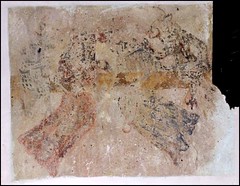
other is less distinct, a warning against gossip. Devils
hovering to write down the sayings of village women
neglecting their rosaries. There is a fragment of the
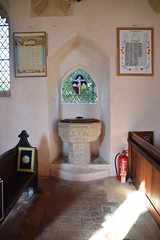
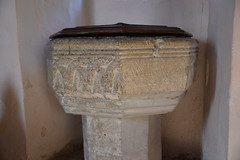
same scene across the county at Grundisburgh. The font
below has been reset in the blocked north doorway, which
looks rather well, actually. It was obviously a square
Norman bowl, of a kind common in this part of the world.
At some point, the corners have been cut off to make it
octagonal.
The view to the east is curious. Two medieval tie beams
are very low across the span, cutting off the view to the
east window. Actually, they are plenty high enough, but
from the nave you have the illusion that you might knock
your head on one. And a final, fascinating detail is so
tiny that you might even miss it. The rood screen has
gone, along with the entire rood apparatus, of course.
But look up high on the north pier of the chancel arch.
You'll see that the moulding has been cut away from the
western part of the arch to accommodate the rood loft.
Even more interesting, a medieval nail still protrudes
from the pillar. It probably supported the candlebeam.
I sat for a while, and another memory came back to me
from my visit ten years before. I'd known that this would
be my last church of the day. It was nearly three
o'clock, and I was a good twelve miles from Ipswich, and
I don't like cycling around country lanes after dark. I'd
come outside and spent a few moments pottering around in
the churchyard before continuing my journey.
Suddenly, there was one of the loudest bangs I had ever
heard. Someone on the edge of the graveyard, about 20
feet away, had let fly with a shotgun at a rook in the
tree above me. Shot scattered on the headstones around.
The shooter ran in gleefully to pick up his kill, nodding
but without saying anything to me, grinning broadly.
Perhaps it was all he'd shot all day.
And so, as then, I left. On the edge of the village, a
row of houses and a garage are Nedging Tye, the ancient
grazing settlement of the adjacent parish of Nedging,
which has quietly melted into Bildeston itself.