| |
|
Suffolk's most
secret places are among the twisting valleys to the west
of Ipswich, the little churches hidden in glades on
hilltops or in the dips below where the narrow lanes
snake down into groves of ash and elm. Maybe there's a
stream nearby, but not many houses, hardly a village at
all. The churches in these places are among my
favourites. Their ancient stones endure through the
shadowy grip of winter, and cool the summer haze. They
sit in silence as the centuries go by, far from the
mundane bustle of traffic, beyond the scope of the
tourist guides.
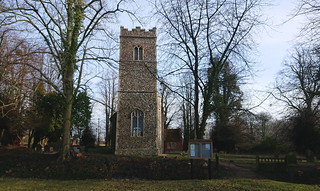
Nettlestead is one of these places. The pretty
unbuttressed 14th century tower shows evidence of Norman
work in its lower reaches, although Mortlock thought this
may have been found and reset during the 19th Century
restoration. Similarly, a Norman lancet window in the
north wall is surmounted by a reset delicate carving,
interlacings of beads, arches and scrolls. You see such
things in the Victoria and Albert museum, but they do not
have the same power there, out of context. Here, a
thousand Suffolk summers and winters have come and gone
and still it endures. Speaking of Victoria and Albert,
their portraits form the headstops to the outside of the
east window.
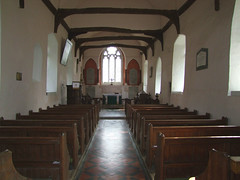
The inside of the church is neat, bright and welcoming.
It is easy to describe the interior of a small church as
pretty, but Nettlestead really is so, and once stepped
into it will not easily be forgotten.
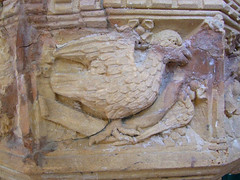
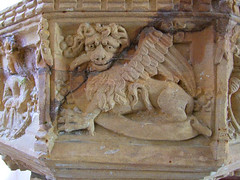
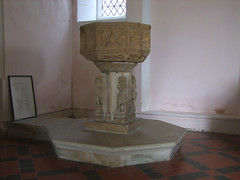
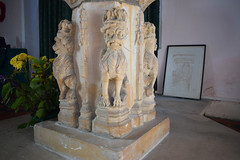
The crowning jewel here is one of Suffolk's loveliest
fonts. Panels intersperse lively evangelistic symbols
with grinning men, one with his tongue sticking out (a
wild man I suppose, but could he be a lion?), a jolly
bishop, and, almost surreally amongst all this merriment,
St Catherine clutching her wheel of martyrdom. There are
noticeable cracks around the bowl, as if at some point it
has been seriously damaged. There is a story behind this
font and its survival, as we shall see.

  
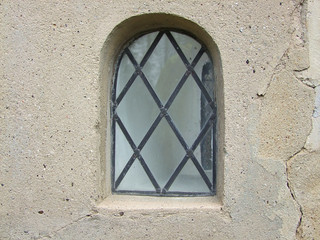
Another curious
survival is the large squint in the splay of a window in
the south wall. It seems to be focused on where the
pulpit is now, so we might assume that there was once an
altar in the nave there. But why was the squint where it
is? Mortlock thought there might have been an anchorite's
cell outside the south wall there, but it is hard to see
how an outbuilding could have offered a view through the
squint without its east wall cutting into the window. I
wondered if the Easter sepulchre had been built where the
pulpit is now, and the squint allowed parishioners a view
of it on Good Friday, when the church was out of use.
Cautley doesn't mention the squint in his 1935 survey, so
it was probably uncovered during a major restoration
after the war. On the night of 12th August 1940, this
pretty church suffered the same fate as that at Akenham,
six miles away, when German bombers returning from a raid
on the Midlands dropped their remaining bombs in a swathe
across this part of rural Suffolk before embarking on the
crossing of the North Sea. The church was gutted, and its
restoration and reopening in 1950 was one of Munro
Cautley's last jobs for the Anglican diocese. He is
responsible for the meticulous piecing back together of
the font, which was wrecked in the explosion.
The east end of the sanctuary is a curious thing, too.
Its rather sober classical blank arcades are elegant, but
beside them on the north wall are the remains of the
grimly morbid early 17th century memorial to Samuel and
Thomasina Sayer holding hands above a skull. They
survived the explosion, but much of their memorial
didn't, and so they have been reset on a kind of shelf,
their inscription beneath. Sayer built a faire almes
house at Bewdley in Worstershier for six poore men and
gave thirty powndes a yeare for ever, but he seems
none too happy about it.
  
Rather jollier are the
lion and unicorn on the George IV coat of arms, which,
instead of supporting the shield, emerge dramatically
from behind it. Bizarrely, a ledger stone to Thomas
Wingfeilde of 1629 in the chancel has had the words who
dyed altered to was buryed. Did they
perhaps keep him around for long?
As lovely as this church is, only the font has survived
until today from the Medieval period. But there was once
much more. The iconoclast William Dowsing visited
Nettlestead on 22nd August 1644. It was one of seven
churches he visited in the area that day. One of his
houses was in the adjacent parish of Baylham, and these
small churches are close together, but in any case the
going on horseback would have been easy that day.
He found plenty to do at Nettlestead. The Saints on the
screen, of which no trace survives, had not been defaced,
and there were a dozen further Saints in stained glass,
again none of which survive. It appears that his
instructions with regard to the screen and ancient glass
were carried out by the churchwardens in full, and he
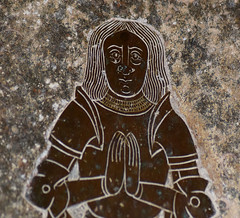
also noticed a prayer clause in brass which had gone by
the time the antiquarian William Blois visited in 1660.
The knight above its matrix survives, suggesting that the
inscription wasn't taken by collectors or early modern
metal thieves. The armour is early 16th Century and it
may be to Richard Wentworth who died in the 1520s in the
last days of Catholic England.
Dowsing does not
usually get too worked up about fonts, but he mentions St
Catherine on the one here, who survives, unlike her
saintly companions in paint and glass, so presumably she
was consequently either plastered over, or the font was
removed from the church and used as a drinking trough for
cattle or something. Further, and most unusually, Dowsing
names the Saints he sees at Nettlestead, and this despite
it being just one of many churches he visited that day.
Why was Dowsing so thorough at Nettlestead? The obvious
conclusion is simply that, being local, he already knew
the church well.
And there is one further intriguing connection between
Dowsing and Nettlestead. Thomasina Sayer on the Sayer
memorial in the chancel was born Thomasina Lea, and she
was the sister of Thamar Lea, William Dowsing's first
wife.
The thought that this wonderful little church once had a
medieval screen and medieval glass that had survived the
Reformation makes you want to weep. Ho hum. Back outside,
then.
The pompous memorial by the north east hedge to Stephen
Jackson, publisher of the Ipswich Journal, is a quite
different prospect to the quiet beauty we have
encountered so far. You might see this in the V&A as
well, as an example of the arrogance of the Gothic
revival. Here is someone who thought very highly of
himself, and now lies under flowering columns, pillars,
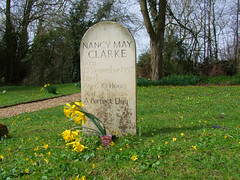
balls, pyramids and curlicues. An antidote by the south
porch is the memorial to a child who died after just ten
hours. Just a Perfect Day as the inscription
reminds us. It's one of the loveliest modern memorials I
know in Suffolk.
So there you are, what a delightful little church this
is, how can you possibly resist? And then, if you are on
foot, or on a bike, just keep going. On the other side of
Somersham, you'll come to Flowton, which is equally
remote, equally lovely, equally welcoming. If you are in
a car - well, you should be ashamed of yourself.
Simon
Knott, November 2019
Follow these journeys as they happen at Last Of England
Twitter.
  
 
  
| |
| |
|
|
|
|
|
|
|
| |
|
|
|
|
|
|
|
|
The Churches of East
Anglia websites are
non-profit-making, in fact they
are run at a loss. But if you
enjoy using them and find them
useful, a small contribution
towards the costs of web space,
train fares and the like would be
most gratefully received. You can
donate via Paypal.
|
|
|
|
|
|
|
|
|
|
|
|
|
|
|
|
|
|
|
|
|
|
|
|
| |
|
|
|
|
|
|
|
|
|
|
|
|
|
|
|
|
|