St Mary, Newbourne

www.suffolkchurches.co.uk - a journey through the churches of Suffolk
|
St Mary, Newbourne |
|
|
||
www.suffolkchurches.co.uk - a journey through the churches of Suffolk |
||


Follow these journeys as they happen at Last Of England Twitter.
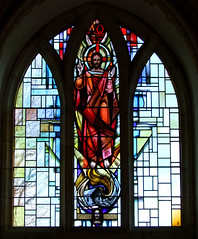
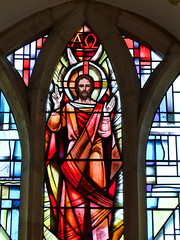
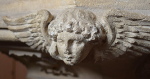
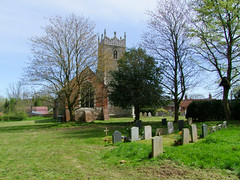
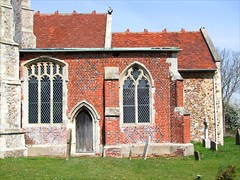
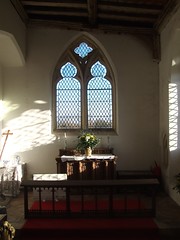
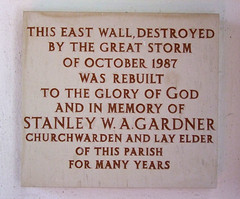
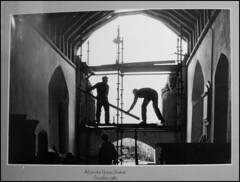
We are not so very far from the edge of Ipswich here, indeed barely a mile from the busy Foxhall roundabout on the A12, but the road dips and narrows and then leads down into the pretty quiet village. And Newbourne is a village which is a little different to most, because in the 1930s it became the home of the utopian Land Settlement Association, a community of market gardeners from the deprived coal-mining areas of Yorkshire. You'll still find several market garden stalls on the high street, and the village stands out on an Ordnance Survey map because of its glass houses. The LSA came to an end in 1983 and now most of the greenhouses are operated by local nursery giants Notcutts. Newbourne's pub, the Fox, is one of my favourite village pubs in the Ipswich area, a place to sit outside on a summer weekday afternoon when the rest of the world is busy, and lazily let time pass. Above it on a gentle rise is the lovely old church. The neighbouring churches of Waldringfield and Hemley both have red brick towers, but Newbourne's is of flint, and St Mary has one of those south towers common in the Ipswich area, forming an entrance porch and bellringing chamber. At first sight from the south the positioning of the tower is not immediately apparent, because a chapel from the south aisle forms a redbrick wall against the tower. You might think at first that this is a small church with a larger, later nave built on to the north. The west end of the nave is heavily buttressed, possibly to stop it heading down to join the pub at the bottom of the rise, and indeed this is a church which has known violent movement, for the east end was blown out in the great storm of October 1987. The same thing happened elsewhere in Suffolk at Uggeshall. The winds blew in at 80 mph from the south-west, blasting open the church door and forcing up and out through the east window, which was completely destroyed. Repairs began almost immediately, but no attempt was made to restore the chancel's former Victorian broodiness. Rather, a lighter, airy modern window shows Christ ascending, and the curious face at the bottom is that of Christ from the former, blown-out window. The survival of this fragment among the rubble and masonry ws spoken of locally as a miracle, albeit with tongue in cheek - after all, this is the Church of England.
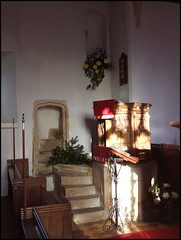
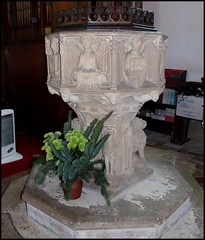
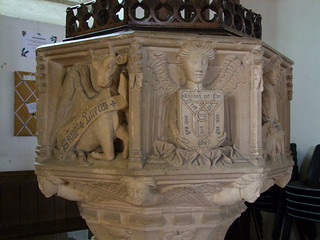
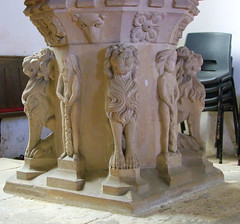
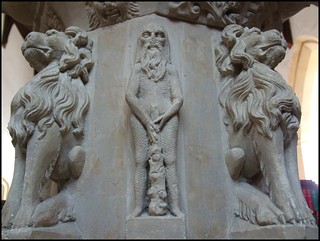
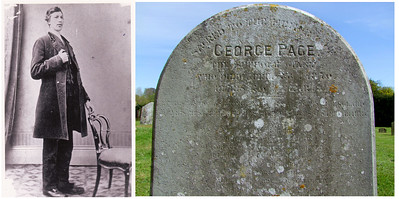
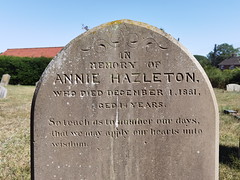
The south chapel is perhaps not really a chapel at all, but an aisle at arm's length. It is built of Tudor brick, and known as the Rowley chapel, but nothing in it dates back before the mid-20th century. It contains a nice memorial with a roundel featuring a Suffolk Punch horse. The rood loft stairs curve sweetly behind the stepped pulpit. On my first visit back in 1999, the nice lady cleaning the stairs was worried that I was from the Health and Safety Executive when she saw me photographing it. I assured her that many Suffolk churches had more precipitous rood loft stairs than hers. The 15th century font is typically East Anglian, but it was recut in the 1840s in quite an interesting way. This is an early date in Suffolk for a Victorian restoration, and no attempt was made to make the font appear medieval - rather, it has been neatly lettered in black paint, and is now rather austere and impressive. The wild man with a club on the stem is not one you'd like to meet on a dark night. Just outside the porch, on the eastern side of the path, there are three 19th century gravestones to the Page family, and the third one is the gravestone of the Suffolk Giant, George Page. It is rather faded now, but you can still make out his name and title. He was 7 feet 9 inches tall when he died in 1870, after a short life spent in a travelling circus. The story goes that George joined a fair run by Samuel Whiting on May 1st 1869, together with his brother Meadows, who was about 7 feet 4 inches. Like many superlatively tall people, George died young. His inscription reads Sacred to the Memory of George Page, the Suffolk Giant, Died 20th April 1870, age 26 years. He was exhibited in most towns in England but his best exhibition was with his Blessed Redeemer. The gravestone inspired the 1926 novel The Giant of Oldbourne by John Owen, who lived at nearby Felixstowe. George's brother Meadows continued to tour until 1875, when his daughter was born. Apparently, a knife was left in their caravan; in the secret language of the fairground, this was a warning to get out. Meadows returned to his old job in Newbourne as a farm labourer, and died as recently as 1917. |
Simon Knott, August 2020



Follow these journeys as they happen at Last Of England Twitter.
Amazon commission helps cover the running costs of this site