| |
|
Newton Green is
one of the busy villages along the road between Sudbury
and Colchester. This close to the Essex frontier, the
area has something of the feel of border country. Gentle
hills roll down to die in the Stour valley. It is a
pleasing landscape but, unless you are a golfer and like
that sort of thing, the village is greatly spoilt by the
conversion of its green into a golf course. I am not a
golfer, and it is hard to see any great beauty in the
main road through this village, which is in any case the
main road, despite the collection of fine 16th and 17th
century houses on the north side.
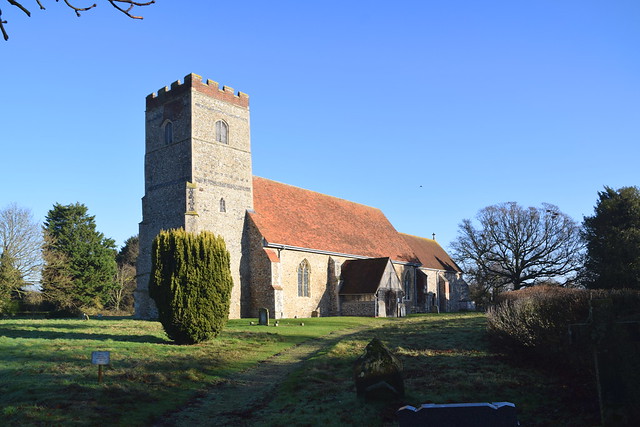
But the setting of the church is lovely, down a lane
opposite the golf course. Quite what the people who live
in the house on the north side of the churchyard have
done to deserve it, I don't know, but it must have been
something really good, because it is one of the sweetest
houses I've seen around here.
By the 1970s this church was in a terrible state. The
roof of the nave was in desperate need of repair, and the
congregation had retreated into the chancel. In a great
act of pragmatism, the nave and tower were declared
redundant, and vested in the care of the Redundant
Churches Fund, now the Churches Conservation Trust, who
carry out their duties here with customary enthusiasm
although so far resisting renting it out as a Bed &
Breakfast which appears to be happening in some CCT
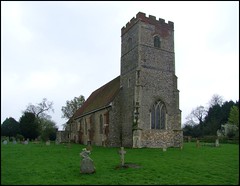
churches elsewhere. The exterior is somewhat stark at a
distance, but closer to there are lovely little headstops
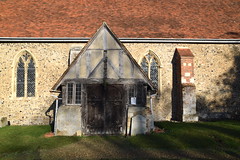
surviving on the windows, and the 14th century wooden
porch is a delight, one of the largest of its kind,
although unfortunately it is currently out of use because
of the dangerous condition of the outer doors. On the
north side, so you'll need to go round, is a good Norman
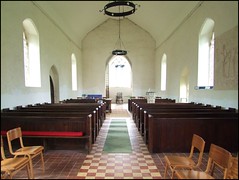
doorway. The church is open daily, and you step through
the chancel door into the intimacy of the chancel. But as
this feels unnatural, let us pretend that the porch is
still accessible, and you enter the nave. As ever,
stepping into a redundant church gives you a sense of the
presence of a past community, as if they had filed out at
the end of their last service and all that remained of
them now were echoes and perhaps friendly ghosts glimpsed
out of the corner of your eye.
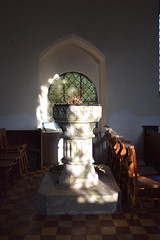
Opposite to the south doorway is the font, and beyond it
the now-filled-in north doorway, with a pretty modern
patterned window set in it. And to the east of this is
something very exciting. During the restoration of the
nave walls in the 1970s, remarkable 13th Century wall
paintings were found, which have been carefully restored.
They show a sequence of three moments in the story of the
Incarnation as described in St Luke's Gospel. From the
left, the angel appears to Mary at the Annunciation, who
appears uncharacteristically confident as she faces him.
Another angel has his back to her, and then there is
quite a large blank at this point in the sequence, where
something has been filled in. At first I wondered if it
is actually the appearance of the angel to Joseph.
However, if you look more closely you will see that the
angel is holding a censer. Now, this would suggest that
there was, in fact, an image niche in the missing part,
and possibly a second censing angel facing the other way
beyond. This niche has been replaced by a later window,
now filled in. After the Visitation, there is a faint but
exquisite Nativity, the ox and ass peeping tenderly over
the sleeping Christchild.
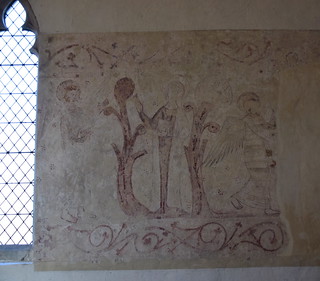  
The sequence forms the
first three joyful mysteries of the rosary, although of
course the sequence was rather less concrete at the time
this was painted in the 13th century. It is one of the
best wall painting sequences in Suffolk, somewhat
different in scale and style to the same subjects nearby
at Wissington.
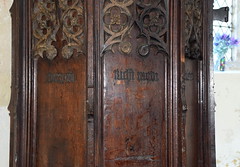
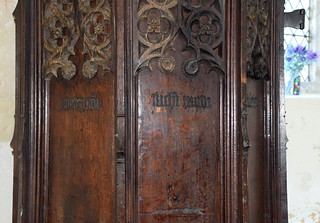
The paintings are so remarkable that you might not notice
something equally remarkable in front of them. This is a
pre-Reformation pulpit, in a wineglass style. Several of
these survive in Suffolk, but what makes this one so
special is that it retains its dedicatory inscription, Orate
P(ro) A(n)i(m)a Richi Modi et Leticie Consortis suae
('Pray for the soul of Richard Mody and Letitia his
wife').
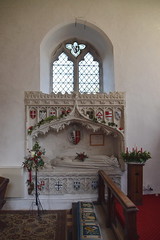
In the south wall, opposite the pulpit, is a low tomb
recess, with the effigy of a woman in it. The effigy was
found under the floorboards during the 1870s restoration.
Mortlock thinks it is in its right place, which is
probably so, although it does seem a little unusual. A
nice piece of Victorian sentiment is fixed to the back of
it, possibly from the panelling of the pulpit before it
was properly restored.
In any case, the most significant memorial here is up in
the parish church. You step through glass doors into the
intimacy of the chancel with its fine set of sedilia and
double piscina in the south side of the sanctuary.
Opposite is the tomb of Margaret Boteler, who died in
1410. The shields are all recoloured of course, but the
most remarkable thing is the detailing on her dress.
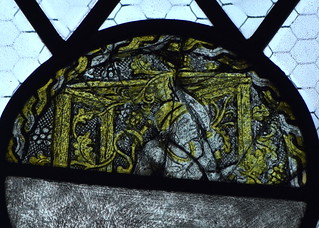
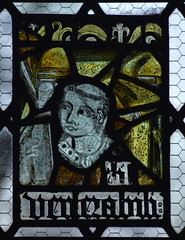
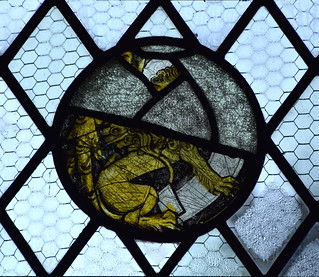
Another lovely detail in the chancel is the scattering of
medieval heraldic glass in the upper tracery of the grand
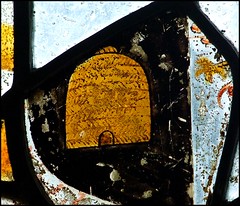
five-light east window, and the fragments of 15th Century
glass on the south side. These include an image of
someone trimming vines from the Labours of the Months,
the winged lion of St Mark and the head of a monk,
perhaps a donor. Fragmentary heraldic shields contain
little beehives in one of the quarters. Another panel is
so faded as to be almost indecipherable, but if you look
closely you can just make out the head and foreleg of a
horse, and the shadow of a man on his back. St George? St
Martin? It is hard to tell. Not inappropriate in this
church full of ghosts of the past.
Simon
Knott, January 2020
Follow these journeys as they happen at Last Of England
Twitter.

Amazon commission helps cover the running
costs of this site
|
|
|