St Nicholas, Oakley

www.suffolkchurches.co.uk - a journey through the churches of Suffolk
|
St Nicholas, Oakley |
|
|
||
www.suffolkchurches.co.uk - a journey through the churches of Suffolk |
||

Follow these journeys as they happen at Last Of England Twitter.
| Oakley is one of the beautiful,
rolling little parishes on the south bank of the Waveney,
sparsely populated and little-visited, although the
church tower will be familiar to many for being visible
on its rise from the main Diss to Yarmouth road which
runs about half a mile to the north on the Norfolk side
of the border. The church sits alone in the fields with
just one house for company, the churchyard tree-shrouded
and silent apart from the birds. Oakley has long been a
joint benefice with the neighbouring busier parish of
Brome. It seems to have been a wealthy benefice, for when
George Paterson was Rector here for forty years in the
19th Century, he was receiving more than £650 a year,
something like £130,000 in today's money. By the 1860s
he was contributing some of his riches to the Kerrison
family's rebuilding of Brome church, the work of the
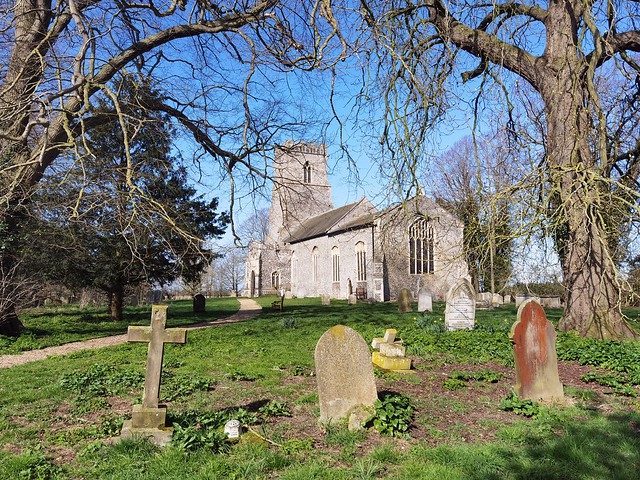
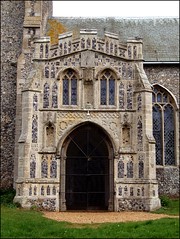
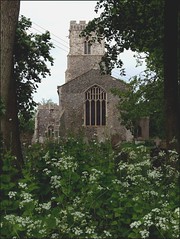
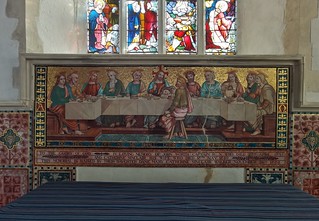
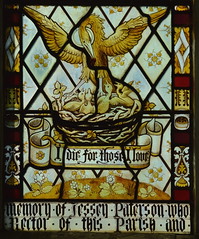
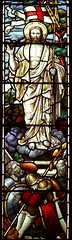
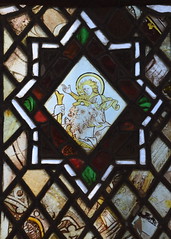
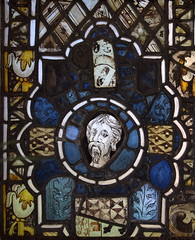
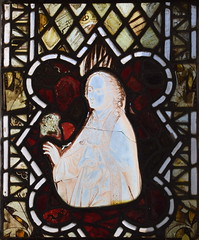
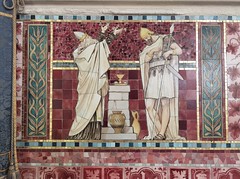
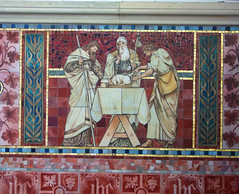
great Thomas Jekyll. Incidentally, the 1851 Census of Religious Worship is revealing about Brome and Oakley. The combined parishes had a population of 650, and a regular Sunday morning attendance of just over a hundred, the two churches alternating weekly in holding morning and evening services. That means about one in six of the population were attending the parish church on a Sunday morning, which was above average for East Anglia because of the enthusiasm for non-conformism. Congregational, Baptist and Methodist chapels often attracted larger congregations. However, there was nothing like that here. The nearest chapel was in Hoxne, but that was host to barely thirty people on a Sunday morning. The census noted that there were five Baptist families in the combined parishes, but that was all. Anglican congregations generally rose during the second half of the 19th Century, reaching a peak in the years after the First World War, before slowly falling away again. Those years of plenty are often reflected in the furnishings and decorations, and that is certainly so here at Oakley. The church looks bigger than it is. The 14th Century tower and 15th Century porch are familiar from other East Anglian churches, but there are no aisles, no clerestory. This is a simple church made to look grand by the enthusiasms of confident ages. The 15th century porch is perhaps the most impressive feature. They seem to have been proud of their porch at Oakley if wills transcribed by Peter Northeast and Simon Cotton are anything to go by. In 1430 John Hubert asked to be buried in the porch and left 20 marks to the fabric of the porch. In 1453 Simon Cordeburgh left the considerable sum of 20 shillings to the emending of the porch, and in 1506 Philip Cursson, a gentleman and alderman of Norwich, topped them all by requiring that I will that the chirche of Okeley beside Hoxen have marbill to the sum of XXs to patheyn the porch with all. At one time the porch had two storeys, but the upper floor has now gone. There is a collection of medieval fragments in the side windows including the top part of a St Christopher carrying the Christ child on his shoulders and the head of Christ as the Man of Sorrows. The flowers in some of the quarries might easily have been copied from the life in this churchyard. You step into what a simple,
aisleless building, a church of the ordinary people, as
ordinary as Brome's church is extraordinary. The fairly
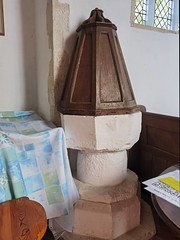
primitive font is set directly against the north wall as
was often the way before Victorian restorations. To the
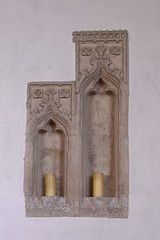
east, the roodloft stairs run up from a window sill on
the north side of the nave, as at Occold and Kenton on
the other side of Eye. Money began to be spent here in
the 1870s when all the furnishings were renewed, and then
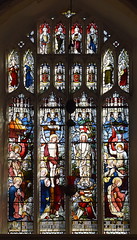
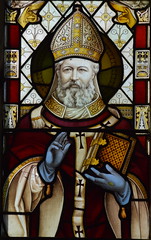
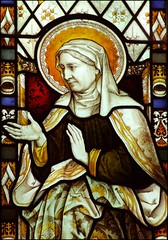
came the late 19th and early 20th Century glass by
Heaton, Butler & Bayne. The subjects of the glass
suggest rector George Paterson's enthusiasms, including
what must have seemed some fairly obscure Saints at the
time, including St Denys and St Longinus,some of which
have been given the faces of the Paterson family. Amongst
all this splendour is one quieter, later window which
remembers Maude Tacon of Brome Hall who bankrolled the
fabulous Anglo-Catholic makeover of Eye church at the
hands of her friend Ninian Comper. |
Simon Knott, April 2023
Follow these journeys as they happen at Last Of England Twitter.











|
||||||||||||||||||||||||||||||||||||||||||||||||||||||