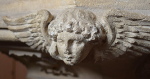
St Michael, Occold

www.suffolkchurches.co.uk - a journey through the churches of Suffolk
|
St Michael, Occold |
|
|
||
www.suffolkchurches.co.uk - a journey through the churches of Suffolk |
||

Follow these journeys as they happen at Last Of England Twitter.
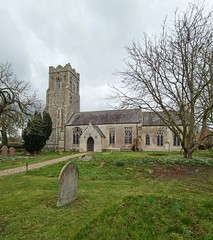
| We are in the rolling agricultural
landscape of north Suffolk, not far from the little town
of Eye which hides in the valley below. The great former
Eye airfield, now an industrial park, stretches away
northwards of the town, but here to the south of it
Occold is a quiet and intimate village that turns its
back on the modern world. Occold church is directly on
the high street, and the grand late medieval tower and
perpendicular windows cannot disguise the fact that it is
a simple, homely building. Peter Northeast and Simon
Cotton record a 1426 bequest by William Osmond of 40
shillings facturam novi campanile, which is to
say the making of the new tower. Birkin Haward noted that
the west window appears to be the work of the master
mason Hawes of Occold, a figure known for his work in a
number of churches in Suffolk and south Norfolk,
particularly a short way off at Eye. Apart from a few
small details like the Early English south doorway, it's
clear that the 15th Century saw a general rebuilding of
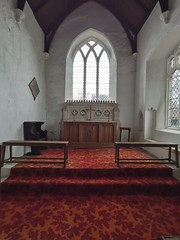
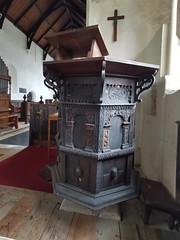
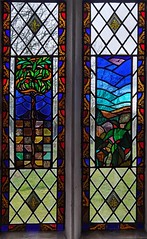
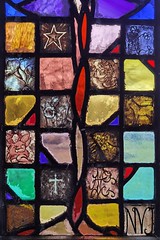
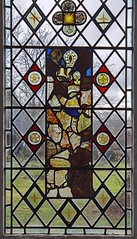
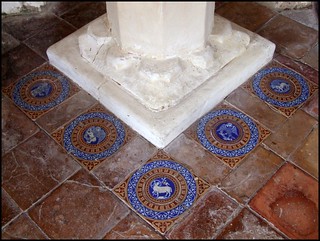
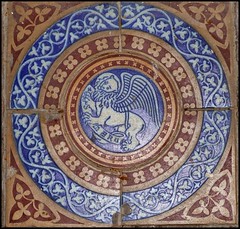
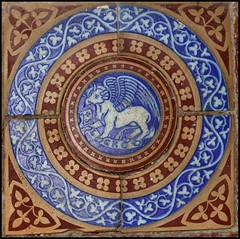
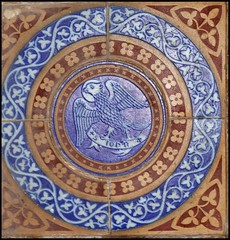
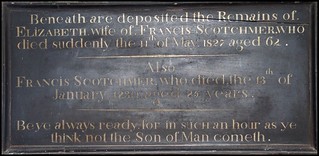
the whole of Occold church. You step through that doorway into a neat, light church, obviously well-used and well-looked after. The 19th Century restoration of the interior was robust without being particularly urban in feel, and it is easy to imagine the ploughboy and the blacksmith here. The 15th Century font has been reset oddly at an angle in the blocked north doorway opposite, with glazed tiles depicting the agnus dei and the four evangelistic symbols set about its stem. The bowl has been scoured of all imagery, perhaps vandalised by protestant-minded parishioners in the 1540s and then tided up by the Victorian restorers. Certainly the iconoclast William Dowsing makes no mention of the font in his journal entry for 30th August 1640, the day of his visit. Dowsing's visits often involved giving advice to churchwardens on how to comply with the new ordinances, which they would be keen to do. The ordinance of May 1644 had specifically mentioned imagery on fonts, warning that whereunto all persons within this Kingdome, whom it may concern, are hereby required at their peril to yield due obedience. However, it seems that the font imagery at Occold had already been dealt with. Instead, Dowsing turned his attention to some surviving images in stained glass, often left in place by parishes because of the inconvenience of replacing it with clear glass. Dowsing's journal records that divers superstitious pictures were broke. I came, and there was Jesus, Mary and St Lawrence with his grid iron, and Peter's keys. It is clear from the wording that Dowsing's visit had been made in person, but he further adds that the churchwarden promised to send 5s to Mr Oales before Michaelmas and concludes 5s paid. This adds up to 10s, which is curious, because Dowsing's standard charge for his advice was 6s 8d, or a noble, and he sometimes waived this altogether if he felt an honest effort had been made. The fine for failing to conform to the Act was much higher, although it would not be Dowsing who collected it. Trevor Cooper, in his 2001 edition of The Journal of William Dowsing, suggests that 'Mr Oales' was Alexander Ouldis of Thorndon, acting as Dowsing's deputy. The charge would make sense if Ouldis was expected to come and check that work had been done, for Dowsing usually charged just 3s 4d, or half a noble, if work had been carried out to his satisfaction, and 6s 8d added to 3s 4d makes 10s, the total charge levied on the Occold churchwarden, a noble and a half altogether. However, Dowsing's journal entry suggests that the work had been carried out to his own satisfaction, so perhaps there was something else. There are other medieval survivals. Two image niches are set in window splays either side of the nave, and on the south side the roodloft stairs rise up from the sill of the most easterly window to turn up through the wall about a newel rail. There is a 15th century brass to William and Johanna Corboulde beneath the carpet in the middle of the nave. In the chancel, an old stall has a misericord seat depicting the Assumption of the Blessed Virgin, the crowned Mary lifted through a cloud up to heaven by angels. In contrast, the wooden memorial board on the north side of the nave for Elizabeth and Francis Scotchmer is a plain and simple thing, surprisingly dating from as recently as 1830. Be ye always ready, for in such an hour as ye think not the Son of Man cometh it warns us in a near-puritan style, barely a decade before the Oxford Movement began to refashion the modern Church of England. On the north side of the nave is the sweetly naive Stuart royal arms, as though taken from a child's colouring book. Occold had been supportive of the Laudian project in the 1630s, beautifying its church with a font cover and pulpit. Some of the fragments of the glass broken down by William Dowsing have been collected in a window on the south side of the chancel, and the window to the east of it contains a lovely setting of small panels of glass brought together as a memorial to Nerissa Jones, a parishioner who died in 1985. She was an illustrator of children's books. The artist was Louise Spencer, and a description of the glass tells us that the imagery, although secular, was intended to fit in with the special atmosphere of the church, rather quiet and mysterious, and that some of the glass is recut Victorian glass from damaged panels found in storage. Images from Nerissa Jones' sketchbooks were included, fairies, flowers, elves and elegant letters. It adds to the sense of continuity, of ordinary people who have lived in this place. |
Simon Knott, March 2023
Follow these journeys as they happen at Last Of England Twitter.










|
||||||||||||||||||||||||||||||||||||||||||||||||||||||