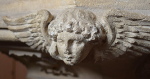
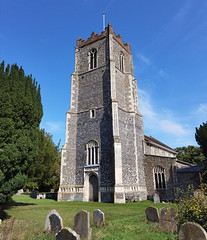
St Mary, Otley

www.suffolkchurches.co.uk - a journey through the churches of Suffolk
|
St Mary, Otley |
|
|
||
www.suffolkchurches.co.uk - a journey through the churches of Suffolk |
||



Follow these journeys as they happen at Last Of England Twitter.
Cycling around high Suffolk on a summer's
day can make the modern world seem very far away, but as
you come down along the narrow
lanes which dogleg through the ridges of rolling fields
from Monewden you emerge into the surprise of a proper
road just north of Otley. Soon there is a bus garage, an
old chapel, and then a shop, more cars and a housing
estate. You might even think that Otley was outer-Ipswich
suburbia, but this is a large, proper village, with a
strong sense of its own identity. Otley College, the
'agricultural college' of Ronald Blythe's masterpiece Akenfield,
is a mile or so away on the far side of the village. An enthusiastic series
of bequests in the late 15th Century left money for the
bells, but then curiously in 1510 John Gossenold left the
relatively large sum of 20 marks to the making of the
steeple (which is to say, the tower) in the
churchyard. Perhaps the tower had to be adapted to
accommodate the bells, but it is curious. In any case St
Mary was in a poor way by the 1830s, and in the first
years of the reign of Queen Victoria the church underwent
a considerable and largely pre-ecclesiological
restoration at the hands of the firm of Pink & Erlam.
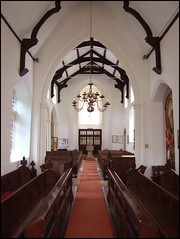
They shortened the chancel and reroofed the nave to which
a west gallery was added. The rector at the time was the
well-known evangelical Francis Storr, and his main
concern seems to have been to enlarge the capacity of the
church and to make it suitable for congregational worship
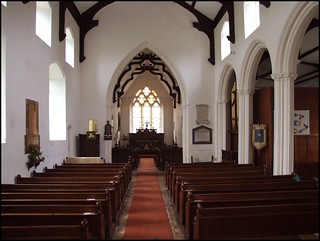
focused on the pulpit. However, another restoration of
the 1870s by HM Eyton tells a more familiar story of
removing the west gallery and refurnishing the church for
the fashionable High Church services of the day. All in
all it feels a fine old village church, with a sense of
continuity and the sense of being at the heart of a faith
community, at once rustic and yet renewed. A late medieval series of bequests unearthed by Simon Cotton and Peter Northeast give us a sense of the life of Otley parish in the years before the Reformation. In 1461 Edmund Ingold gave 9 marks towards buying an antiphoner. This was a large book in illustrated manuscript form used for the Sarum Rite liturgy of the Catholic Church. Agnes Woodward in 1474 left money for a pilgrim to go on pilgrimage to 3 different places, that is to say Walsingham, Woolpit and Bury St Edmunds for the soul of the testator and John Wodeward, her late husband. And in 1489 Peter Fletcher left 26s 8d for my executors to buy 22 brazen candlesticks to be placed on the candlebeam before the crucifix in Otley church and to the new bell in order to have a four-fold sound. Of course, the Reformation of the 1540s and 1550s put an end to all this, but an interesting insight into this church in the 17th Century is given us by the journal of WIlliam Dowsing, the Commissioner in the Eastern Association for 'the Destruction of Monuments of Idolatry and Superstition' according to the Ordinance of 1643. His journal details his progress through about three hundred churches in Suffolk and Cambridgeshire over the course of 1644. Dowsing's journal records a visit to Otley on 27th February, one of four churches in the journal for that day: A deputy brake down 50 superstitious pictures, a cross on the chancel, 2 brass inscriptions & Moses with a rod & Aaron with his mitre taken down & 20 cherubims to be taken down, 6s 8d. Trevor Cooper, in his 2002 edition of the Dowsing Journal, thought that the deputy was probably Thomas Denny, and it's not clear if Dowsing was supervising him or if the journal entry is an account of Denny's report afterwards. The superstitious pictures were all in glass, the cross on the chancel would have been the gable cross outside, the brass inscriptions would have had Catholic prayer clauses (Dowsing left inscriptions alone if they were not what he thought superstitious) and the 20 cherubims to be taken down would have been roof angels - the journal shows that an order was given for these to be removed rather than Dowsing or Denny doing it themselves, as it would have been a long job. The reference to Moses
with a rod & Aaron with his mitre is
interesting, because it is likely that these were not
medieval survivals at all, but painted panels flanking
the decalogue boards. A number of 17th and 18th Century
examples survive in East Anglia. It's the only time
Dowsing refers to such things, and it isn't clear why he
wasn't happy with them, as they were unlikely to have
been considered idolatrous. Maybe Denny was simply
playing it safe. It is worth saying that Dowsing was
warmly welcomed at most of the churches he visited, for
churchwardens were keen to obey the new law. The 6s
8d quoted in the journal was the charge for
Dowsing's advice. This was preferable to the fine of 20s
for not having carried out the work, although Dowsing
often halved his charge or waived it altogether where he
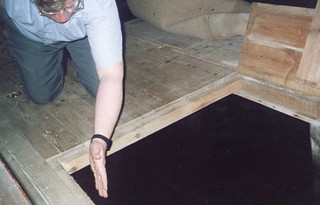
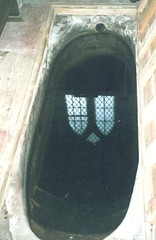
felt the churchwardens had made an honest effort. It is about six feet long and three feet wide, with an extension on the north side for the minister to stand in. There are steps down from the west end, which is also where the water flows in, draining from some part of the roof. It goes out through an overflow in the east end, probably into the pond which lies beyond the churchyard boundary. It appears to be made of concrete, although the varying layers of water over the years have created brick-like strata markings on the walls. The photographs I took on that occasion are towards the bottom of this page. There is a theory that the bath was installed by Anabaptists who had charge of the church during the 17th Century Commonwealth. It seems more likely that it was installed by an evangelically-minded rector in the early 19th Century, in which case it was probably Francis Storr. Nevertheless, of the dozen or so known surviving total immersion fonts in Anglican churches in England, this is one of the oldest. |
Simon Knott, January 2021
Follow these journeys as they happen at Last Of England Twitter.








|
||||||||||||||||||||||||||||||||||||||||||||||||||||||