All Saints and St Margaret, Pakefield, Lowestoft

www.suffolkchurches.co.uk - a journey through the churches of Suffolk
|
All Saints and St Margaret, Pakefield, Lowestoft |
|
|
||
www.suffolkchurches.co.uk - a journey through the churches of Suffolk |
||



Follow these journeys as they happen at Last Of England Twitter.
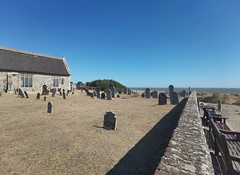
| Pakefield Cliffs can feel a
melancholy place, the grey North Sea grinding and
tumbling across the shingle below, and if it seems
threatening then there is good reason. All along this
coast, for centuries, communities have suffered from the
voracious appetite of the waves. At the start of the 20th
Century a new pier was built to the south of Lowestoft
docks which altered the movement of the tides to such an
extent that, over the next 30 years, Pakefield lost
dozens of houses and several whole streets. The
churchyard of All Saints and St Margaret, which now
stands precipitously above the beach, was then several
hundred yards from the waves' reach. Look at it now, only
time and a fragile sea wall separate this church from its
ultimate watery destiny. Until the 1930s, Pakefield
Parish Council clung stubbornly on to its independence,
refusing to be incorporated into Lowestoft Borough
despite the fait accompli that the sprawling
suburb of Kirkley had presented it with. The provision of
sea defences nearly bankrupted the village, and still the
sea took their houses. Eventually, they gave up in
despair, and surrendered themselves to urban living. The
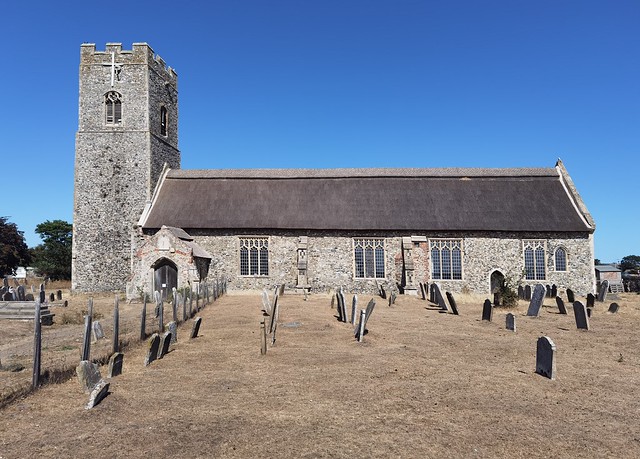
Borough became responsible for holding the line. Technically speaking, All Saints and St Margaret is not a church at all, but two separate churches joined by a party wall, serving two separate parishes until the 18th Century. All Saints is the church with the tower, and it sits to the south of the towerless St Margaret. Both appear to have been erected over the course of the late 14th Century, which may explain them having been built together in a shared churchyard. In1411 onwards the priest of St Margaret also became the incumbent of All Saints, and as James Bettley in his revision of the Buildings of England volume for East Suffolk explains, at this point the wall between the two churches was broken open and an arcade inserted. This also seems to have been the time that the time that the tower was built. But when the priest died in 1421 the two incumbencies were held separately again, and the arcade was filled in, and would not be reopened until the 18th Century. However, this decade of joining is an interesting snapshot, as we will see inside. If you had come this way before the
Second World War you would have seen the only surviving
Lenten veil pulley in all England, a 15th Century device
for drawing the Lenten curtain across the rood, to be
pulled dramatically aside at the Easter Vigil. Back in
the 1990s, when I had first read about it in Munro
Cautley's 1937 Suffolk Churches and their Treasures,
I hastened up here to see it. But there was something I
did not know, for on a night in April 1941 Lowestoft
suffered a serious bombing raid. All Saints and St
Margaret sustained a direct hit, and was more or less
gutted. The pulley was destroyed. After the war, plans
were discussed by the Diocese of Norwich to abandon the
church, and replace it with a modern church further
inland. But in the end it was restored, All Saints having
to be pretty much rebuilt, and a new interior took shape
within the shell of the old church.
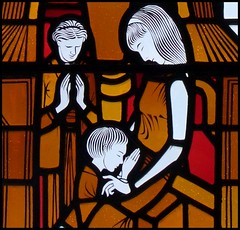
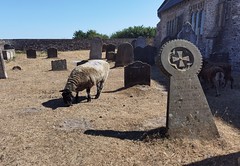
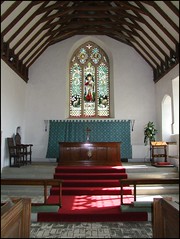
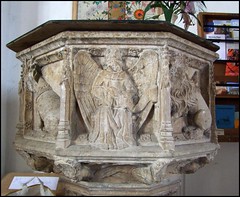
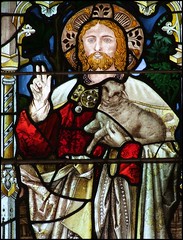
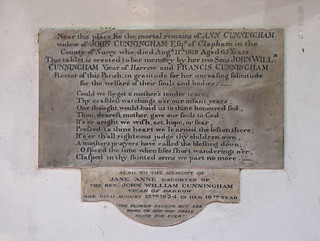
The image of Christ as the Good Shepherd by HJ Salisbury in the chancel is not so good. It has been restored at some point, presumably after the bombing, and the head of Christ replaced in a slightly different style and made of what looks like thinner glass. The original glass was installed to celebrate the protestant and evangelical ministry of a 19th Century Rector, presumably in reaction to the Anglo-catholic shenanigans up the road at Kirkley. There is a scattering of fragments of surviving medieval and continental glass in some of the upper lights. They are not the only older survival here, for mounted on the north wall is a set of brasses to John and Agnes Bowf, which is of interest because, dating from 1417, it is the earliest civilian brass in Suffolk. It is not in terribly good condition, but the fact that it survived at all is a testimony to the fact that it was mounted on the floor at the time of the German bombing. If there was a fire at Pakefield today it would run away like melting butter. As at nearby Kessingland, the font is a late 14th Century piece in unusually good condition, deeply cut and crocketted. It bears the badge of Richard II so was most likely the original font of All Saints before the arcade was opened up for the first time. To the east, and surprisingly perhaps, part of the dado of the screen survived the bombing, although the greater part of the structure dates from the 1950s. However, as with its predecessor it runs continuously across the two churches. James Bettley suggests that this dates it precisely to the second decade of the 15th Century, when the two churches were briefly joined to make a single liturgical space. As if to confirm this, there is a entrance cut above the arcade to allow passage from one side to the other. As with most coastal churchyards, there are some interesting and sometimes moving inscriptions on the headstones around the church. To the north west is a tall memorial erected by the Suffolk Humane Society to Nathaniel Colby, who was for many years coxswain to their Pakefield lifeboat and commanded her on the occasion of their saving (under divine providence) more than seventy shipwrecked seamen. He died at the age of 76 in 1882. Earlier in that century, the 1851 Census of Religious Worship had found that the Vicar of Lowestoft, the Reverend Francis Cunningham, was also Rector of Pakefield and Rector of nearby Kirkley! You might have thought that such proximate pluralism would allow him to attend to all three churches, especially as his annual income from the three was £750, roughly £150,000 a year in today's money, but no. He paid a curate, John Rumpf, to do all his work at Pakefield for £80 a year, and at Kirkley for another £50 a year, a total equivalent today to an annual salary of £26,000. Not bad for a poor Victorian curate perhaps, but exactly the kind of abuse that the Anglican revival of the second half of the century would do away with. |
Simon Knott, September 2022
Follow these journeys as they happen at Last Of England Twitter.




|
||||||||||||||||||||||||||||||||||||||||||||||||||||||