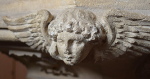
St Mary, Parham

www.suffolkchurches.co.uk - a journey through the churches of Suffolk
|
St Mary, Parham |
|
|
||
www.suffolkchurches.co.uk - a journey through the churches of Suffolk |
||


Follow these journeys as they happen at Last Of England Twitter.
| By a great sleight of hand, the
A12 dual carriageway threads through the most intensely
rural heart of Suffolk, and yet a mile or so from its
course you wouldn't even guess it was there. Small,
beautiful villages are joined by lattices of tiny lanes
which meander sleepily about the fields and copses of
sprawling, empty parishes. They are in no particular
hurry to get anywhere. In the villages you can still find
the occasional old-fashioned pub, and for miles around
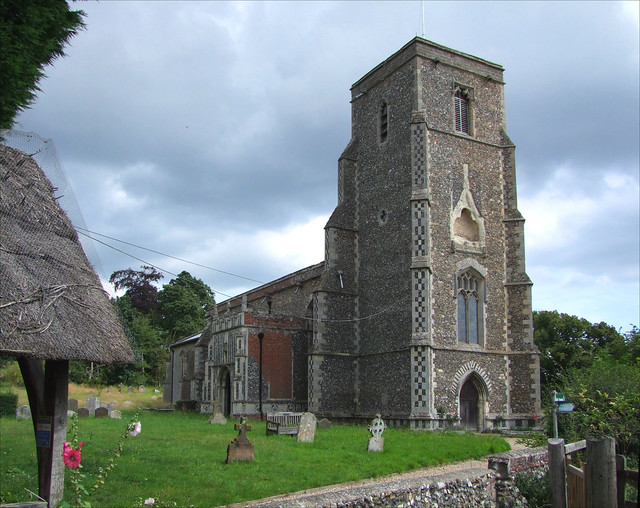
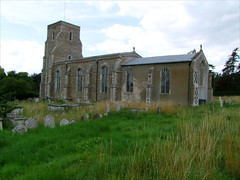
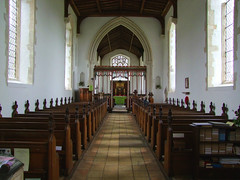
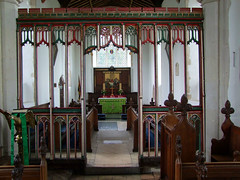
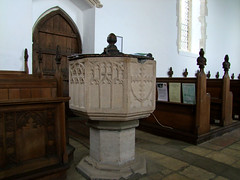
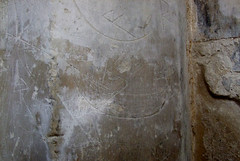
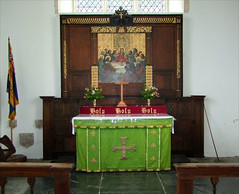
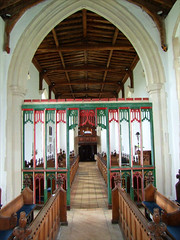
the churches are all open every day, pretty much. Parham has no pub, but it does have an interesting and in some ways an unusual church. The heart of the village, pronounced Parrum, the first syllable the same as the first syllable of the word parrot, is not far from the busy road which connects Framlingham to the A12, and the church is set in a little dip with ancient houses in attendance. The fields that rise to Parham Hall to the east were the setting for many of the outdoor scenes in the first series of the award-winning BBC television programme The Detectorists, and this church is one of several in Suffolk to make an appearance in that programme. You enter the churchyard by a pretty thatched lychgate in the north-west corner, and the graves sprawl away south and eastwards across the attractive but particularly uneven and bumpy churchyard. The structure largely dates from a major rebuilding right at the very end of the 14th Century which was bankrolled by the Earls of Suffolk. At first sight, the most striking feature of the exterior of the church is the large niche on the western face of the tower. It probably held a rood group, the crucifixion in the middle, with St John and the Virgin Mary on either side. From what remains above the niche you can see that it would have had an elaborate canopy, although this is now mostly lost. The eastern buttresses of the tower are parallel to the tower eastern face and there are no battlements on the tower, making it seem rather severe, especially with the low nave roof. The tower a few miles off at Rendlesham is similar. There was a refurbishment a hundred years after the rebuilding, giving the window beneath the niche and the grand north porch with its typical Suffolk flushwork, now a vestry, the result of a bequest of 1456. The nave windows were also replaced at this time and are tall and stately, making the church seem larger than it actually is. Unusually for Suffolk, you enter the church from the west, beneath the gallery. The interior is surprisingly spacious given that there are no aisles. The overwhelming sense is of light, for there is very little coloured glass and the dado panels of the rood screen were removed in the 1880s, leaving just the tracery painted in a gay red and green. It gave Cautley the horrors, and even made Mortlock tut, but the whole building has a sense of space because of it, unusual in a church so comprehensively restored in the 1880s. The reredos beyond is a simple and seemly structure, a cobbling together of 17th Century woodwork with a picture of the Last Supper in the Russian style. Above it is some good 15th Century glass, albeit restored. Four angel musicians in the upper tracery look on with the serious faces of that century.
England's medieval churches are
deposit and treasure houses of the folk memory of their
parish. Here at Parham the Corrance family were the
people at the Big House. Frederick Snowden Corrance was
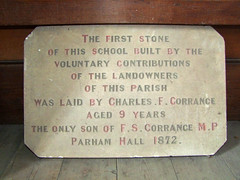
the Conservative MP for East Suffolk, and in 1872 his
nine year old only son Charles laid the first stone
(though it was probably a brick) of the village school.
The building has now gone, but the dedication plaque
survives, and is in the church. It notes that the
school was built by voluntary contributions of the
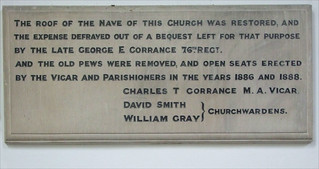
landowners of this parish. Another plaque records
that, in the following decade, the roofs and pews were
replaced by a bequest from George Corrance, who was
presumably Charles Corrance's grandfather. His uncle,
another Charles, was vicar at the time. A folk memory of
an earlier time is preserved in the form of a graffito of
a ship at the west end of the nave, reminiscent of that
not far off at Tunstall. |
Simon Knott, January 2021
Follow these journeys as they happen at Last Of England Twitter.



|
||||||||||||||||||||||||||||||||||||||||||||||||||||||


