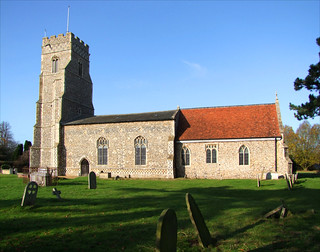
St Peter and St Paul, Pettistree

www.suffolkchurches.co.uk - a journey through the churches of Suffolk
|
St Peter and St Paul, Pettistree |
|
|
||
www.suffolkchurches.co.uk - a journey through the churches of Suffolk |
||


Follow these journeys as they happen at Last Of England Twitter.
| Pettistree is set on a pleasantly
straggling street just off what was once the main London
to Great Yarmouth road, but it is now thankfully
bypassed. The placename probably means 'Peter's tree',
which is interesting given the dedication of the church.
It sits in the heart of its village, a long church with a
powerful tower. The style of the nave is grand 15th
Century East Anglian Perpendicular, and yet there are no
aisles and never were any, and at some point the
clerestory has been blocked up. The buttressing to the
eastern face of the tower makes it seem remarkably stark,
and the same effect can be seen not far off at
Rendlesham. Frederick Barnes restored the chancel in the
1880s, but Pevsner was confident that not much had been
changed other than the addition of an organ chamber. The
14th Century Greyhound Inn on the edge of the churchyard
was perhaps once used by the church for its guild ales, a
juxtaposition found elsewhere in Suffolk at Fressingfield
and Laxfield, and which must have once been more common. There is no south porch, and a simple doorway lets you into a narrow and yet light interior thanks to the large windows and very little coloured glass. It is a strikingly tall interior, and the overwhelming impression is of successive 19th Century restorations. There are furnishings from the 1860s and a large square font which, if slightly later, may show the influence of diocesan surveyor Herbert Green who was a neo-Norman enthusiast. There are brief memories of earlier liturgical enthusiasms including the remains of an image niche in the jamb of a window, with the very top of what appears to be a piscina arch surviving to the east of it. Curiously, there are two more piscinas either side of the chancel arch. A couple of 15th Century benches with poppy heads stand proudly at the front of the range of seating. Up in the chancel, a 14th century angle piscina was rescued by Barnes and reset. Francis Bacon's late 16th Century figure brass memorial with his two wives has been reset on a wall. Beyond it, the glass in the east window is by Clayton & Bell. Pettistree's 19th Century restoration may speak loudest to us now, but Peter Northeast and Simon Cotton transcribed wills that tell of the quite different life of this place during the early 16th Century, in those unsettled decades as the Church hurtled towards the Reformation. In 1508 Stephen Crowe left to Pettistree church oon vestment that is to say the choseebylle the passe the awbe the stole the phanton with the amyce lyke of color and cloth to the best cope.These were liturgical vestments in the form of a chasuble, cincture, alb, stole, maniple and amice. In 1528 the will of Thomas Starke required the curate of Pettistree to say placebo and dirige with ryngyng upon the rogacion monday at nyght with masse the next daye and halff a bushell malte browen in ale or beer to be spent at the dedemannys grave by the inhabitants of pitistre whan they go procession upon the rogacion tuesday and they of there charite to pray for my soule and all christen soulys. Thus Thomas Starke ordered a Vigil Mass and the ringing of the church bells on the night of the Monday of Rogation to be followed by drinking around his grave after Mass and the Rogation procession the following day, where the people of Pettistree would also pray for his soul. Sam Mortlock reminds up of the six bells in the tower at Pettistree, three of which are pre-Reformation. The story goes that, having remained silent throughout the Second World War, they were rung in celebration of victory on May 8th 1945, and appeared to make cracks in the tower. And so they remained silent, until everything was restored in the late 1980s. Two of the medieval bells bear Latin inscriptions invoking the help of St Nicholas and St John, but the third says Me Clamante Ihesu Maneat Bethleem Sine Lectu. This seems to mean 'While I ring out, let there remain a bed in Bethlehem for Jesus'. Perhaps the donor of the bell was the keeper of the adjacent Greyhound Inn. |
Simon Knott, March 2023
Follow these journeys as they happen at Last Of England Twitter.


|
||||||||||||||||||||||||||||||||||||||||||||||||||||||