| |
|
The gentle rolling
landscape between Halesworth, Beccles and Bungay
is always a pleasure to cycle. There are so many
narrow lanes meandering pleasantly towards
nowhere in particular, and the three main roads
on the outside of this triangle seem to pick up
virtually all the traffic.The villages are mostly
quiet and peaceful, the churches mostly open
Redisham is the nearest village to Brampton
railway station, one of the most remote in
Suffolk. In the days before phone train apps,
when I used to have to buy a paper ticket to
here, the man behind the counter at Ipswich
station who knew of my cycling activities used to
make a little joke about whether I want the
Brampton in Suffolk or the Brampton in Cumbria.
He told me that I was the only person he'd ever
sold a ticket to for the Suffolk one. When I told
him that there isn't much to the Suffolk Brampton
- except for the railway station, of course - he
listened as if I was Marco Polo bringing back
tales of foreign lands.
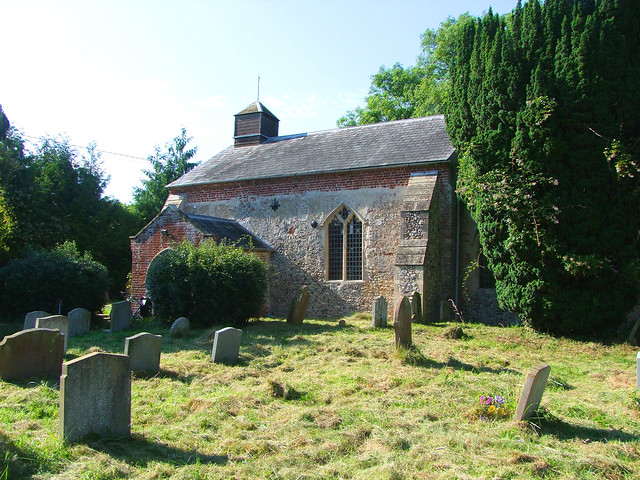
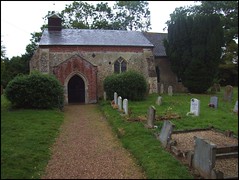
St Peter is a pretty little church, lovely on its
green cushion. Sam Mortlock described it as
'unobtrusive', and indeed it is easy to miss it
if you don't know exactly where it is. But when
you find it you'll be pleased to discover that it
is open every day - on my most recent visit in
July 2016, the inner door was propped open with a
brick. The little bell turret at the west end is
rather squat, and from a distance it looks a
little like a chimney, as if this was a cottage.
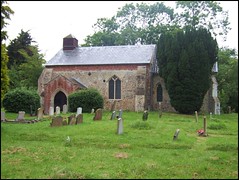
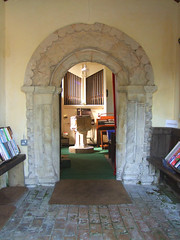
The most striking feature as you approach is the
grand Norman doorway in which is set the south
entrance. This, then, was a Norman church. The
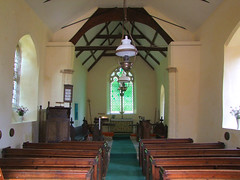
interior is even prettier than the exterior, and
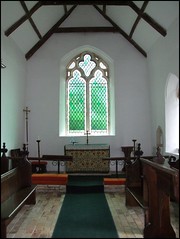
the clear light is coloured by one of the finest
early 20th Century windows in this part of
Suffolk. It is the work of Christopher Webb, and
depicts Christ beginning his mission by summoning
the fishermen, including this church's patron, St
Peter.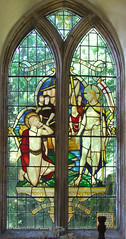 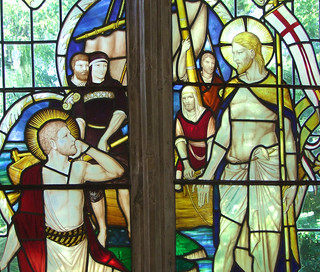
The 19th Century
restoration by Butterworth was gentle to St
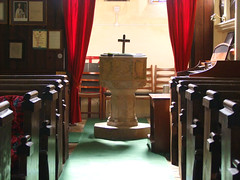
Peter, and the brick floors give the interior
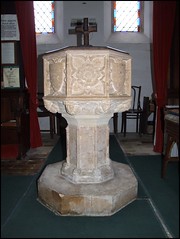
great character. There are a few impressive late
medieval survivals: the font is elegant and
harmonious, with blank shields which must once
have been painted alternating with roses. Best of
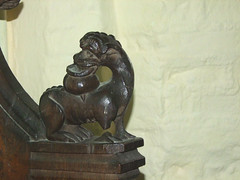
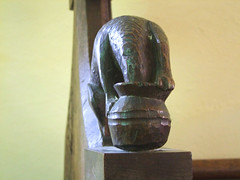
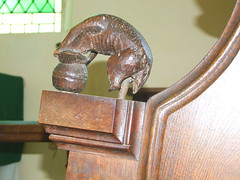
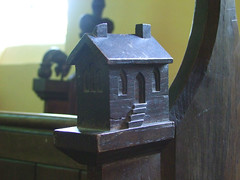
all, up in the chancel, I liked the bench ends.
An old one shows a creature reaching back to eat
from a pot on its back. A modern companion is a
bear licking out another pot, as if he was Winnie
the Pooh.
Outside, I pottered about
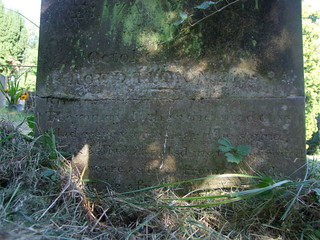
the churchyard. I was looking for a gravestone
mentioned by Mortlock, and I found it in a line
to the west of the path. It is to an 11 month old
girl, Eliza Westrup, who died in 1840. Her birth
was obviously the result of an illicit tryst, and
the father either unknown or denied. The
inscription is an unveiled attack on him, and it
is fascinating because it uses the Puritan
language of two centuries earlier. Interestingly,
the gravestone is set facing away from the path,
unlike all the others:
Remember me as you pass
by, tho' you my father did me deny.
Glad were you to hear the sound of the bell that
passed me to the ground.
If you were free from sin as I, you would not be
afraid to die.
As I am now so you must be, therefore prepare to
follow me.
|
|
|