St Gregory, Rendlesham

www.suffolkchurches.co.uk - a journey through the churches of Suffolk
|
St Gregory, Rendlesham |
|
|
||
www.suffolkchurches.co.uk - a journey through the churches of Suffolk |
||

Follow these journeys as they happen at Last Of England Twitter.
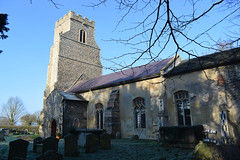
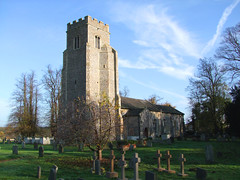
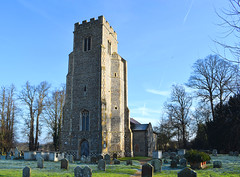
Rendllesham is in an area of Suffolk that has seen considerable changes over the last forty years or so. Back in the eighties the parish was home to RAF Bentwaters, one of the largest and busiest American airbases in Europe, and there was another American airbase a few miles off at Woodbridge. The Americans seemed an exotic species back then. To cycle past the perimeter fences of the housing, gazing in at the big American cars sitting on the driveways and the kids playing baseball, was to see a people in comfortable possession. And around the bases the great Rendlesham and Tunstall forests flourished. And then in October 1987 the Great Storm destroyed a million trees in Suffolk, and was particularly cruel to the forests of the east of the county. Not long afterwards, the Berlin Wall fell, and the Americans left, leaving empty holes in this district. For many years their absence was most striking if you stood in Wantisden churchyard beside the perimeter fence of the great Bentwaters airbase which stretched away to the horizon, abandoned and derelict. Today, you would not think that for almost half a century Rendlesham village was virtually a small garrison town. In more recent years the former base was sold for housing, and the population of this village has increased greatly. The former airbase chapel, now dedicated to St Felix, has been reopened as a second church for the parish. Rendlesham's parish
church is set in the fields on the far side of the
village from the air base, on a backroad which runs off
of the Woodbridge to Orford road. The road climbs and
dips between the rolling fields of the Deben Valley, and
it is easy to forget that you are close to the sleeve of
the busy A12.
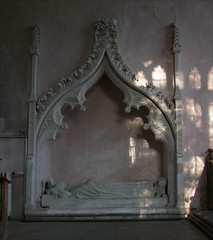
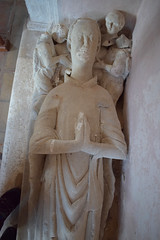
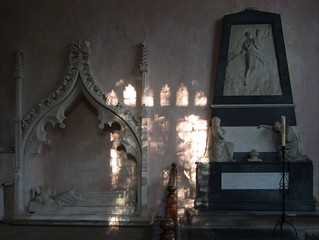
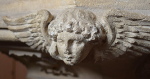
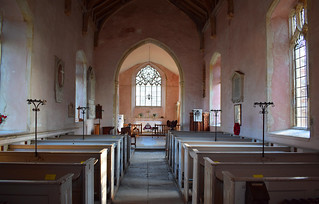
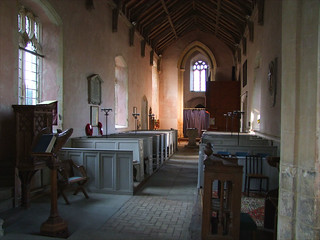
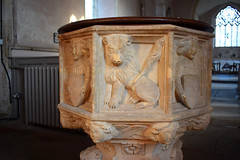
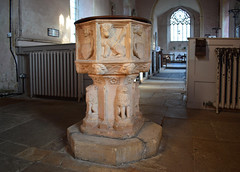
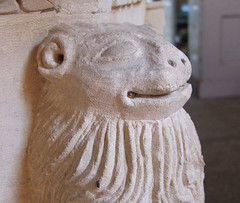
Most imposing of all is an effigy in a wide 14th Century tomb recess, probably for a priest who died in the years before the Black Death. Broken angels cradle his head, and seem to whisper in his ears. Behind a wine glass pulpit, the rood stairs wind up from the chancel arch into the south wall. The font is a typical example in the 15th Century East Anglian style, with cheerful lions and angels supporting the bowl, and on its panels. There is a Table of Fees similar to the one at nearby Pettistree. As old as this place is, Rendlesham was a place of note much further back in history. Long before this church was built, Rendlesham was the capital of Anglo-Saxon East Anglia. King Redwald and the Wuffinga ruled a country from here, one of the major kingdoms of early medieval Europe. A straight path can be traced from here to Sutton Hoo, the royal burial ground, nowadays an archaeological site of national significance. The way the road diverts around the churchyard suggests that it is an ancient site, perhaps the site of a pagan temple. The story told of King Redwald was that he was baptised on this very site, but that he later recanted in deference to his pagan wife. Perhaps it was from here that his body set out, to be carried on its final journey to the great ship burial on the hill above the Deben. |
Simon Knott, April 2021
Follow these journeys as they happen at Last Of England Twitter.







|
||||||||||||||||||||||||||||||||||||||||||||||||||||||
Amazon commission helps cover the running costs of this site