All Saints, Ringsfield

www.suffolkchurches.co.uk - a journey through the churches of Suffolk
|
All Saints, Ringsfield |
|
|
||
www.suffolkchurches.co.uk - a journey through the churches of Suffolk |
||



Follow these journeys as they happen at Last Of England Twitter.
A delightfully set
and deceptively rural church for Ringsfield is actually a
large village to the south of Beccles. The parish name
may be familiar to X-Files fans and UFO
conspiracy theorists, because this parish was one of the
centres of the great crop circle enthusiasm of the 1970s,
presumably because its name and that of neighbouring
Shipmeadow seemed deliberately chosen by the Anglo-Saxons
to encourage flying saucers to land. I'm told that there
is one Ringsfield farmer who still cuts a crop circle
into his barley field to attract tourists, to whom ice
creams may be sold.
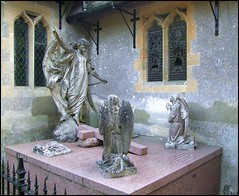
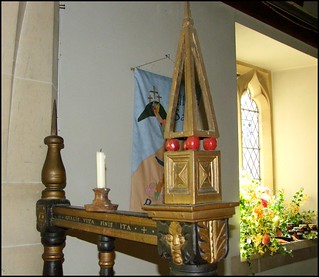
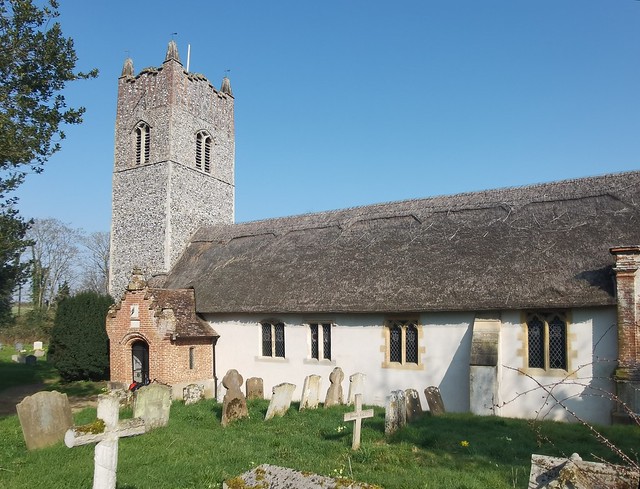
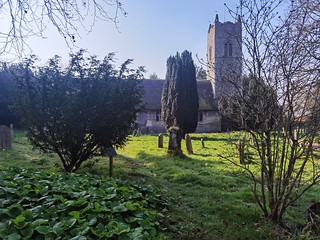
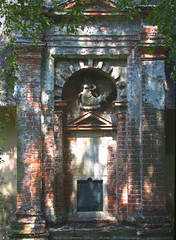
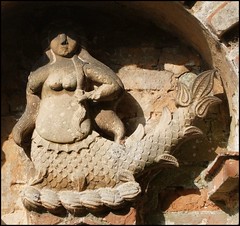
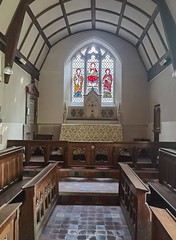
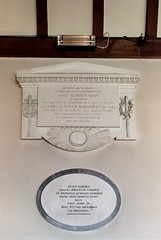
Apart from the tower and the western two thirds of the nave, the church was substantially rebuilt by William Butterfield in the 1880s. He was also responsible for the refurbishments at nearby Ellough and Redisham. The church appears sunken within the graveyard. You have the impression of walking between green and yellow banks to reach the red brick 15th Century porch on the far side. Here, on the south side of the church there is another splendid sight, for a great red brick memorial to Nicholas Garneys, who died in 1599 was reset here at the time of the Victorian restoration. A tall arch encloses a terracotta mermaid. The memorial has that great rarity, an external brass, a copy of the one for his grandfather not far off at Kenton. Oddly, a modern brass headstone nearby remembers Thomas de la Garde Grissell who died in 1915 and is in the form of a peacock. You step into a church which can feel quite dark even on a sunny day. Butterfield's extension of the nave and rebuilding of the chance accentuates what is a common feature of churches around here, the sense of being in a long tunnel. This sense is increased further at Ringsfield by the dimness of the interior, punctuated as it is by jewel-like windows. Butterworth took out the box pews and even a western gallery, and so this interior must have been very cramped indeed. A great curiosity is the Jacobean wooden screen. It is painted gold and black and decorated with Latin texts and carving. The finials are jaunty pyramids, and I do not think I have seen another quite like it. James Bettley thought it was probably the work of the Laudian Robert Shelford, rector here at Ringsfield for the first four decades of the 17th Century. His simple memorial is set in the wall nearby.
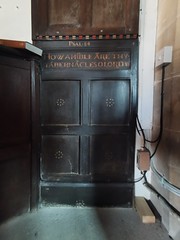
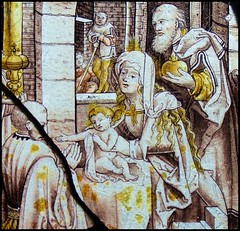
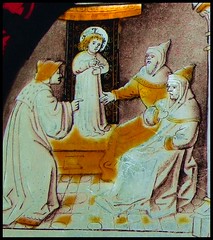
Beside the screen is the contemporary pulpit, or, at least, what is left of it. Pulpits of this period are rather more common than screens, of course, but what survives here apart from the back boards is the octagonal tester, a sounding board placed above the minister so that his sermon could ring out. It is octagonal but small, perfectly in proportion, and the whole piece must have looked very elegant when complete. Beyond, in Butterfield's chancel, are some contemporary stalls. Presumably the lost box pews and west gallery were of a similar date. You can't help imagining what this interior must have looked like before Butterfield got his hands on it. To the south, there are two good panels of continental glass, probably dating from the 17th Century and installed here as the gift of a collector. One depicts the Adoration of the Magi, while the other is a delightful and simple roundel of Mary and Joseph looking for the infant Christ. Unseen to his parents, he is glimpsed through a doorway, standing on a table in the temple, preaching.
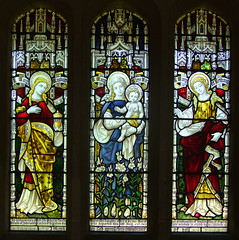
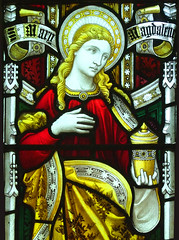
The east and west windows came as part of Butterfield's restoration, the work of Bell & Beckham who worked with Butterfield at Ardleigh over the Essex border. The west window of the Annunciation is in their familiar style, whilst in the east window the figures of Christ in Majesty flanked by St Peter and St Paul are set somewhat uneasily in clear glass surrounds. I wonder if this was a later alteration, possibly to let in more light. The glass along the north side of the nave is by Clayton & Bell and was installed over the last two decades of the Century. The start of the 20th Century here saw the restoration as pretty well complete, a pleasing result overall and a bit of a period piece. |
Simon Knott, December 2022
Follow these journeys as they happen at Last Of England Twitter.










|
||||||||||||||||||||||||||||||||||||||||||||||||||||||