St Michael, Rumburgh

www.suffolkchurches.co.uk - a journey through the churches of Suffolk
|
St Michael, Rumburgh |
|
|
||
www.suffolkchurches.co.uk - a journey through the churches of Suffolk |
||


Follow these journeys as they happen at Last Of England Twitter.
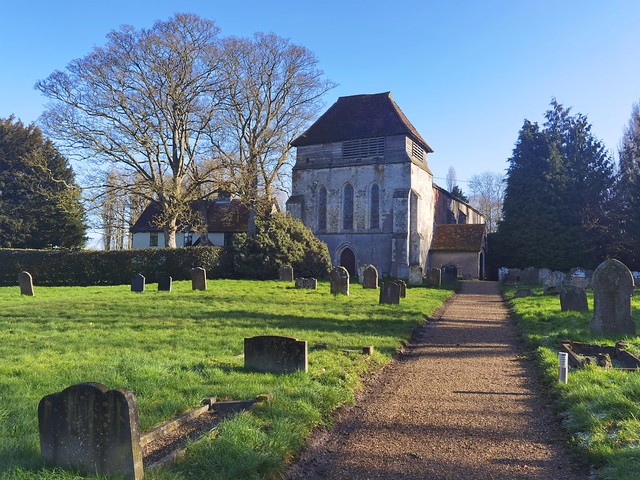
| The first sight of Rumburgh church
is memorable as you approach the churchyard across a
paddock from the Halesworth road. The churchyard lies
entirely to the west of the church, and the three tall
lancets in the wide, stumpy tower beyond lead the eye to
a wooden belfry stage, common enough in Essex perhaps but
an exotic beast around here. You inevitably ask yourself
if this all of it that ever there was of it, or was it
once taller? A further oddity is that the tower is as
wide as the church, but its depth is narrow in
proportion. It appears to be entirely the work of the
13th Century, and that it is so different in style to
other Suffolk churches may be due to the fact that this
building was not built as a parish church at all, but as
the church of a Benedictine priory. It was founded
shortly before the Norman conquest, and James Bettley in
the revised Buildings of England volume for East
Suffolk suggests that the plan is oddly Saxon,
with tower, nave and chancel all exactly the same width,
indicating that the later church that we see today was
built along the lines of the earlier one. The tower may
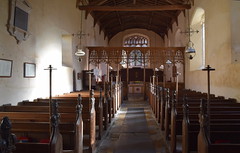
have taken the place of a more typical Saxon west porch. The priory had chapels at neighbouring Wissett and Spexhall, both surviving as parish churches. Within fifty years of its foundation, Rumburgh Priory had passed into the ownership of St Mary's Abbey, York, until Cardinal Wolsey sequestrated it in 1528 for funds to build his college at Ipswich. Intriguingly, a number of bequests have been recorded by Peter Northeast and Simon Cotton towards to rebuilding of the tower at Rumburgh. In 1456 John Alberch left the not inconsiderable sum of 40s to the building of the church and tower. There was more money left towards the new building of the tower by Robert Tye in 1465 and in 1483 Geoffrey Barrett left money to the reparation of the new tower in Rumburgh. The earliest of these bequests is almost a century before the Reformation, and the later bequests seem to suggest work being planned if not actually begun, but it seems that nothing was ever done. Th entrance to the church is through the south porch, and it is worth pointing out that the north, east and south sides of the church beyond the porch are on private land, the garden of the neighbouring house. But you step into the strange atmosphere of the church, one that might be accurately described as a sober silence. There is no coloured glass, and yet the light falls rather dimly through the quarries onto wood and old brick floors. Despite the 19th Century furnishings of the nave there is an austerity which perhaps conjures up something of this building's long past. The 15th Century font has
quatrefoils on its faces, rather like the contemporary
font a couple of miles off at Spexhall, although the font
there has shields set in the quatrefoils. Turning east,
the narrow nave leads you to the screen which broods
rather gloomily at the point where the nave morphs into
the chancel. The roofs are continuous, there is no other
division. But if you look at the screen closely there is
gessowork under the varnish as on the screens at
Bramfield and Southwold. This is a kind of plaster which
is applied wet to a screen or font, and then when it
dries it can be carved more delicately than wood or stone
can. It suggests that the donor was a person of some
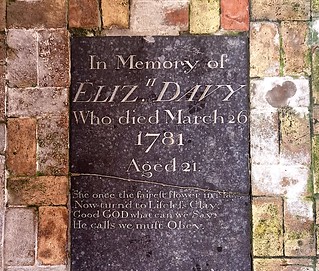
means. Sam Mortlock quotes in full the epitaph for Elizabeth Davy, set in stone on the floor. So I shall do the same: She once the fairest flower in May, now turned to lifeless clay; Good God, what can we say? He calls, we must obey. It seems a fitting memorial for this rather sad place. Some Suffolk churches have a timelessness about them, a sense of continuity. But here is a church in which a sense of the past pervades all. To sit here is to be surrounded by ghosts, by stone-cold age. There is much to be impressed by here. But it was rather a relief to step outside, back into the sunshine, and the birds singing in the churchyard. Back into to the 21st Century. Simon Knott, February 2022 Follow these journeys as they happen at Last Of England Twitter. |



|
||||||||||||||||||||||||||||||||||||||||||||||||||||||