| |
|
A return to Rushbrooke, and
I knew it would be the same. Only the landscape
changes as the seasons turn, and I have been here
in all seasons, both in the heat of high summer
and with snow on the ground. Now, at the end of
September, autumn was mellowing out, and a breeze
from the east was beginning to tug at the
goldening leaves. And I remembered another visit,
a good ten years previously, one bright Saturday
in early spring. That day, I do not think I had
ever seen so many hares before, but they were in
every field as I headed south-east out of Bury St
Edmunds up the rambling, hilly lane to
Rushbrooke. I'd seen half a dozen before I was
even a mile from the turn-off. Two of them were
having fisticuffs near the pig fields, and I
hauled my bike off into the verge to watch.
I must have stood there for twenty minutes,
gazing through the hedgerow, and they must have
known I was there - the pigs certainly did. But
spring madness had infected them, and they had
other priorities than worrying about me. I got
even closer to one old fellow. He was as big as a
dog, and lay sullenly in the furrow of a ploughed
hillside barely twenty feet from the road.
Perhaps he was sulking that, at his age, he was
missing out on all the excitement. Eventually he
lifted himself out of the rut, and hauled himself
up the bank, his powerful legs kicking back
slowly behind him, as if he owned the place.
Which, of course, he did. And so I got back on my
bike and, with the lunatic hares oblivious to the
way they lifted my heart, I had free-wheeled my
way down into Rushbrooke.
And today it was good to come back again. If you
like something a little out of the ordinary, then
Rushbrooke is exactly the kind of place you'd
find interesting. On its ridge above the valley,
this little settlement is quite unlike any other.
Rushbrooke Hall, home to generations of the
Jermyn family, was Suffolk's largest and finest
moated Tudor mansion. Used for housing troops
during the war, it suffered a mysterious fire,
and was demolished without permission in 1961.
Pevsner called it a capital loss, a
tragic disruption of the post-war Suffolk
landscape.
There is a late medieval brick well house at a
turn in the lane, set between rows of
extraordinarily good farmworkers' cottages. They
were built in the early 1960s, by the
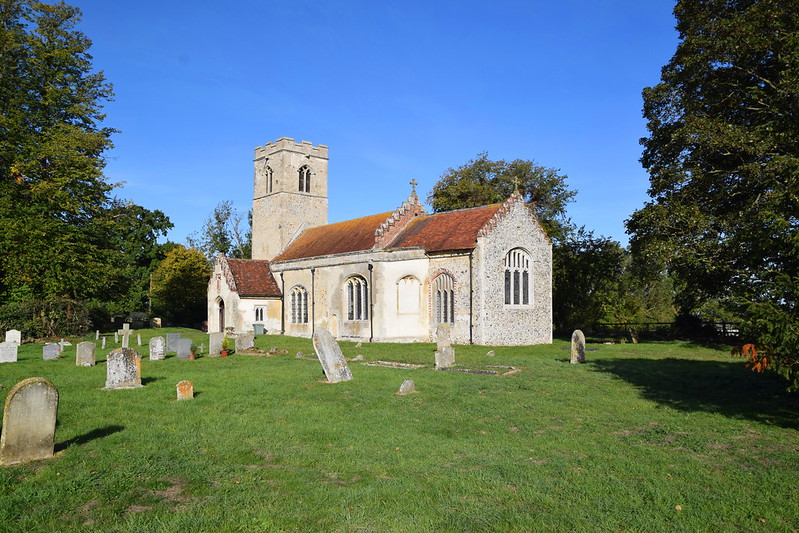
Llewelyn-Davies and Weekes Partnership. St
Nicholas is just beyond, looking reassuringly
familiar, its 14th century tower and 15th century
everything-else all plastered. Mortlock tells us
that, beneath this skin, the tower is flint, but
the rest brick. Indeed, brick surrounds are
evident on several windows. There are fine
headstops on the west window, and on the windows
of the south aisle. There seems to have been an
early 16th Century makeover, which brought the
porch and south doorway, and perhaps the
crow-stepped gables, the height of which show
that the church was once thatched.
If I tell you that this church was extensively
restored in the 19th century, you might imagine a
well-polished but anonymous interior, all Minton
tiles and deal benches. You'd expect recut
stonework and a garish reredos. It would all be
pleasantly ordered for late 19th century
sacramental worship, rather out of date now
perhaps, but obviously cared for, as at thousands
of other English village churches.
If you thought that, then you would be in for a
mighty surprise. For this is perhaps the most
extraordinary of all Suffolk church interiors. It
is the work of, and a testimony to, one of the
great Suffolk eccentrics. The first time you
realise that something decidedly odd has taken
place is when you step from the porch into what
you believe to be the south aisle. Instead, you
find yourself in a most unusual vestibule. To the
east, your right, is a solid partition wall with
a door in it, blocking off the south aisle. A few
feet ahead of you is a wooden partition, less
substantial, and not going all the way up to the
ceiling. The intention seems to be a baptistery,
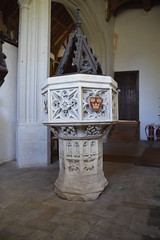
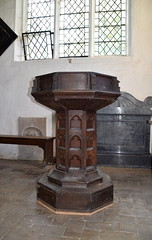
and there are two 19th Century fonts, a stone one
set on a medieval base, and beside it a wooden
one.
I'm not sure where the stone one came from. It
was brought here in the 1980s, and reunited with
its column. It may even have been placed on the
original base, which had been removed in the 19th
century and obviously spent a century or so out
of doors, to judge by the weathering. But the
wooden font is more interesting, a piece of
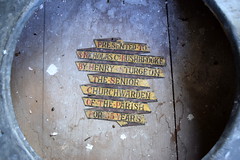
Victorian curiosa. If you look inside, beneath
where the bowl would be placed, an inscription
tells us that it was presented to St Nicholas
Church Rushbrooke by Henry Sturgeon the senior
churchwarden of the parish for 35 years.
Behind the font, low down on the wall, is a
monument to the man responsible for Rushbrooke
church being the way it is today, Colonel
Rushbrooke, who lived at the Hall in the early
19th century. If you have already visited nearby
Nowton, you will have seen there the 84 roundels
of Flemish glass plundered by the Rushbrookes
from Belgian monasteries. Here, Colonel
Rushbrooke recycled panelling from the Hall and
other sources to create a glorious Gothick
Fantasy.
For the best first impression, ignore the
entrance into the main part of the church ahead
of you, turn left, go past the fonts and enter
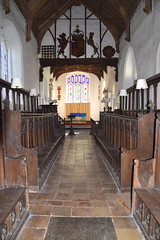
the body of the church from the west. As you pull
aside the curtain and step inside, you may be
unbalanced slightly for a moment by the sheer
lack of familiarity. Colonel Rushbrooke, inspired
perhaps by happy memories of his youth, recreated
here a college chapel quire, along the lines of
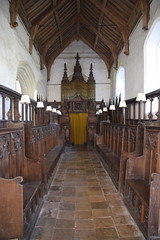
Peterhouse, Cambridge. Banked dark seats face
inwards, awaiting choral scholars. Old bench ends
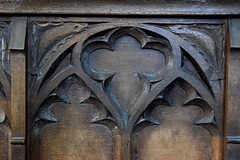
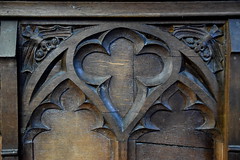
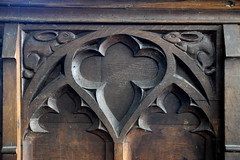
were pressed into use, but the arcaded carving in
the 15th Century style along the fronts is all
the work of the Colonel, the spandrels depicting
pairs of sturgeons, shrouded skulls, dragons and
even rabbits.
At the west end, above your head as you enter,
there is a grand array of organ pipes. In fact,
they are an elaborate fantasy, a conceit
connected to no instrument, purely for
decoration. Turning east, the tympanum is still
in place, and on it is something even more
remarkable, which we'll return to in a moment.
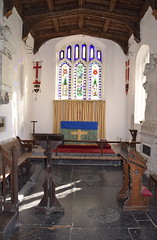
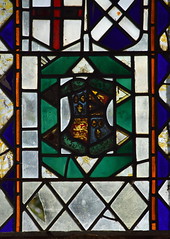
Beyond, the chancel is full of light, a balance
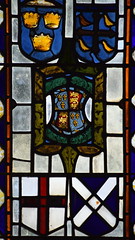
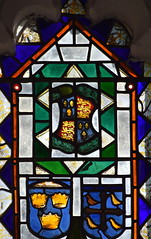
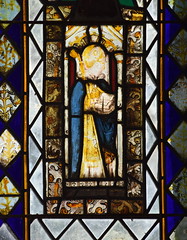
to the serious gloom of the quire. Medieval glass
is offset by blue surrounding panes, and the
banners of Jermyns and Rushbrookes hang down in
front. If you turn southwards, you see that the
part of the south aisle partitioned off from the
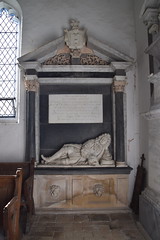
entrance. It forms a funerary chapel to the
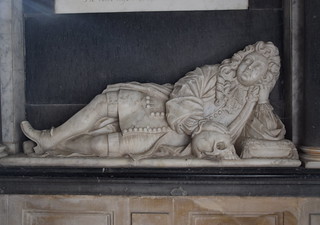
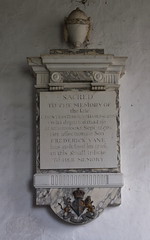
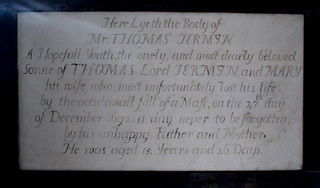
Jermyn family. Of several monuments, the best is
to Thomas, the last of the Jermyns. He died in
1692, in a boating accident on the River Thames.
He was just 15 years old. A mast collapsed, and
landed on his head. And so, after centuries, a
great landed family became extinct.
Colonel Rushbrooke's vision is at once absurd and
splendid. And yet, perhaps he thought that it
wasn't quite triumphant enough, and did not
articulate sufficiently the Establishment of the
Church. So, on the tympanum at the east end of
the nave, he put in place the great royal arms of
Henry VIII, the only Henrician set of arms in all
England.
 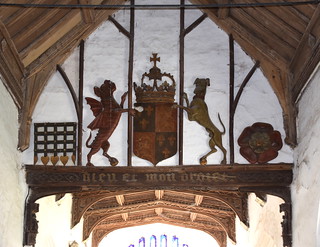 
Various claims have been made that
the arms are, in fact, genuine. The church
guidebook still insists on this, pointing out
that an installation could have happened at the
time of the rebuilding of the roof in the 1530s.
Before scoffing, it is worth exploring further.
The set of arms was not here in 1840. Its placing
in the church therefore roughly coincided with
Colonel Rushbrooke's reordering. Thus far, simple
enough. And yet, the coat of arms is a rather
more primitive piece of work than the furnishings
of the chapel below. Simply, it looks
older. In raised lettering on the former rood
beam below it is the motto Dieu et mon Droict.
We know that Henrician coats of arms were put
into churches. At the time of the Marian
restoration in the 1550s they would have been
removed and destroyed. It is simply beyond all
theological and political credibility that a set
could have survived in situ. No symbol
of loyalty to the crown could be used to express
disloyalty to that crown. They were all replaced
by crucifixes - or, at least, that was the
intention.
At Ludham in Norfolk, the tympanum was retained,
and the rood painted on it. Elsewhere, roods seem
to have been reconstructed enthusiastically, but
Mary died before her counter-reformation was
solidly in place. Also apparently destroyed, of
course, were Edward VI arms, although in practice
these must have been few and far between. If most
churches obeyed the order to install the royal
arms of Henry in the previous reign, we may
assume that those which didn't would hardly have
been disposed to install them as an act of
submission to the lunatic policies of his young
son's advisers. There were no Marian arms, and
Suffolk's only set of Elizabeth I royal arms is
at Preston, a magnificent object. There are three
more in Norfolk of about a dozen surviving
Elizabethan sets in all England, that's all.
So, where did this set of arms come from? Is it
possible that it could be genuine, and removed
from a church by the order of 1553, it survived
the 290 years in storage somewhere? And then,
Colonel Rushbrooke found it, bought it, and
installed it here? Is it even possible that it
came originally from this church, and was stored
at Rushbrooke Hall?
Or is it possible that the arms are something
wholly different, and were never designed for a
church? The arms of Henry VIII are also those of
Henry VII. Many were produced in the late 15th
and early 16th centuries to further the hegemony
of the Tudor cause. Rushbrooke was an
enthusiastic collector, and might have tracked
this set down in a public building, for instance.
He was enough of an antiquarian to know that a
Henrician set in a church would be unique.
Or perhaps this is all complete speculation, and
he made them specially. Cautley hedged his bets,
although his posthumous editors scoffed. Mortlock
was also tongue-in-cheek about it, but I don't
suppose that we will ever really know.
In the years I have been coming here, I have
grown very fond of this utterly unusual little
church. It is quirky in so many respects, from
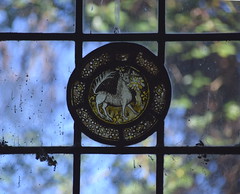
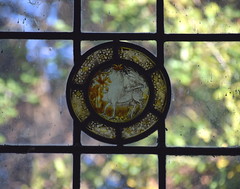
the aspects already described to the splendid
little Flemish roundels of unicorns, which didn't
make it into Nowton, the skulls carved deep into
the walls of the south aisle, and the great
hatchment hanging a few feet above the floor. It
was good to see it all again.
Stepping outside into the churchyard, you can
wander across to the enclosure of Rushbrooke
graves. In this lonely spot they seem grander
than they are, and it seems odd to think of the
major landed families who have this church and
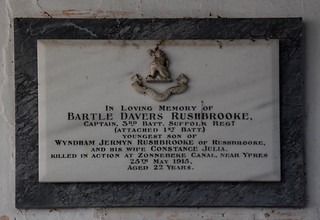
churchyard as a touchstone. As well as the
Rushbrookes, there are the Jermyns inside the
church along with the Davers and the Hervey
families into which they married, not to mention
the Rothschilds who have owned the estate for
these last eighty years or so. One of the
Rothschilds is buried to the south-east of the
church beneath a simple headstone.
|
|
|