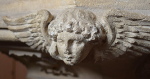
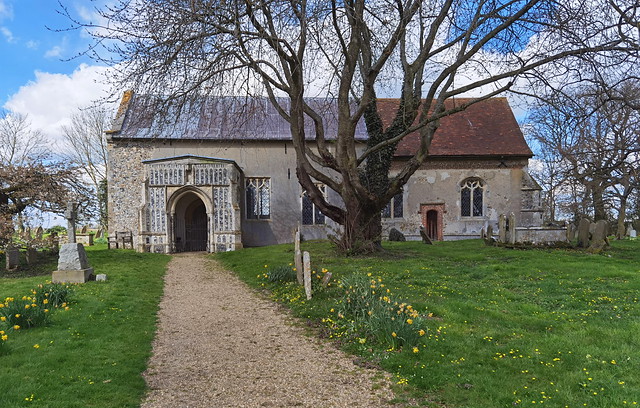
All Saints, Saxtead

www.suffolkchurches.co.uk - a journey through the churches of Suffolk
|
All Saints, Saxtead |
|
|
||
www.suffolkchurches.co.uk - a journey through the churches of Suffolk |
||


Follow these journeys as they happen at Last Of England Twitter.
The busy A1120
bypasses Framlingham, but hurtles through the
neighbouring straggle of Saxtead on its impatient journey
towards the coast. Saxtead's best-known building is its
post mill, which sits on Saxtead Green about half a mile
from All Saints. The church is far less prominent than
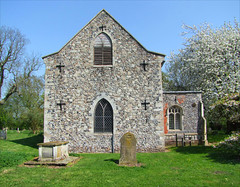
the mill. It lost its tower on the 8th July 1805, one of
several in the county that collapsed before the
Victorians had a chance to restore them. One wonders what
the Suffolk landscape would be like today if the Oxford
Movement and the 19th Century revival had never happened.
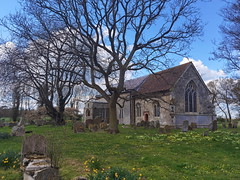
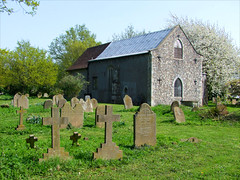
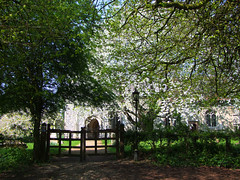
The surviving little structure with its odd western face
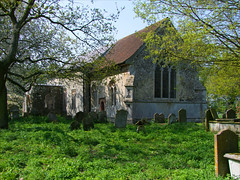
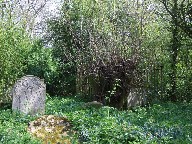
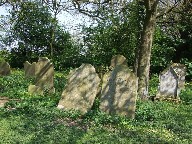
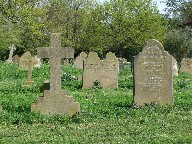
is constrained within and hidden by a tight churchyard
full of mature trees, which look very beautiful, but make
photographing the exterior in summer difficult. You could
easily drive past without noticing it. The porch is a
typical 15th Century Suffolk job, all flushwork and
niches. The church it stands against is much older, and
we still see it largely in its 13th and 14th Century
form.
Peter Northeast and Simon Cotton found a number of early 16th Century wills which tell us something about the late medieval life of this place. In 1504 Reynold Dalby left 13s 4d (two nobles) to the painting of the canopy, meaning the ceilure above the rood screen, and the same amount to the making of an image of St Margaret, with the tabernacle. Anne Davys left the remarkably large amount of £4 towards the price of a cope in 1504, and the following year Thomas Boton left 12 marks for an antiphoner. But there was still work to be done on the fabric of the building. Margaret Boton in 1507 and John Boton in 1508 left money towards the making of a boterasse (buttress) and Peter Bedyngfelde left 33s 4d to the reconciling or hallowing of the church, which seems to mean either to the fabric or to the devotional furnishings. Thomas Norman's 1534 bequest to the making of the church porch is odd, for surely the porch is older than that. But thereafter, the Reformation intervened, so perhaps a planned replacement porch was never built, and the canopy, image, tabernacle, cope and antiphoner were all either burnt or sold for profit. One of the most
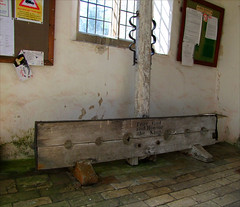
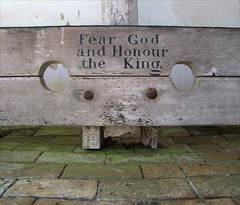
interesting features of the church is the set of stocks
and whipping post in the porch. Similar survivals can be
seen in the porches at Redlingfield and South Elmham St
Margaret and also at Ufford where they are by the gate. I
think this set is the best of all, though. They bear a
warning to 'Fear God and Honour the King' - none of this
wishy-washy liberal nonsense in the 18th Century Church
of England. |
Simon Knott, April 2021
Follow these journeys as they happen at Last Of England Twitter.



|
||||||||||||||||||||||||||||||||||||||||||||||||||||||
Amazon commission helps cover the running costs of this site


