All Saints, South Elmham All Saints

www.suffolkchurches.co.uk - a journey through the churches of Suffolk
|
All Saints, South Elmham All Saints |
|
|
||
www.suffolkchurches.co.uk - a journey through the churches of Suffolk |
||


Follow these journeys as they happen at Last Of England Twitter.
| There is no village, although this
of itself is not unusual in this part of Suffolk. A
farmhouse, a huge former rectory, a disused garage and a
couple of cottages are barely company for the curious
church, for it sits out in the fields, and the road up to
it falls short by a hundred metres or so. A designated
footpath leads along the edge of a ploughed field, and
will take you to the east side of the churchyard, but it
isn't easy going, even outside of winter. However, the
parish is not without at least one superlative, for after
the the Reformation it was consolidated with that of
neighbouring St Nicholas which had lost its church. And
so today, as South Elmham All Saints and St Nicholas, it
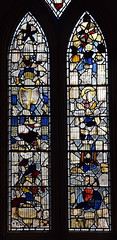
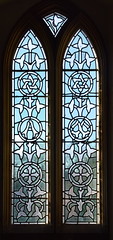
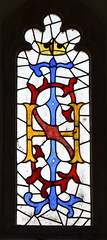
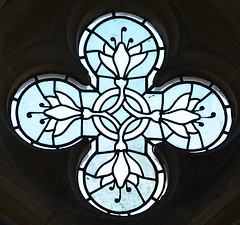
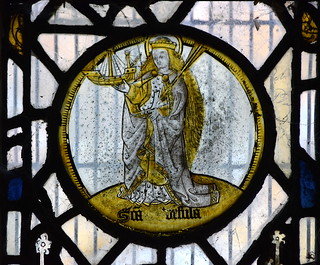
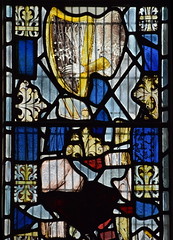
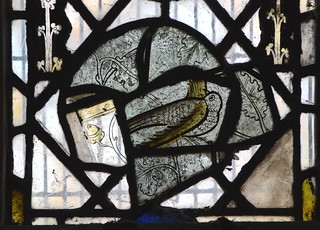
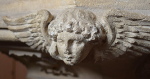
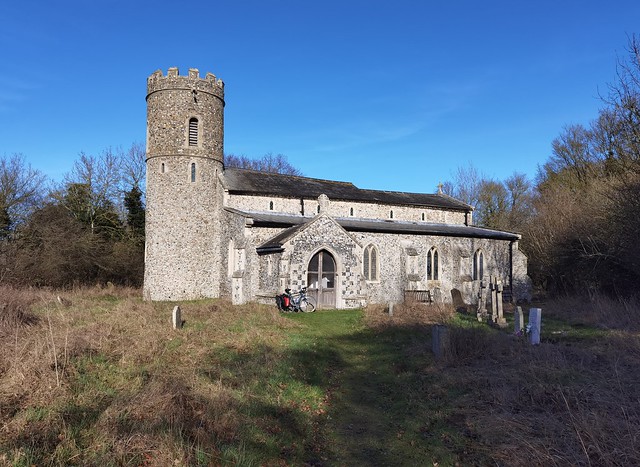
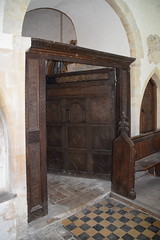
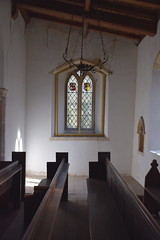
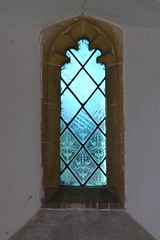
has the longest name of any parish in Suffolk. The reward for the walk is a delightful setting, especially when the churchyard is high with the wild grasses of early summer. There is a crispness to the exterior, and it was all heftily restored in the 1870s, a late date for what was done inside, but the exterior is a curious mixture of Decorated and Norman. James Bettley in his revision of the Buildings of England volume for East Suffolk thought that the architect was likely to have been the diocesan surveyor Richard Phipson. In 1910 the 15th Century octagonal bell stage of the Norman round tower was replaced with an embattled circular stage, with Norman-style bell windows to match. You step into a narrow south aisle which opens beyond a great square Norman font into the nave, also narrow of proportion and feeling rather cramped with a surfeit of 19th Century furnishings. The character is that of a prayerbook church, one of few in the county from that century, which devoted most of its energies into reinventing them as sacramental spaces. A pulpit sits between the two large windows on the north wall, and all the benches are angled towards it. Such a protestant restoration was most unusual in the 1870s, when even the arch-evangelical and future Bishop of Liverpool J.C. Ryle was using the eastwards position at Helmingham and then Stradbroke. However, despite the considerable rebuilding and refurnishing here there are a number of older survivals. The tower arch is screened off by 17th Century panelling that seems designed for the task, Even more than this, All Saints is the only church in the Saints with substantial medieval survivals. On the north side there are two dear little roundels of Continental glass. One is of St Ursula holding a ship and an arrow, and the other of St Dorothy with her flowers, sending a basket of fruit to Theophilus, the messenger here shown as the Christchild. In the south aisle are two composites, one largely consisting of part of a harpist, the other a curly-haired angel. As if this were not enough there is some very good 19th Century glass. The floral decorative glass is likely to have been made by Emily Owles & Son of Halesworth, so similar is it to the workshop's glass at Bramfield, and indeed to glass at Dennington credited to Constantine Woolnough of Framlingham who may well have been the designer for the windows in all three churches. There are also two lancets with what appear to be monograms in that may also have been made by the Owles workshop.
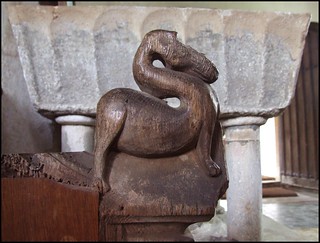
Beside the font is a medieval bench with two curious bench ends. One is a floppy-eared dog, while the other is a creature with a long, curved neck. It is probably intended as a giraffe. These were known to late-medieval Suffolkers (there is another on a bench end at nearby Dennington) but they appear not to have known that their long necks would be erect. There is something particularly
enticing about a church which has such a sense of its
19th Century days. At the time of the 1851 Census of
Religious Worship, before the major restoration here,
there were two hundred and thirty two people living in
this parish, an extraordinary number compared with today.
Most of them must have lived and worked on local farms,
and on the morning of the census eighty-seven of them
made there way here for George Sanby, the Rector of
Flixton, to lead them in divine worship. This figure of
one in four is relatively high for this part of Suffolk,
and another thirty-three were in the local Methodist
church, suggesting that they were a particularly
religious lot in this neck of the woods - or, perhaps,
that the local landowners were insistent that their
employees went to church. Simon Knott, February 2022 You can also read a general introduction to the churches of the Saints. Follow these journeys as they happen at Last Of England Twitter. |




|
||||||||||||||||||||||||||||||||||||||||||||||||||||||