St James, South Elmham St James

www.suffolkchurches.co.uk - a journey through the churches of Suffolk
|
St James, South Elmham St James |
|
|
||
www.suffolkchurches.co.uk - a journey through the churches of Suffolk |
||


Follow these journeys as they happen at Last Of England Twitter.
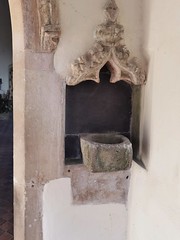
| St James sits out on a limb, away
from the other Saints. The climb up to it is so gentle
and steady that you might not notice, but in fact it is
the highest parish above sea level in East Suffolk. The
churchyard is small and pleasingly full of headstones. It
provides the setting for a late 13th Century tower and
some 13th Century features in the otherwise Decorated
style walls, although as usual in the Saints it is the
12th Century that provides a few Norman details that
indicate the true date of the building. A curiosity in
the porch is a mortar which has been fitted beneath a
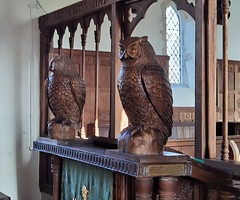
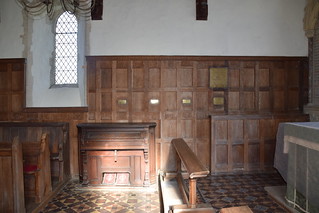
fine Decorated canopy to form a holy water stoup. You step into a space which is clearly much loved and cared for. The Victorian restoration was at the hands of Diocesan surveyor Richard Phipson, but more recently the church was beautified by its enthusiastic parish. Sir Shafto Adair of Flixton hall was the patron of the living. He was also an enthusiastic carpenter, and he led a parish woodworking class which over a period of several years produced the rood screen as a war memorial, carved reliefs which are set in the chancel wall, and most memorably of all a large, idiosyncratic lectern which features two more-than-lifesize owls which flank the desk and look out on to the congregation. Adair's wife Mary designed the lectern and he himself carved the owls for it. In fact, they are not the originals, for these were stolen in the 1990s and have been replaced by replicas.
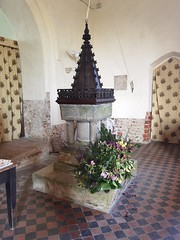
Two brass figures of a civilian and his wife of about 1500 sit in the nave floor. They are unidentified, but a bequest of 1517 by Thomas Ashby of Hoxne left half a noble to the reparation of the rood loft of St James, and it is tempting to think that this couple might be the Ashbys. The font is Norman and it seems likely it was made for the Norman church. It is topped by an extraordinary crown of a font cover which Pevsner thought 15th Century, and which is as idiosyncratic as the rest of the woodwork in the building. More medieval woodwork stands at the west end of the south aisle, where what was probably the medieval rood screen now cordons off a vestry. But the real treasure of this church is the medieval relief of St James in the chancel, above the priest door. I was told that it had been given to the church in the 19th Century by the vicar of neighbouring Rumburgh, but it isn't clear where he got it from. It may even have come from this church originally. Simon Knott, February 2022 You can also read a general introduction to the churches of the Saints. Follow these journeys as they happen at Last Of England Twitter. |





|
||||||||||||||||||||||||||||||||||||||||||||||||||||||