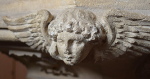
St Margaret, South Elmham St Margaret

www.suffolkchurches.co.uk - a journey through the churches of Suffolk
|
St Margaret, South Elmham St Margaret |
|
|
||
www.suffolkchurches.co.uk - a journey through the churches of Suffolk |
||


Follow these journeys as they happen at Last Of England Twitter.
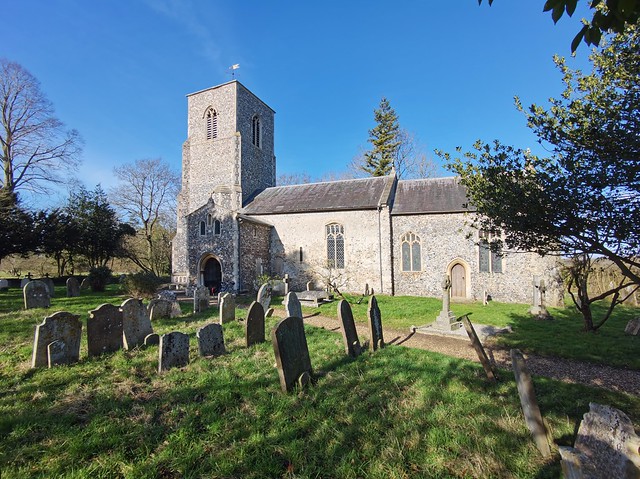
| South Elmham St Margaret is that
rare thing among the Saints, for it is a proper village,
stretching for half a mile or so along the curving road
between Homersfield and Halesworth. For much of the way,
council houses add a touch of life to the place, several
of them with roadside stalls selling eggs, flowers and
apples. I liked this a lot. The church is in the tightest
part of the curve, with a hemmed in churchyard with a
good collection of 18th and early 19th Century
headstones. There were considerable bequests in 1524 and
1526 to the bilding of the steple, and this is
odd, for as Pevsner points out the tower is surely
entirely of the 14th Century. The obvious conclusion is
that the Reformation intervened before the rebuilding of
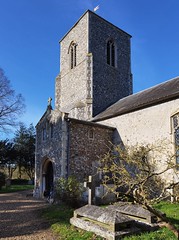
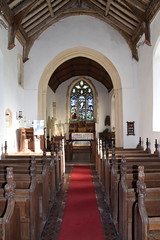
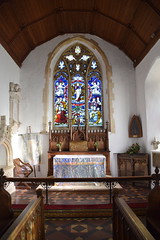
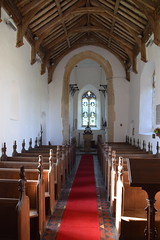
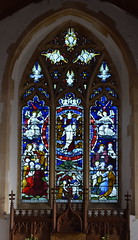
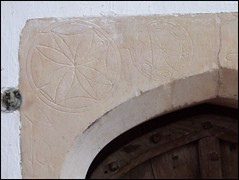
the tower on a grander scale could begin. The tower has pretty little windows in its stair turret, but the outside was generally sanitised by our old friend Phipson in the 1870s. In the porch are the old village stocks, and it takes a moment or two to work out what is strange about them, for there are an odd number of holes. Stepping through the Norman south doorway, you enter this lovely little church. This is a small church, richly furnished and pleasing to the eye. The roof is simple yet beautiful, accentuated by the high tower arch. The glass in the west window is probably by FC Eden, who was very busy indeed a few miles off at Barsham. This also seems to have been an uncharacteristically wealthy parish, and as well as the Eden glass there is good glass here by the Ward & Hughes and Clayton & Bell workshops A striking feature of the chancel
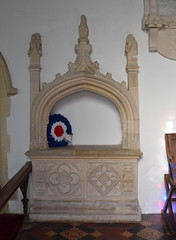
is the early 16th Century Easter Sepulchre, late and
crisply carved, but if it was also a tombchest then we no
longer know who it belonged to. It is small, compact,
like its church. A rare survival, and one easily missed,
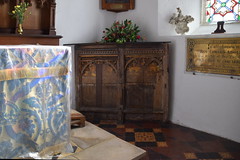
is the section of the rood screen dado reset in the
corner of the sanctuary to make a table. The figures are
barely discernible, but Mortlock thought that one of them
was probably St Hubert, which would be a unique survival
in Suffolk. Simon Knott, February 2022 You can also read a general introduction to the churches of the Saints. Follow these journeys as they happen at Last Of England Twitter. |





|
||||||||||||||||||||||||||||||||||||||||||||||||||||||