| |
|
 |
|
The Shotley Peninsula runs
like a flame, or a tongue, between the
Rivers Stour and Orwell as they sprawl
lazily towards the sea. At Shotley Point,
the two rivers meet before emptying into
the grey North Sea, the great industrial
expanse of Felixstowe Docks on the north
bank dominating the scene, while prettier
Harwich to the south busies itself
looking purposeful. You can stand all day
at Shotley Point watching. There is
always something to see: the vast
container ships bringing Chinese
televisions and Vietnamese shoes, the
ferries with their cargoes of sleepy
Dutch and German motorists, small Arthur
Ransomesque yachts speeding out of the
Orwell with its marinas, a wherry of
London bankers sipping Pimms in the
sunshine, wondering where their next
bonus is coming from... In
winter this is a wild place, the gales
from the great German Ocean flattening
the hedgerows, the windows of the Bristol
Arms rattling in the gusts along the
empty streets, the ghosts of HMS Ganges,
the Royal Navy Training College, silent
now above the mudflats when the tide is
out. But this was once a busy place, full
of the chatter of young sailors, and
during the First World War it was a
famous place. Today it has lost its way:
it is still one of Suffolk's biggest
villages, but its remoteness ill-serves
the housing estates which sprawl back
towards Erwarton and Chelmondiston.
Shotley is a strange place.
|
The setting of this church
is also most curious. It is further from the
village it serves than any other Suffolk church.
Erwarton parish church is closer to Shotley
village than Shotley church is. St Mary stands in
a tiny, tightly-packed hamlet in the low hills
towards Chelmondiston. In fact, this was the
original village. The place we now call Shotley
was once an outlying fishing hamlet, Shotley
Gate. You reach St Mary along one of two narrow
lanes.
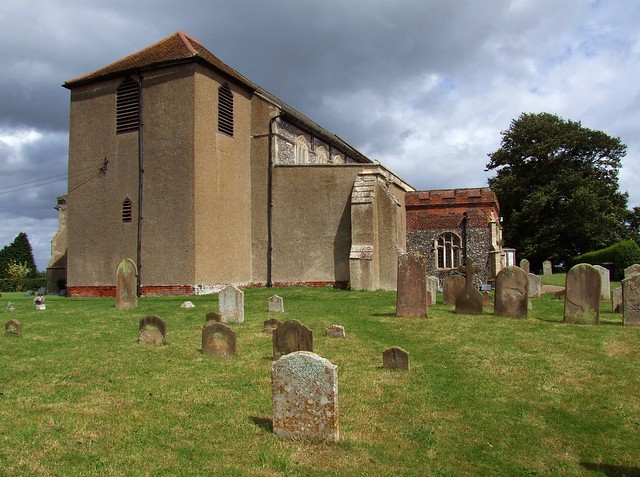
The stubby tower of the
church hugs a later raised clerestory, quite out
of keeping with each other. If I come here on a
hot Summer's day, and climb the steep hill
leading up to it, I am always reminded more of
the Dordogne than of East Anglia. The graveyard
is set on a steep hillside, the huge cranes of
Trimley Dock towering precipitously beyond the
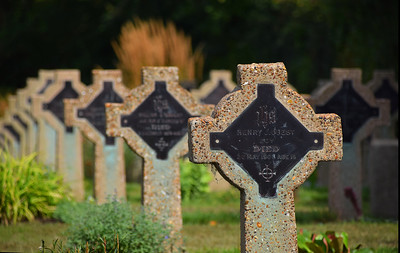
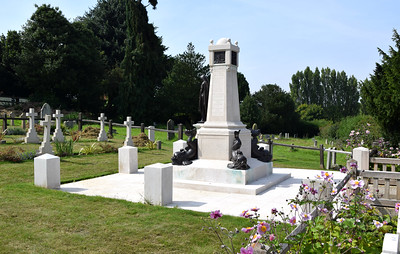
river below. This graveyard is one of the most
haunting in East Anglia, filled with the graves
of mostly teenage lads sent out by HMS Ganges to
die in accidents and wars. Some of their bodies
were brought back for burial, but most often
these are mere memorials to young boys lost deep
beneath fathoms of filthy, icy water. You think
of their happy laughter: climbing onto the bus to
go to the pictures in Ipswich, or courting a
local girl along one of the narrow, poppy-lined
lanes. It is heartbreaking, particularly if you
are a parent. You can see images of some of these
memorials by clicking on the large photograph of
Shotley church at the bottom of this page.
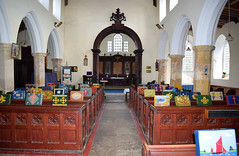
Unusually for Suffolk, the
south door opens almost onto the street. You step
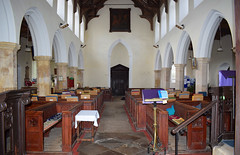
into the light of a wide-aisled nave. The
pleasantly cool whitewashed interior seems much
larger than is possible from the outside. But the
eye is irresistably drawn to one of the most
extraordinary chancel arches in Suffolk, a great
dark wood casement surmounted by a set of arms,
offset slightly in the east wall. Beyond, the
effect is startling, and rather wonderful. In
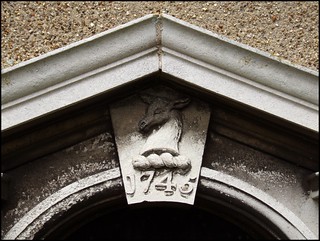
1745, the year of the Jacobite Rising, the
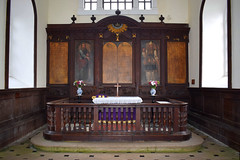
chancel here was rebuilt in the style of a
Classical City of London church, a striking
counterpoint to the ancient Gothic space to the
west. The black and white marbled floor leads to
curved, three-sided rails surrounding a sweet
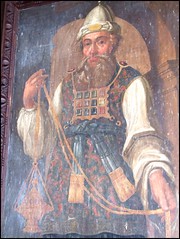
little holy table, the decalogue boards flanked
by Moses and Aaron behind. White light pours
through high windows. Such rational elegance!
There could be no greater statement of the power
of Protestant triumphalism at that troubled time.
Stepping
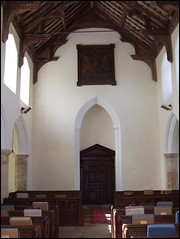
back westwards, the nave suddenly lifts high
above the space you have just left, and is
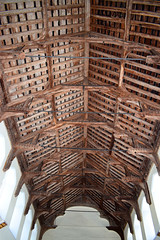
crowned above the clerestories by a gorgeous late
15th Century hammerbeam roof. The arcades stride
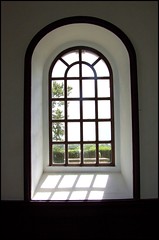
away westwards, a simple classical casement in
the tower arch reflecting back the mood of the
chancel. High above are the arms of George II,
contemporary with the rebuilding, and so they
probably once hung above the chancel arch. And
what a statement they would have made. Charles Stuart's attempted coup
d'etat of 1745 was a romantic fancy, and had
no real chance of succeeding, any more than his
grandfather James II was ever likely to have held
onto his throne more than half a century earlier.
And perhaps things would
not have turned out well if it had succeeded.
The power of the protestant London merchant
classes, which had formerly backed Cromwell, had
also guaranteed the success of the Dutch William
of Orange's takeover of the English throne in
1688. That power was now deeply invested in the
Hanovers. The Church of England, the regular Army
and the Royal Navy, those three constant and
essential arms of government, reacted to the
uprising by forging a consensus which would be
the key to the imagination of the people, a
notion of identity which would at last reinvent
and create the British as a Nation. Nothing would
bend it from its path now, and it would reach its
apotheosis on the fields of Flanders and the
Somme. But that was all in the future.
| Meanwhile, in the
rural backwaters, the Catholic
aristocracy was little shaken by the
events of '45. Perhaps they stirred, and
perhaps they read their newspapers with a
frisson. But after all, they were
only just awakening from the long years
of penal silence. Although the Old
Religion was still technically outlawed,
they were no longer persecuted, and many
had begun to retake their place in the
national heirarchy. It was a compromise,
but an ordered and easy one. But what of ordinary
Catholics in England, Scotland and, most
of all, Ireland? What of their hopes?
They had been dashed along with the
throne of James II at the Battle of the
Boyne, and were now trampled with the
troops of Charles Stuart into the
blood-soaked fields of Culloden. No one
had expected the Jacobites to succeed,
but the fury with which the rebellion was
put down had been startling. Those hopes
would turn to a hurt, and it would echo
uncomfortably for the emerging British
State down the next two and a half
centuries.
|
 |
 |
|
|
|