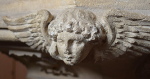
St Margaret, Shottisham

www.suffolkchurches.co.uk - a journey through the churches of Suffolk
|
St Margaret, Shottisham |
|
|
||
www.suffolkchurches.co.uk - a journey through the churches of Suffolk |
||


Follow these journeys as they happen at Last Of England Twitter.
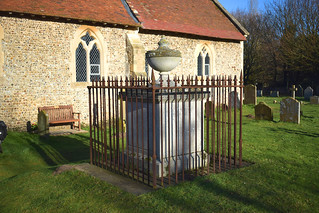
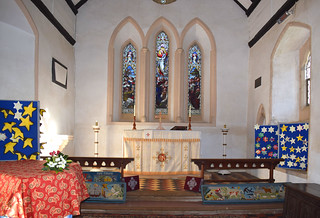
Shottisham sits at the heart of the Bawdsey Peninsula, an idyllic spot, with its church set pleasingly on the village main street. Externally, the nave and chancel with their pretty Decorated windows appear older than the Perpendicular tower, but in fact much of what you see is the result of a substantial 19th Century restoration. The church is one of the dozen or so east Suffolk churches which were 'Hakewilled' in the 19th Century, local architect Edward Hakewill coming along with his pencil and pad, and perhaps tongue sticking everso slightly out of the corner of his mouth, and finally deciding that, yes, what this church needs is a gloomy north aisle. His too is the tower top and the nave window tracery, but all in all it is an attractive interior, rather lovely with its brick floors and faded High Church fittings. The roodloft stairway is set within a window splay as at Whepstead and Barningham. This one has a curious piscina at its foot, to serve a nave altar. Another fascinating detail is that the octagonal Purbeck marble font, on its modern arcade, is set on what appears to be an altar mensa slab. There is also a charming brass set in the nave floor. It remembers Rose Glover, wife of the Rector, who died in 1620. The brass is incised with a picture of a rose and the verse As wither'd rose its fragrant sent retains, so being dead, her vertue still remains. Shee is not dead, but chang'd. The good ner dies, but rather shee is sun-like, sett to rise. I remember coming here some ten years ago in October as they were setting the place up for the Harvest Festival. These Festivals were introduced by Tractarian-minded Rectors a little over 150 years ago to take place at the end of the first week in October, when all is safely gathered in ere the winter storms begin. The sweet smell of apples and dusty barley is an evocative one, a reminder that the summer is over and Suffolk is about to put itself to sleep for another winter. Curiously, the dedication of this church was also given in error to the church at Chattisham on the other side of Ipswich. 18th Century antiquarians investigating the diocesan archives in Norwich had confused the names of the two parishes, and when church dedications were generally revived in the 19th Century the mistake was not rectified. |
Simon Knott, March 2021
Follow these journeys as they happen at Last Of England Twitter.



|
||||||||||||||||||||||||||||||||||||||||||||||||||||||