| |
|
 |
|
St Margaret is one
of the highest churches in Suffolk -
geographically speaking, not
ecclesiastically. There are two
approaches to the village, either up the
long, winding, steep lane from Hartest,
or another long, winding, steep lane from
the Hawkedon road. This second approach,
in particular, is very unlike any other
part of Suffolk. Looking back at the
broad hills and torrent of the river, I
was put in mind of the North. St
Margaret is one of a sequence of hill top
churches in a line from Denston in the
west to Boxted in the east, which perhaps
suggests something about the former pagan
uses of the church sites. This
was a thrilling thought, but the bungalows and cottages
soon restored a sense of the familiar.
The village is known as Upper Somerton,
presumably to distinguish it from the
cluster of houses around Somerton Hall at
the bottom of the hill. The keyholder,
listed on the church sign, can be found
at a nearby cottage, although it is hard
to see the point of keeping the church
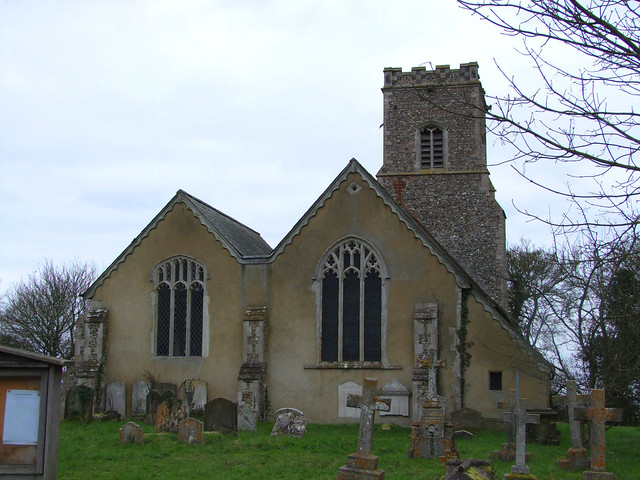
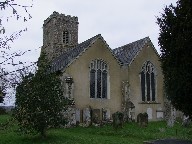
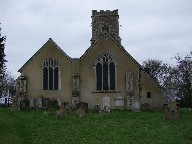
locked here. As you approach the church
from the east up the churchyard path, you
will be forgiven for thinking that here
is a major Victorian reconstruction, with
a new nave put alongside the old one,
turning it into a north aisle, as at St
Mary at Stoke, Ipswich. But nothing could
be further from the truth. As you
continue up the path to the south of the
church it becomes clear that this church
has what appears to be a second,
southern, chancel beside the first. It is
a chancel chapel of course, but it is so
unfamiliar in Suffolk small churches that
one needs to take it in.
|
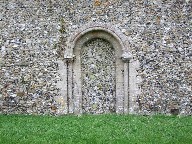
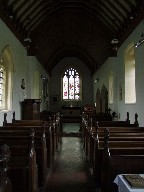
A quick tour of the outside
will show you a blocked Norman north door in the
nave, and the internal arcades are late 13th
century. This is an old church. There seems to be
the remains of the base of an arch in the extreme
south-east corner of the nave. Was a south aisle
planned and never built? It would have made
sense. Stepping through into the chancel (there
is no arch), you see the south chapel and its
juxtaposition with the chancel. Mortlock notes
the 13th century shafts of earlier windows either
side of both east windows, so this chapel, too,
is very old. Between them, there is a curious
squint with a piscina drain inside it -
presumably to serve both altars, although there
is another piscina in the main chancel just to
the left of it, within an arched opening.
Something similar to this arrangement of a chapel
beside the chancel exists nearby at Boxted, where
the Poley family built an outrageously
magnificent north chapel in the eighteenth
century. Its position was probably inspired by
this one.
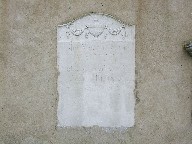
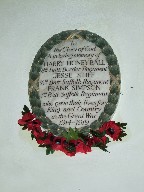
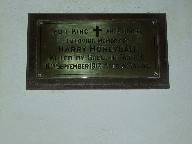
| All three lads remembered on
Somerton's pretty little war memorial
were killed in a three month period
towards the end of the War. None of their
bodies were ever found. They are Harry
Honeyball, Jesse Stiff and Frank Simpson.
Harry Honeyball, who gets a separate
brass memorial to himself up in the
chancel, was the son of William and Lydia
Honeyball, and the husband of Emily
Honeyball. He lived at Mile End Farm,
Hartest. A private in the 8th battalion
of the Border Regiment, he was killed
near Ypres on 6th September 1917. He was
32 years old. Harry's body was never
recovered, and he is remembered on the
Tyne Cot Memorial to the Missing on the
former Ypres battlefield. Jesse Stiff was
the son of Alfred Stiff, of Upper Street,
Somerton. A private in the 1/5th
battalion of the Suffolk Regiment, he was
killed in Palestine on the 15th December
1917. He was 29 years old. He is
remembered on the Jerusalem Memorial to
the Missing. Frank Simpson was a private
in the 7th battalion of the Suffolk
Regiment. He was killed in the Battle of
Cambrai on 30th November 1917. He is
remembered on the Cambrai Memorial to the
Missing at Louveral on the Somme. That
this parish lost just three of its boys
is a mark of how tiny it is. |
|
 |
|
|
|