| |
|
It was the end of
March, and the first properly warm, sunny Saturday of the
year. I caught the early train up from Ipswich to
Halesworth, and cycled off into the hills. Incidentally,
anyone looking for a cure for stress could do a lot worse
than going for a bike ride around the lanes about
Halesworth. Here, the deep green encroaching of the
fields and copses in spring, the angelica and the
birdsong, and the silent heat of the dusty road, are
guaranteed to lower the blood pressure and raise the
spirits. Better for you than valium or prozac as well.
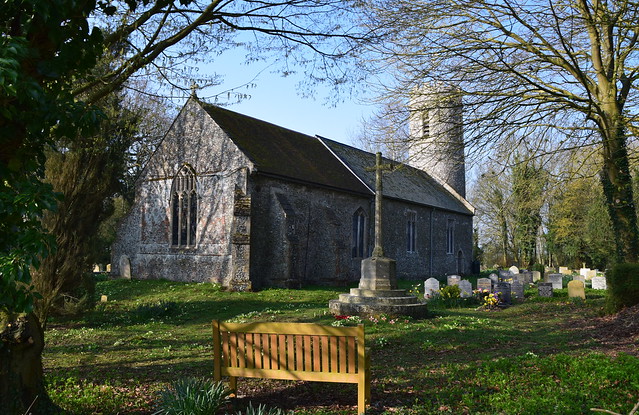
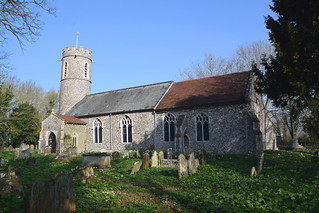
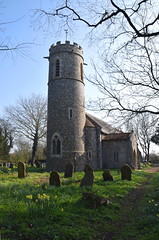
St Peter at Spexhall is a particularly idyllic spot. This
largely Victorianised little church sits in a sweet
little graveyard behind a fence and gates. In spring, the
long grasses and Mary's Lace boil up around the walls,
and if you sit down on the slab of a tombchest for a
while, you'll know that there's nowhere else on earth
you'd rather be. Lichened 18th and 19th century
gravestones peep up for a little sunshine, and beyond
rests the church, a neat little building looking all of
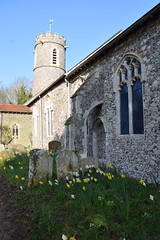
JK Colling's 1870s restoration. He put a flying buttress
over the chancel door, a witty borrowing from
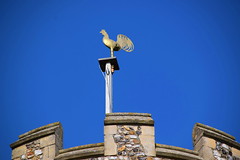
neighbouring Blythburgh. The round tower is from a later
restoration, being rebuilt in 1910. However, there is one
significant survival from earlier days, a great
curiosity. This is the lattice pattern set in brick into
the east wall. This dates from when the chancel was
rebuilt in the early 18th century, presumably because it
had fallen into such a bad state. This is so like the
same thing in 15th century flint at nearby Barsham that
it surely must be a copy.
The tower replaced one that fell in 1720. The base is
possibly Saxon, at the very least early Norman. There is
also a surviving blocked Norman north doorway. It is all
very well looked after, and obviously loved. There is a
sense in which St Peter has re-invented itself as a kind
of wayside shrine, a place for passers-by to seek
spiritual refreshment. As the sign in the porch says, it
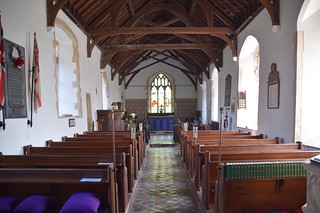
is always open, and you step into a light, pretty
interior that is far more than just a posh venue for a
Sunday club. This seems so obviously the way forward for
the Church of England. The parish churches are its most
visible act of witness, a powerful one, reminding us of
something outside of the busy, materialist world of the
21st Century.
Simple 19th Century tiles and benches give the interior a
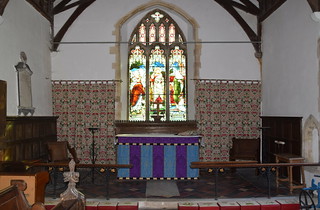
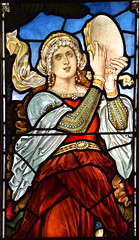
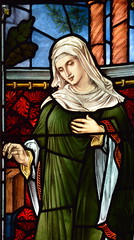
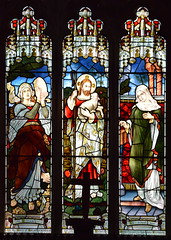
rustic feel. The Jones & Willis glass in the east
window is good and a bit unusual, depicting Christ the
Good Shepherd flanked by Miriam and the Widow with her
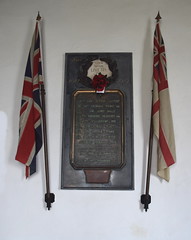
mite. There are 15th and 16th Century brass inscriptions,
and one lady and her children reset on the wall, but more
moving is a surviving WWI battlefield cross, returned to
this parish by the Imperial War Graves Commission when it
was replaced with a permanent one in the years after the
First World War. It marked the grave of Lt. J D Calvert
of the Rifle Brigade, who died on the 15th February 1915.
These crosses are increasingly valued survivals. No one
now is left alive with a memory of the Great War. Just as
this church is a touchstone to the past, so these crosses
spark a remembrance in the heart.
Simon Knott, March 2019
Follow these journeys as they happen at Last Of England
Twitter.
|