| |
|
Follow these journeys as they happen at Last Of England
Twitter.
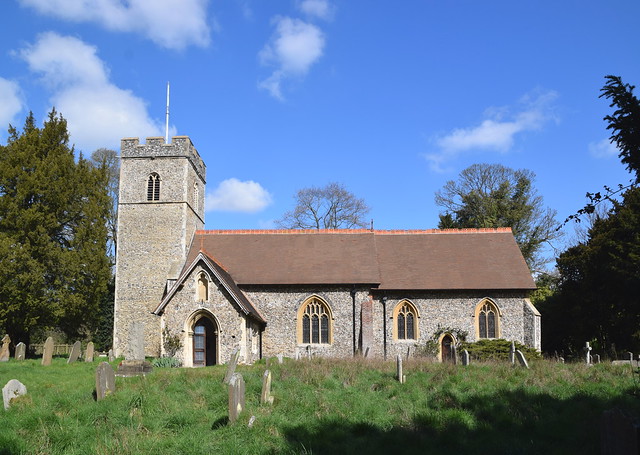
The village of Sternfield is close to
Saxmundham and the A12, but you wouldn't know it. The
churchyard is set back from the road, enclosed by holly
hedges and pine trees, the church sprawling on its slight
rise among the high rustle of the long grass. Rabbits
fled into the ditches as I pushed my bike up the path and
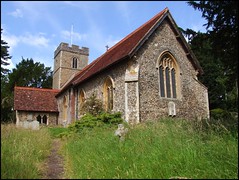
leant it against the unusually long porch almost as if it
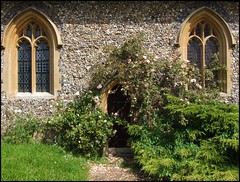
were a transept to the little nave. The window shafts in
the sides are gorgeous, with capitals and tracery, and it
seems a shame that they are infilled with perspex
sheeting. The slight, unbuttressed tower seems to lend
the porch even more grandeur, and on the north side of
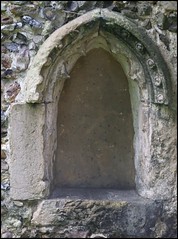
the porch is a curiosity, a 14th century piscina. It
remains from a chapel that once stood here.
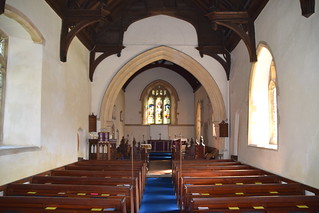
If Sternfield graveyard is wild and rural, the inside of
the church has a neat, even urban feel to it, the work of
that 19th century maverick J.P. St Aubyn. The church had,
in any case, been extensively restored in the 1760s,
generally an unhappy date for restorations, so we may
assume that St Aubyn did much to improve things. He
extended the chancel, and rebuilt the chancel arch. He
raised and glazed the sanctuary. However, a medieval
sanctus window survives in the west wall, as do a couple
of stained glass medieval heraldic shields. Eastwards,
there appear at first to be two entrances to the rood
loft, one each side. Mortlock thought the one on the
south more likely to be a banner stave locker, but if
that was the case then it is in a unique location.
The painted reredos depicting Christ healing a blind man
is by Benjamin West, and was installed here in the 1830s,
thus Georgian in character and early enough to seem
pre-ecclesiological. To the north of the communion rail
an unusual pair of little windows survive, which may have
been a squint from the north chapel altar, or may even
have been moved here from elsewhere. They echo the
openings in the porch. They are reminders of the past
life of this building, and touchstones down the long
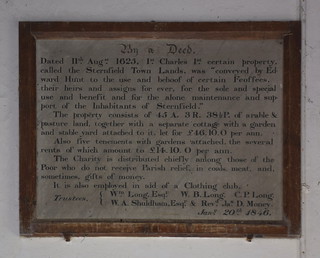
Sternfield generations, who include Edward Hunt, who,
according to a charity board, in 1625 left a gift for
those who do not receive parish relief, in coals,
meat, and sometimes, gifts in money.
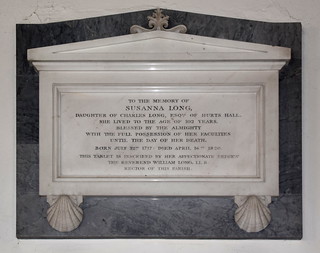
Another former parishioner, Susanna Long, died almost two
centuries later, at the age of 102,blessed by the
Almighty with the full possession of her faculties until
the day of her death. Her nephew was the Rector,
William Long, one of the last of the old guard of
Georgian preachers before the wave of sacramentalism sent
out by the Oxford Movement reached Suffolk and
transformed this little church into the way it is today.
Simon Knott, May 2019
Follow these journeys as they happen at Last Of England
Twitter.
|
|
|