St Mary and St Lambert, Stonham Aspal

www.suffolkchurches.co.uk - a journey through the churches of Suffolk
|
St Mary and St Lambert, Stonham Aspal |
|
|
||
www.suffolkchurches.co.uk - a journey through the churches of Suffolk |
||


Follow these journeys as they happen at Last Of England Twitter.
| Stonham
Aspal sits on the busy A1120, which I'm afraid is a bit
of a ratrun for drivers taking a shortcut between the A14
and the A12. The old village centre is still discernible,
and the former village pub which is now a Mexican
restaurant (or was when I last passed it) was called the
Ten Bells, which tells you something about the building
across the road in its wide churchyard. There are two immediately unusual things
about this church. Firstly, there’s the dedication.
Now, it would be foolish to make too much of the
dedications of Anglican churches, since few of them have
remained unchanged over the centuries. During the years
between the 16th Century Reformation and the 19th Century
revival they largely fell into disuse, except where
required to differentiate one church in a town from
another. Some current dedications of Suffolk churches are
the result of well-meaning but not always entirely
accurate 18th Century antiquarians. Suffolk's churches
were in the Diocese of Norwich in the medieval period,
and several dedications were conflated or confused by the
antiquarians. Chattisham took on Shottisham’s, while
Kirton took on Shotley's, the church there often being
refered to as Shotley Kirkton in old documents. They
confused the Suffolk Hoo with the Norfolk Hoe, and
thought that Suffolk's Shimpling and Norfolk's Shimpling
were the same place. Great Ashfield and Badwell Ash
actually swapped dedications. The enthusiasm of 19th
century Rectors should also not be underestimated. At
Whepstead, the parish church is dedicated to St
Petronilla, uniquely in all England, but this has no
basis in antiquity. Rather, someone there in the 1880s
had a special devotion to the Saint, or perhaps thought
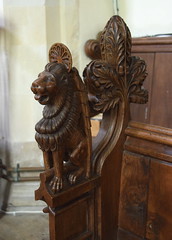
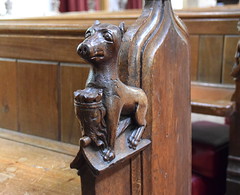
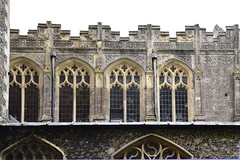
it was simply a nice name. You step into what appears at first sight to be a fairly urbanised Victorian restoration, the work of that low-brow architect Edward Hakewill and later his borther John. There is a disappointment in looking up, because the lovely clerestory is not matched by a timber roof - or, if it is, it has long since been ceiled over with boards and plaster. Hakewill was a great one for adding dark and gloomy north aisles, but fortunately for us this church already had a north aisle, and the building is full of light. Hakewill did however add a vestry to the north of the chancel under one continuous roof with it, another habit of his. There is very little coloured glass, and although the 14th Century west window is unusually small, the clerestory does its work for it. The light falls on an interesting collection of bench ends. Mortlock describes them as extensively and cleverly restored. They are attached to 19th Century benches which James Bettley in the revised Buildings of England: Suffolk East credits to James Gibbon, a local craftsman. The lady clutching her hand to her breast was perhaps once holding a rosary, while the man leaning forward over his prayer desk may be asleep, in which case he is Pride from the Seven Deadly Sins. A wolf guards St Edmund's head, a pious lady kneels at a prayer desk, a rather incongruous Chinese dragon shows off his beard. Up in the chancel there are some late 19th Century evangelist symbols on the stalls, of excellent quality.
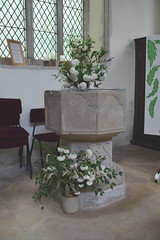
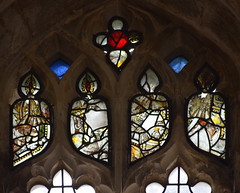
Some 17th century bench ends survive in the north aisle, their solid, slightly rugged appearance typical of the period. There is a good early 17th Century brass to John Metcalfe, who was minister here for more than half the Elizabethan period. The weeping children on an earlier brass have been polished to within an inch of their lives, but this somehow makes them even more haunting. A table at the west end of the nave has been constructed out of the 17th Century tester to the pulpit, and still has the date 1616 and the initials ES, presumably those of a churchwarden of the time. An early 14th Century effigy of a knight who may well have been placed here when the nave was new sleeps in a 19th Century recess. Intriguingly, the two easternmost clerestory windows have fragments of medieval glass in the upper lights, presumably reset by Hakewill from elsewhere in the church. There are more medieval fragments in the aisle windows. Some of them depict pomegranates, perhaps purely decorative or symbolic of eternal life, but of course it was also the symbol of Catherine of Aragon, which may suggest a new scheme of the early 16th Century, perhaps that contributed to in a will of 1509 leaving 6s 8d (one noble) to the elaboration of the Chapel of St Margaret. The oldest thing here is probably the curious 13th century font, its arcading seeming un-East Anglian. Did it come from this church originally? Another curiosity is the vast bound chest in the vestry, which on one occasion the churchwarden showed me - it is so big, indeed, that Hakewill must have built his vestry around it. And the vestry has another curiosity, because if you step outside you can see that the entrance is flanked immediately to east and west by the headstone and footstone of the same person's grave. The story goes that the relatives of the deceased refused to allow him to be moved so that the vestry could be built. The single-minded Rector dealt with this by having the vestry built anyway, and its entrance placed directly over the unfortunate deceased's grave, dividing the headstone from the footstone. Thinking about it afterwards, I realised that they were probably simply reset either side in a decorative manner. But it is a good story. |
Simon Knott, October 2020
Follow these journeys as they happen at Last Of England Twitter.







Amazon commission helps cover the running costs of this site