All Saints, Stuston

www.suffolkchurches.co.uk - a journey through the churches of Suffolk
|
All Saints, Stuston |
|
|
||
www.suffolkchurches.co.uk - a journey through the churches of Suffolk |
||


Follow these journeys as they happen at Last Of England Twitter.
| We are
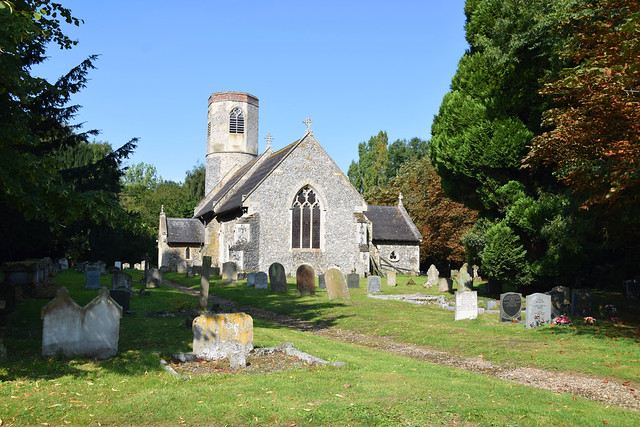
not so very far here from where the busy A140 and A143 roads meet, but this little church sits
deep in the woods, a secret, silent place. We are away
from the village up a narrow lane that peters out in
undergrowth. In summer, the close-flanked trees in the
graveyard absorb all sound - or, at least, most of it.
The first time I visited, I had my two young children in
tow, so the trees had a bit of a job on their hands. In
those days, this church was kept locked, but the
keyholders were very kind to my children, and I 've never
forgotten that. Today, like others in this benefice, All
Saints is open to strangers and pilgrims every day. The tower is round with an octagonal belfry, so presumably 14th century although the tower arch suggests earlier work which it replaced. The body of the church was also perhaps 14th Century, but in any case is pretty much all Victorianised. An old photo inside shows it pre-restoration, the east wall supported by tie-bars. There are two dated slabs, one on the south side with an ornate monogram for 1861, and a memorial stone to Osmund Clarke dated 1865 on the north side. So what was more a reconstruction than a restoration happened here in the 1860s, when exciting things were happening across the main road at Brome. The
populations of rural East Anglian parishes reached their
peak in the middle of the 19th century, and have been
slowly falling away since, but it is hard to imagine that
Stuston was a particularly busy place even in those days.
Half a mile or so north of the churchyard, the River
Waveney forms the northern boundary of the parish,
touching Norfolk and the town of Diss, but even today you
would not know that you were so close to somewhere so
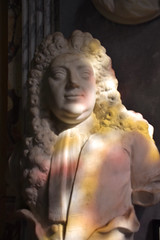
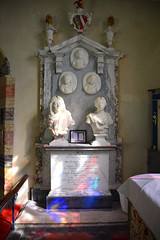
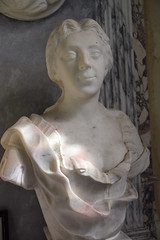
urban. The 1727 memorial to Sir John Castleton is opulent, with sweet cameo portraits of the children who predeceased him, as if they were miniatures from the lockets of giants.
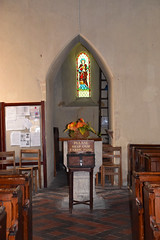
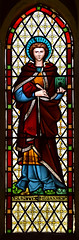
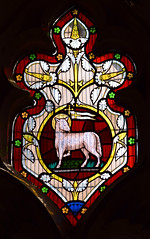
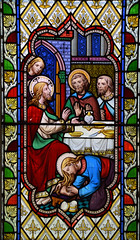
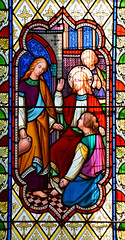
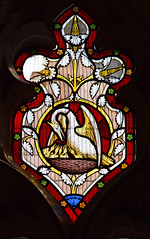
Other survivals from before the restoration include a little image niche in the eastern splay of a window, with its associated piscina. A nave altar was here once, focus of some long-forgotten devotion. In another window the socket for the door bar emerges in a splay. The glass is good of its kind, by
three competent workshops. The east and west windows are
by Heaton, Butler & Bayne who were at their best in
the 1860s, and scenes in the life of Mary Magdalene are
of the same date by William Wailes. The glass of half a
century later by the Norwich workshop of J &J King
depicting the Flight into Egypt and the Presentation in
the Temple is probably the best glass in the place, but
perhaps it doesn't have quite the 'period piece' feel of
the other glass which was installed during the
restoration. |
Simon Knott, August 2020






Follow these journeys as they happen at Last Of England Twitter.
Amazon commission helps cover the running costs of this site