| |
|
 |
|
The Ipswich to
Manningtree road cuts off a long tongue
of land from the rest of Suffolk. As the
great Rivers Orwell and Stour roll
towards the sea, the edge inexorably
closer to each other, until at Shotley
gate they meet before emptying into the
North Sea. This huge natural harbour is
now home to England's largest container
port, but you wouldn't think anything of
the kind could be so close in the gentle
woods and lanes of the Peninsula, except
for the cranes which occasionally peep
above the treetops, of course. The
setting of St Peter is idyllic: you head
down through Holbrook, and then into the
woods. It sits in a close with several
awesomely grand houses for company, and
the Stour estuary is below, wild Essex
beyond.
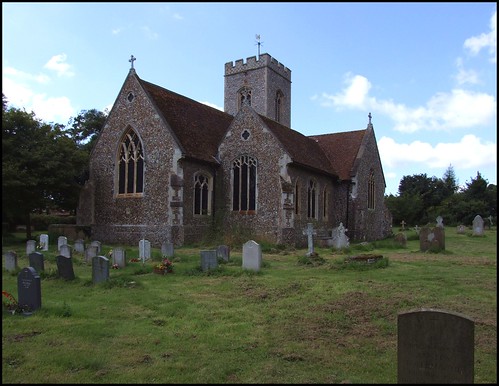
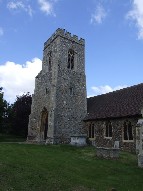
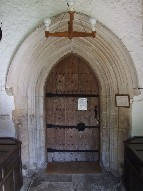
The appearance of the church is a little
unusual, and requires some
interpretation. This is one of the south
towers found commonly in the Ipswich
area. No south aisle was ever built
beside it as at neighbouring Holbrook,
but several successive Victorian
restorations saw the addition of a long
south transept which contains an organ
chamber and a vestry which is largely
invisible from inside the church, and the
rebuilding of the chancel with the
addition of a north aisle and transept.
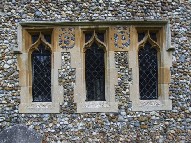
But the original tracery of the chancel
east window was moved into the chancel
aisle, which explains why such an
overwhelmingly 19th century extension has
a medieval window. |
None of the restorations
were the work of a major local architect. There
seems to have been a rolling programme of
refurbishment throughout the 1840s and 1850s,
probably at the behest of a Tractarian-minded
Rector. The two major restorations came in the
1860s and 1870s, and although Richard Phipson, as
Norwich Diocesan Architect, certainly oversaw the
work, the combination of, first, Hawkins of
London, and then the firm of Francis, has left
something unusual and interesting.
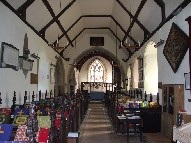
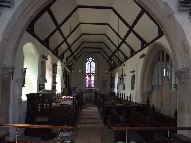
Stepping inside, this is an almost-entirely early
Victorian interior of some high quality. The
furnishings are the work of the great Ipswich
woodcarver Henry Ringham, who, despite going
bankrupt after overspending on his infamous
Gothic House, was still sufficiently highly
thought of some decades after his death to have
an Ipswich road named after him. If they really
date from 1842 then they are the major example of
his early work.
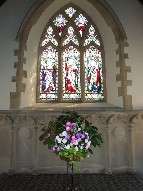
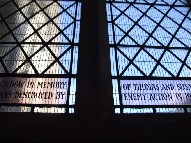
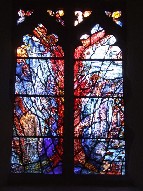
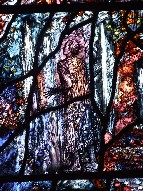
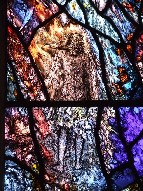
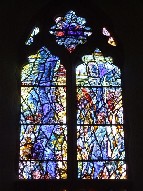
An outstanding feature of the west end is
Stutton's millennium window. These were installed
in many churches at the turn of the century, and
are too often kitschy and dull. No such charge
could possibly levelled against Stutton's. The
window is absolutely outstanding of its kind, at
once enthralling, theologically articulate and
inclusive. The artist was Thomas Denny, whose
work is more familiar in the west of England. The
upper part depicts a passage from Isaiah: And
a man shall be as an hiding place from the wind
and a covert from the tempest; as rovers of water
in a dry place, as the shadow of a great rock in
a weary land. And the eyes of them that see shall
not be dim and the ears of them that hear shall
hearken. The lower part depicts the
counterpoint passage from the book of Revelation:
And he shewed me a pure river of water of
life, clear as crystal, proceeding out of the
throne of the Lamb. In the midst of the street of
it, and on either side of the river, was there
the tree of life, which bare twelve manner of
fruits, and yielded her fruit every month: and
the leaves of the tree were for the healing of
the nations.
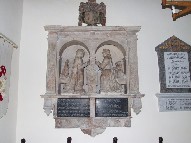
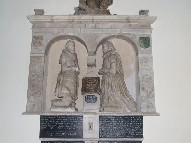
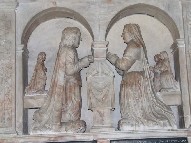
Either side of the west end
are memorials to 17th century Jermys. These are
rather striking - they were moved here at the
time the chancel was rebuilt, and depict Sir
Isaac and Lady Jane Jermy on the south wall, with
their son Sir John and Lady Mary Jermy opposite.
The verses are well worth a second glance for an
insight into 17th Century eloquence.
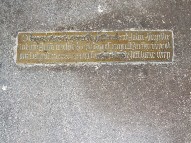
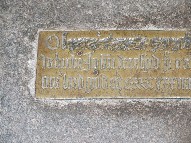
A remarkable memorial from more than a century
earlier is at first sight rather unexciting. It
is under the carpet at the east end of the nave,
commemorating John Smythe of Stutton Hall, who
died in 1534. It is a brass plaque in English,
reading O(f your charity pray for the soule)
of John Smythe, Knight. John deceased the XIIIIth
day of August in the year of Our Lord
MCCCCCXXXIIII O(n his soul)e Jesus have mercy.
There is no figure, no heraldic devices, no
trimmings at all. So what makes it so
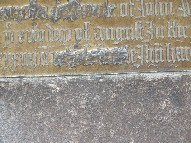
interesting? Well, at some stage, probably in the
late 1540s, possibly in the early 1640s, or
perhaps at some time between or shortly
afterwards, all the parts of the inscription that
reflect Catholic theology and doctrine have been
viciously raked out, with either a sword-tip or
chisel. So, we have lost f your charity pray
for the soul and, at the end, n his soul.
A fascinating document of the protestant
intolerance of early modern England.
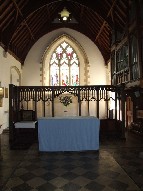
The chancel has been
reordered in a curious manner. The rood screen is
almost certainly also by Henry Ringham, making it
a work of some significance, and was installed
here before the chancel arch was rebuilt in 1862.
It has been set further east, with the altar
brought forward, and now provides an elegant
backdrop to the sanctuary.
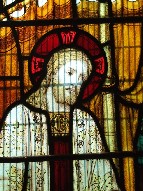
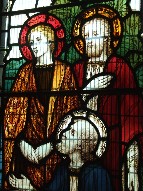
All the 19th Century glass
is worth a look, being a record of work through
the decades of the 19th century. Some is the
1840s work of Charles Clutterbuck, which as
Pevsner points out makes them rare survivals in
Suffolk. As often on the peninsula, the church
suffered blast damage during the last War and
several windows are lost, but these losses are
recorded in their replacements.
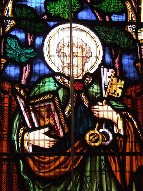
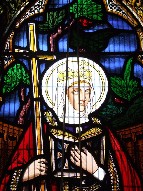
The Ward &
Hughes-style window of St Helen and St
Peter appears to date from the 1850s, and
if so it is a remarkably early example of
such a thing in Suffolk, where such
papistry would have been controversial
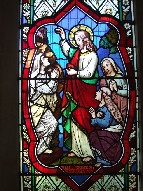
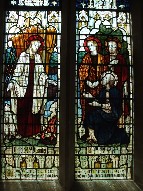
until well into the 1860s. Powell's glass
of the post-Resurrection Christ greeting
his Disciples on the shores of Galilee of
a couple of decades later must have
struck a chord of familiarity in this
coastal parish, and remains a good
example of the workshop's early work in
Suffolk.
There is more good work in the north
transept and chapel, but unfortunately
this is now used as a meeting room, and
is kept locked. You can see it through
the glass partition, but it is impossible
to photograph. Otherwise, this is a
interesting and welcoming church, with a
beautiful setting and a strong sense of
continuity. |
|
 |
|
|
|